


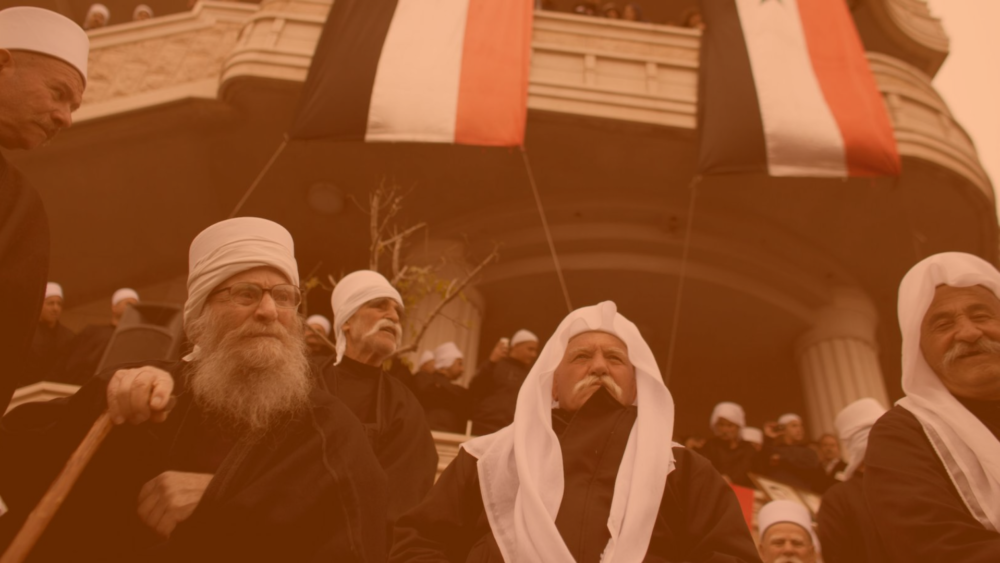
Long off the radar, southern Syria’s minority faces a double threat: repression from within and Israeli colonial agenda
Some might say the violence happened again; others would argue it never really stopped. In southern Syria, where news rarely crosses regional borders and victims remain nameless, a community is consumed by the silence, secrecy, and exploitation that mark their existence. The Druze, an esoteric offshoot of Isma’ili Shiism, have long drawn scepticism and persecution from both Sunni and Shiite majorities, viewed as neither fully “Muslim” nor entirely separate from Islam.
Armed jihadist groups recently raided Suwayda, the historic heart of Druze culture and political life. In response to repeated killings and abductions, it was Israel’s government that stepped forward, offering protection over a highly disputed territory while advancing its broader program of regional control.
Although the events briefly reached international headlines, coverage quickly faded, failing to grasp the fragility of a minority that has long forgotten what peace and stability mean, buried beneath overlapping systems of discrimination. Suspected by Arab forces, erased from Western narratives, they are left aside in global discourses that rarely consider Syria’s diversity.
The Druze position has only made visible to when it serves the interests of those in power. Nothing about this is accidental. Brutality erupts, erasure follows, and “protection” arrives draped in the colours of imperial strategy.
Trapped between regimes that repress and instrumentalise them, the Druze are a textbook case of what Frantz Fanon referred to as the Wretched of the Earth: condemned to live at the margins of every political order, even when cast as its supposed beneficiaries.
The latest atrocities in the Suwayda Governorate are not isolated incidents, but part of a long-standing pattern of domination sustained by fear and the language of salvation. Widespread accounts of Syrian sectarianism or failed national unity only scratch the surface of the deeper Druze condition. The question is more delicate, and the truth is more disturbing.
Despite Bashar al-Assad’s fall last December, minorities like the Druze remain relentlessly marginalised under the new al-Sharaa leadership, rooted in Islamist extremism. From outside, the same wretched group continues to suffer from the intolerance inflicted upon the broader Syrian population.
Meanwhile, Israel pursues its masterplan of territorial control and militarised influence. As Fanon warned, colonialism cannot exist without brutality, always masked under the deceptive pretense of rescue.
A history of no one’s priority
Among Syria’s fragmented demographics, the Druze have never been anyone’s priority. Making up 3 to 4% of the country’s pre-war population, they have been pushed into diaspora by war and economic collapse, facing new challenges of cultural preservation and survival. Their internal sidelining predates the Assad’s regime and its downfall. It reflects deeper, long-standing practices that erase communities who do not conform to dominant power scripts.
For centuries, their religious opacity, political independence, and refusal to conform to majoritarian expectations have rendered them strangers to the systems around them: not fully colonised, nor settlers; not always subaltern, yet never sovereign. This ambiguity has never granted them safety; instead, it has condemned them to structural exclusion.
In a region scarred by the violent tragedy of the civil war that extinguished an impossible revolution, the Druze persist as a neither/nor identity. Never fully embraced by nationalist movements, yet not entirely rejected by colonial ones, they are folded into both when convenient, and abandoned when not. Their existence is treated as nothing more than a void: too small to matter, too different to trust, too complex to care for.
To be Druze, in this world, is to be trapped between recognition and rejection: erased in peace, summoned in crisis, sacrificed in strategy. This isn’t neglect, it is engineered invisibility.
In this context, historical memory becomes a burden more than a resource. The past offers no clear lineage of victories or belonging: only superficial reminders of being tolerated, betrayed, or ignored. Political survival becomes a tactical art, not a right. And like all wretched communities, the Druze are expected to accept their fate quietly, as though this were the natural order of things. Absence, in turn, absorbs the prejudices projected onto them from both ends: not conforming enough to both Sunni and Shiite, not sufficiently anti-Muslim for the West.
Clearly, this invisibility is not benign: it turns into instrumentalisation. As Fanon argued, what the colonial order cannot integrate, it weaponises. The Druze become relevant only when their suffering serves a narrative, or when their survival becomes a strategic asset. Denouncing the horrible jihadist attacks does not really recognise the victims themselves, but reinforces Islamophobia.
And so the rhetoric of “protection” comes into play: not in defence of life, but in service of a colonial project that gains from every claim of humanitarian urgency.
Colonialism as protection
The promise of “protection” reflects a script rehearsed and refined across centuries and continents. Drawing from Fanon, colonialism never arrives simply as brute force. It claims the role of guardian, rescuer, civiliser. In this rhetoric, domination is disguised as salvation, a veil that renders occupation and expansion not just acceptable, but inevitable.
The colonial power that has fully embraced this dynamic, backed by its Western allies, is Israel. The ongoing massacre in the Gaza Strip and the apartheid state imposed on the West Bank precisely fits into the discourse of one-sided concern for human life.
By framing starvation and ethnic cleansing as defence measures, Israel justifies what are, in fact, crimes against humanity. This narrative erases Palestinian existence, suppress resistance, all under the illusion of humanitarian responsibility.
Benjamin Netanyahu’s plan spares no exception for the Druze in southern Syria. Rather, it exploits a minority that has long made silence its strategy for survival. This so-called “protection” is a calculated move within a broader imperial design: a classic example of what Fanon described as colonial violence masked by the language of salvation.
The irony is grotesque: the architects of genocide now pose as guardians of minorities, legitimising their military presence in contested territories, extending control over an already fractured landscape.
The Druze, like many wretched communities, are reduced to pawns in an imperial chess game that thrives on chaos, fragmentation, and instability. Their voices, histories, and lives are erased, replaced by a story of helplessness needing external rescue. There is no genuine interest in preserving life, no morality to stick to. Only a logic of power.
Vulnerability becomes a profitable prize, humanitarianism an empty word. The premise of urgency serves only to obscure the broader agenda: a relentless assertion of dominance dressed as benevolence. Such Fanonian mechanism of control ensures the colonial order remains unchallenged while perpetuating colonial war and the psychic violence it breeds.
Protection only helps the colonial campaign itself. It fuels the very aggressiveness it claims to stop, entrenches militarisation, and perpetuates occupation under a humanitarian facade. Understanding this is key: not just to grasp the Druze condition, but to reveal the enduring colonial structures that fracture the Middle East.
While writing this, people in Suwayda are living under siege once again. Their electricity generators destroyed, they are slowly running out of food and water. And those starving Gaza to death are the very ones now claiming to protect the Druze.
Do you want to be informed of DiEM25's actions? Sign up here