

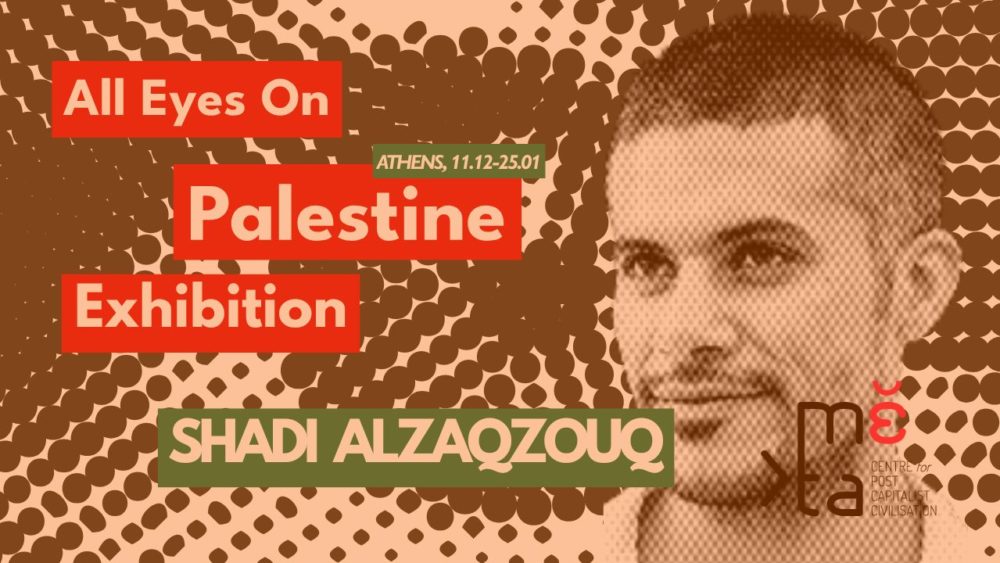
The All Eyes on Palestine Exhibition raises awareness about the ongoing genocide in Gaza. Through the work of Palestinian artists, it creates a space for expression and solidarity, where art becomes a form of resistance.
As the All Eyes on Palestine exhibition continues its journey across Europe, it brings with it not only artworks but the lived histories and emotional geographies of the artists themselves. Among them is Shadi Alzaqzouq, whose work fuses painting, performance and provocation, and whose life story is inseparable from the dislocation that shapes the Palestinian condition.
Shadi begins with a stark truth: “I was born in Libya, in the desert. I was born without land, without home. I didn’t know what it meant to be born in your own country. Since I was a young boy, very young, I felt like a stranger everywhere.” He recalls hearing the same phrase repeatedly—go back to your country—even though he had none to return to. “I grew up with this feeling of injustice… searching for a weapon to define myself… I found myself, defined myself, with drawing in the street. This is the beginning.”
His path into art was anything but straightforward. After his family returned to Gaza following the Oslo Accords, he studied music because art school had rejected him. “They didn’t accept my level in high school… so I studied music. And after finishing music, the academic art school refused me again.” It was only years later, after moving to France, that persistence finally carried him through. “I tried very hard for four years to study art… finally they accepted me… and last year I finished my Master of Art Plastique here in France.”
Exile, for Shadi, is not simply geographical but existential. “For me… every place is my own. But where I feel injustice, it draws me more.” He describes feeling out of place not as a condition to escape, but a truth to live alongside. “My homeland is Palestine, but for the moment it’s incubated. So I move.” His reflections echo the writings of Edward Said, though he rejects the idea of a “right” or “wrong” place altogether.
Shadi’s art blends identities that mainstream narratives insist on keeping apart. Punk aesthetics meet Palestinian symbols; rebellion meets the weight of stereotype. He explains: “I work a lot on the Arab Revolution… and the second project I work on, until now, is Muslim punk.” This project emerged from his everyday experience in France, where Islamophobia shaped how others perceived him. “All the time I feel this need to explain that I am Arab, but I am good. I am Muslim, but I am good… I need more energy just to live a normal life.”
The “Muslim punk” persona became his answer to this pressure. “Punk means you are not welcome – you are outside of this society. So here I am… I feel I’m outside whatever I do.” By merging two identities cast as oppositional, he creates a space of freedom: “Imagine a Muslim woman with a scarf… she’s punk, she’s free to shout and revolt.”
When asked whether he feels part of a contemporary Palestinian or Arab art community, his response is frank. “I don’t agree with a lot of things happening in contemporary Arab or Palestinian art… I feel we were being used, like political issues. No one cares about us. We are just a card to enter this world.” He describes how, if his work does not explicitly address Palestine, it is often sidelined: “If you are Palestinian and you do other things… no one cares. Otherwise, you are not a Palestinian artist.”
Yet he reserves his strongest words for Gaza. “Before I create my art, I feel as a human being… We are really dying there. I have my family there. No one cares, no one asks.” He accepted this interview, he says, for the simplest and most urgent reason: “Please give Palestinians the right to speak… never stop talking about Palestine.” He sees this not only as personal testimony but as resistance. “There are so many creative people in Gaza, not just artists – women surviving this genocide. Let people talk and talk and talk.”
In elevating Shadi’s voice, the exhibition showcases its core purpose: not only to show art, but to protect the possibility of expression itself, at a time when Palestinian culture is under assault.
Do you want to be informed of DiEM25's actions? Sign up here