

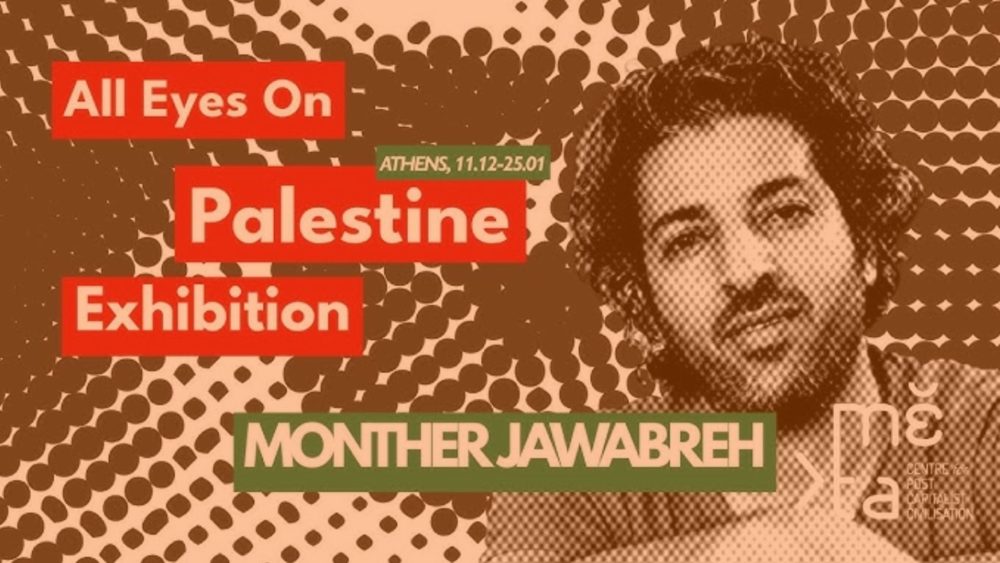
The All Eyes on Palestine Exhibition on December 11, 2025 in Athens, raises awareness about the ongoing genocide in Gaza. Through the work of Palestinian artists, it creates a space for expression and solidarity, where art becomes a form of resistance.
As the exhibition continues its journey across Europe, it brings with it not only artworks but the lived histories and emotional geographies of the artists themselves.
For Palestinian artist Monther Jawabreh, art was not a childhood inevitability but a revelation that arrived late – and urgently. “I discovered my… interesting about art late,” he says, laughing gently at the phrase. After two years at university, he realised something fundamental was missing. “I discovered I should be an artist. So I decided to come back again from zero and study art. It was in 1997.”
Jawabreh was born in a Palestinian refugee camp, an origin that shapes every part of his practice. Very early, he felt that art might allow him to articulate what had been imposed on him-and on millions of others. “I’m a Palestinian refugee,” he says plainly, “so I thought art can help me talk about my story. Maybe I can say I’m like a fighter by art, to talk about the Palestinian people, our issues, our struggles.”
In the early years he believed, as many students do, that art was universal and free of limits. But the reality around him changed that quickly. “When the second Intifada came back to Palestine… all the time we had conflict with the Israeli government, the occupation. I thought: OK, this is my material. Art is my material.”
He describes a turning point where individuality ceased to matter. “I forgot myself as an individual. I thought as a group, as a community, because I am an artist… I should reach the voice of the people outside.”
This shift led him towards the symbolic language many Palestinian artists work with-scarves, traditional motifs, and everyday objects saturated with political meaning. But in recent years his materials have changed. “Now I’m using cement, the walls. This is my project. My message now goes outside Palestine. But all the time my feeling about myself: I’m a Palestinian, and I’m talking about my land, my people, my feeling as a Palestinian.”
Curator Elettra Stamboulis describes this as working “body to body with memory”. For her, memory is the other material in Jawabreh’s work: fragile, fractured, endlessly reshaped. Darwish agrees, but emphasises that Palestinian memory is unlike most. “Everyone has a special memory… happy or sad. But I think in Palestine we have collective memory.”
He cites the poet Mahmoud Darwish, who wrote in 1982 during the siege of Beirut. “His memory is like my memory. I’m in Palestine and he was in Lebanon, but he’s talking about the same memories-identity, struggle, freedom, occupation.”
This collective memory, he stresses, is not metaphorical. It is lived through generations. “When I’m talking about my home, a lot of people are losing their homes… When I’m talking about the martyr, a lot of people are losing their sons and children and fathers. So it’s the same memory.”
Art, for him, becomes a way to stabilise what reality constantly destabilises. “How can we fix this memory via art, or text, or cinema? We try to build the good life via art because in reality… it’s very complicated. Every time you have a new memory because all of them are under occupation.”
For the past five years Jawabreh has focused intensely on concrete – the material of walls, checkpoints, boundaries, and borders. “I transfer this material from solid to flexible,” he explains. “I’m talking about architecture and political material via concrete.” Stamboulis notes that in the past 25 years, concrete has become “one political material that colonialism uses,” particularly in Palestine.
Jawabreh ends with humility. “Thank you… and forgive me because my English not deeply. But I try to explain what I’m thinking and feeling.”
His art, however, speaks the language fluently.
Do you want to be informed of DiEM25's actions? Sign up here