

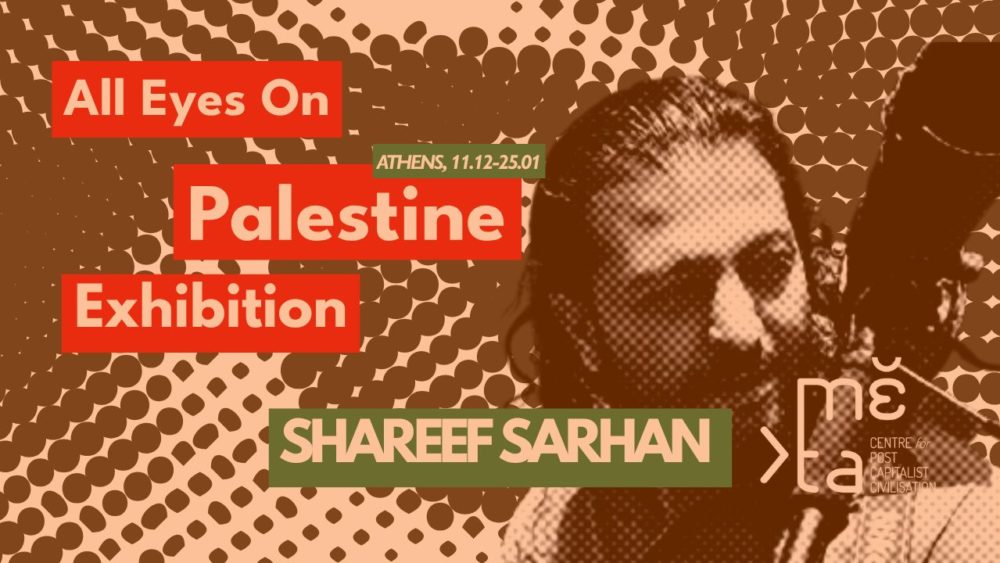
The All Eyes on Palestine Exhibition on December 11, 2025, in Athens raises awareness about the ongoing genocide in Gaza. Through the work of Palestinian artists, it creates a space for expression and solidarity, where art becomes a form of resistance.
As the exhibition travels across Europe, it carries not only artworks but the lived histories and emotional landscapes of the artists themselves. Among them is Shareef Sarhan, a Gazan artist whose work bridges activism, education, and contemporary art, creating pathways for a new generation of Palestinian creatives.
“I love art from a very young age,” Shareef Sarhan recalls. “I think 17, maybe 16. I didn’t fully understand it, but I liked it. Our home in Gaza, the colours, the designs in the living room, everything inspired me.” Yet, growing up under siege meant opportunities were scarce. “In Gaza City, we didn’t have a gallery, an art school, anything. Just one program at the YMCA. Before the internet, there were no resources to see contemporary art or learn about new art models.”
Despite these limitations, Sarhan’s commitment to art deepened. “I started learning the basics, and then I said, okay, I need to continue. I need to develop my talent from a hobby into a profession.” To support himself, he worked as a graphic designer and photographer, eventually collaborating with international organisations such as the United Nations.
For Sarhan, art is inseparable from activism and collective memory. “I’m not just documenting. Photography allows me to see Gaza in multiple ways – as an artist and as someone reflecting on my community,” he explains. “We have to affect our community through our art. A single person cannot do it alone. That’s why my friends and I formed a collective, to build a new generation of artists.”
Starting as a collective in 2003, Sarhan and his colleagues transformed their efforts into a visual arts space by 2009. “Year after year, we developed programmes to support young and established artists. Our first exhibition had an audience of fifty; the last one before the 2023 genocide had 250 people. It shows how far we’ve come.”
He is particularly proud of nurturing young talent. “We worked with external juries, making the selection transparent. We also paired emerging artists with mentors abroad to learn conceptual art and project development. Fifteen years later, around a hundred artists have benefitted. Some are now showing in international galleries and museums.”
Sarhan sees this mentorship as vital for sustaining Palestinian contemporary art. “Living under siege, young artists don’t have the same access to international exhibitions or workshops. It’s our mission to transfer our knowledge, so the next generation can continue, even under difficult circumstances.”
Exhibition curator and interviewer, Elettra Stamboulis, notes how the Palestinian art scene has shifted over the last two decades: “Fifteen years ago, finding a comic artist in Palestine could take years. Now, there is a whole community, and the quality is impressive.” For Sarhan, this growth is both personal and political. “It’s very important. As artists from Gaza, we need to find ways to participate in global art discourse. It’s not just about making art; it’s about ensuring our voices are heard and our stories are seen.”
The All Eyes on Palestine exhibition offers viewers this rare glimpse into Gaza’s artistic resilience. Through Sarhan’s work and the generation he has helped foster, art becomes both witness and resistance – a way to preserve memory, build community, and assert the cultural identity that occupation and siege attempt to erase.
Do you want to be informed of DiEM25's actions? Sign up here