

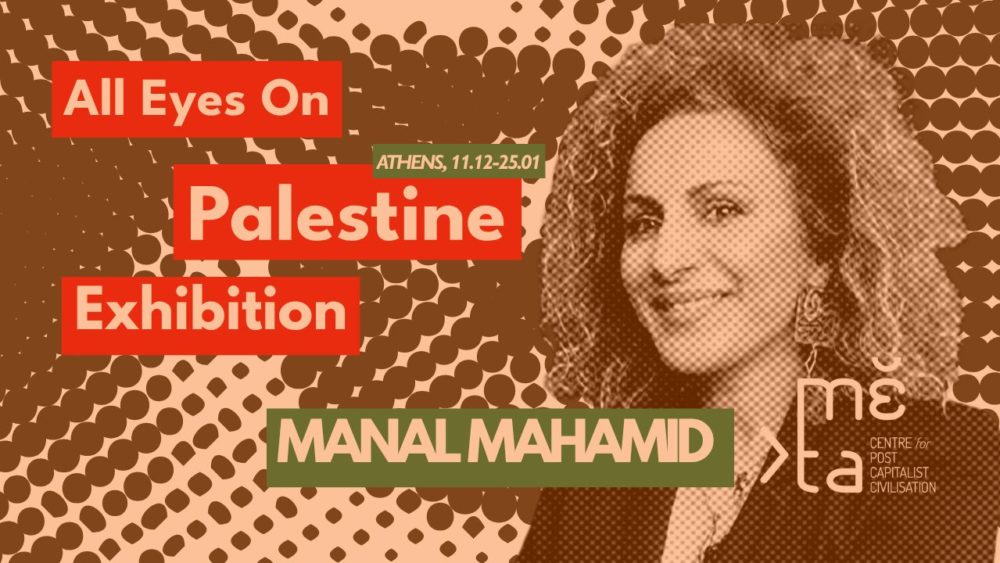
The All Eyes on Palestine Exhibition raises awareness about the ongoing genocide in Gaza. Through the work of Palestinian artists, it creates a space for expression and solidarity, where art becomes a form of resistance. The exhibition showcases a generation of artists whose work preserves the cultural identity of the land and its people, bearing witness to Palestinian identity shaped by trauma and struggle.
Among them is Manal Mahamid, whose art transforms memory, displacement, and resistance into a visual language rooted in the land itself. Growing up in a rural Palestinian village, she experienced firsthand how the landscape was weaponised to erase identity, with forests, monuments, and “reclaimed” green spaces used as tools of colonial control.
“I was born and raised in a rural area,” Mahamid recalls. “From a very young age, I used to create things from the landscape – stones, soil, plants. After finishing school, I decided this was what I wanted to study professionally.” Her early work was inseparable from her environment, and her practice continues to reflect that deep connection.
Mahamid’s pathway into art was intertwined with education. “I also studied special needs education because people told me, what are you going to do with art? It’s not a career. So I studied both, art and education. I worked as a teacher for 20 years, but I kept practicing my art. Now, I’m a full-time artist.”
Her commitment to political and anti-colonial art is evident. “Art and culture are not just decoration,” she says. “As an artist, you have to be committed to what is happening around you – in your village, your country, the world. Beauty and aesthetics are important, but the context and what’s hidden behind the idea are crucial.”
Mahamid’s work often interrogates the colonial logic of landscape. “When Israel was established, they planted pine and eucalyptus trees on the ruins of displaced Palestinian villages,” she explains. “These trees were part of an attempt to raise an ‘authentic’ landscape and erase our memory. My mother would warn us not to go near these trees. Even as children, we understood that something in the land was controlled and forbidden.”
Her recent project, Monument Non Monument, reflects this approach. “I used archival images of women displaced from Palestinian villages in 1948, placing them in the landscapes that were once their homes. The project is about reconnecting with the land and challenging the colonial narrative that tried to erase it.”
For Mahamid, contemporary art is a way to preserve Palestinian culture while speaking to a global audience. “It’s important to use a universal language in my art, but also to incorporate symbols from our heritage. This is how I communicate Palestine to the world,” she says.
Elettra, the interviewer, observes, “What is striking is your focus and commitment. You constantly explore different ways to approach the topic, but you never lose sight of the core – Palestine, memory, and resistance.” Mahamid agrees: “Sometimes it’s exhausting, but you have to keep pushing yourself to create what you believe in. Commitment is not about repetition – it’s about staying focused and persistent.”
Through her work, Mahamid transforms memory, landscape, and resistance into a tangible form that engages viewers with both history and the present. Her art is a testament to resilience, offering a space where the erased and displaced can be remembered, reclaimed, and communicated to the world.
Do you want to be informed of DiEM25's actions? Sign up here