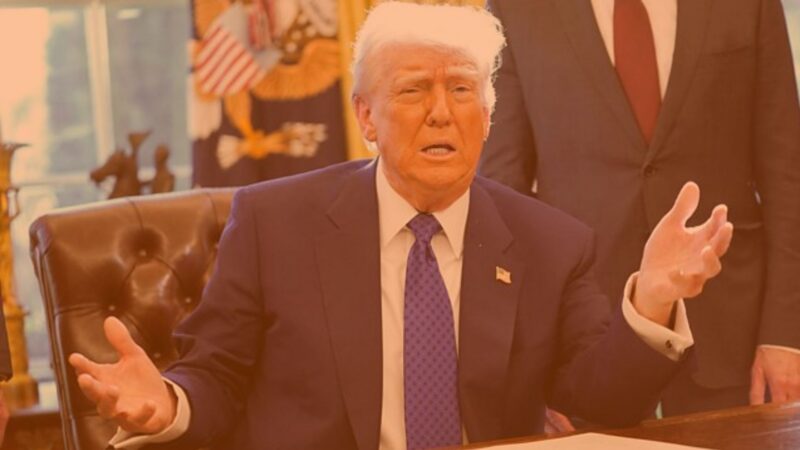


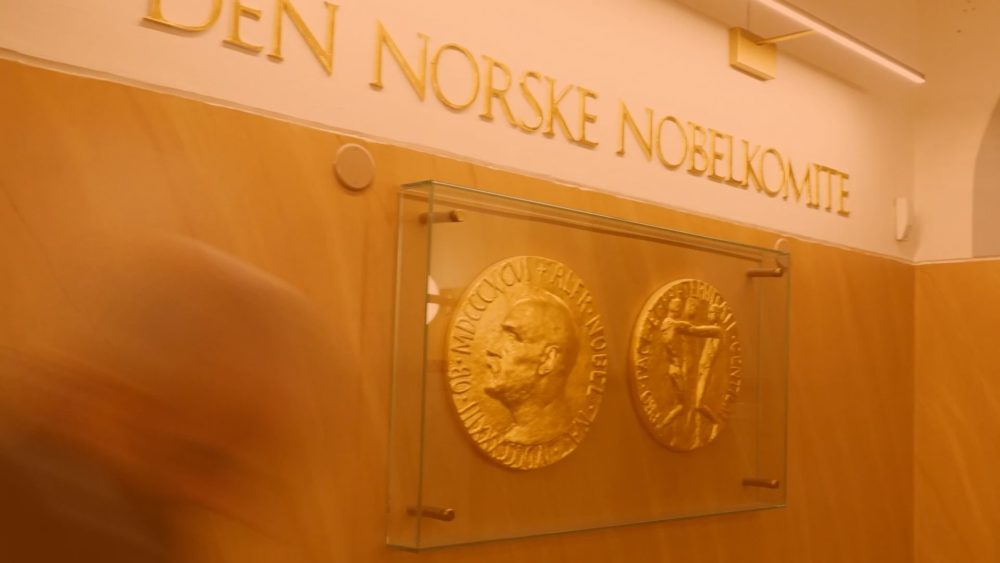
On October 10, 2025, the Norwegian Committee for the Nobel Peace Prize announced its decision to award this year’s prize to María Corina Machado of Venezuela, with the justification that it was being given to “…a brave and committed champion of peace – a woman who keeps the flame of democracy burning amid a growing darkness.” As the US aircraft carrier Gerald S. Ford approached Venezuelan shores in late October 2025, one could not help but wonder what Machado intended by her immediate dedication of the prize to US President Donald J. Trump.
In his 1971 poem “Hymn to the United Nations”, W. H. Auden (1907–1973) warned:
“…let mortals beware of words,
for with words we lie,
and say peace when we mean warFoul thoughts speak fair, and promise falsely…”
Are the Nobel Committee’s eloquence and Machado’s deference to US economic power following this year’s award yet another sad instance of the kind of thinly veiled “foul thought” Auden urged us to recognise and resist? Letting this question guide our inquiry, we begin by taking a closer look at Alfred Nobel’s original intentions when establishing a Peace Prize at the turn of the twentieth century.
Nobel’s statutes for the Peace Prize
In Nobel’s will, the Peace Prize is designated as follows:
“…en del åt den, som har verkat mest eller bäst för folkens förbrödrande och afskaffande eller minskning af stående arméer samt bildande och spridande af fredskongresser.” (Swedish)
“…one part to the person who has done the most or best to advance fellowship among nations, the abolition or reduction of standing armies, and the establishment and promotion of peace congresses.” (English)
One immediately notices that the English translation currently used on the Norwegian Nobel Committee’s website omits the clearly political meaning of “folkens förbrödrande” (“brotherhood of the peoples”). Instead, it substitutes the more interpretative phrase “fellowship among nations”, shifting emphasis from peoples to nation-states. This rhetorical shift weakens the original, unambiguous call for popular fraternity and opens the door for Peace Prize recipients drawn from elite power structures—at the discretion of a committee appointed by Norway’s political establishment.
Secondly, Nobel’s formulation “the abolition or reduction of standing armies” reasonably indicates a desire for his legacy to contribute to reduced militarism. Historically, since the Peace of Westphalia in 1648, standing armies have been central tools of state aggression and coercive power projection.
Thirdly, Nobel explicitly sought to promote peaceful conflict resolution through congresses, dialogue, and international cooperation—placing diplomacy and collective deliberation at the heart of peace-building.
On an organisational level, Nobel was explicit:
“…the prizes for advocates of peace [shall be awarded] by a committee of five persons to be selected by the Norwegian Storting… no consideration shall be given to nationality…”
By assigning this responsibility to the Norwegian Parliament, Nobel ensured that peace-related political deliberation would take place in Norway. Given that Norway gained independence from Sweden in 1905—after Nobel’s death—it is plausible that Nobel sought to support a peaceful independence process. His insistence on internationalism further underscores this intention.
The Nobel Peace Prize in practice
Since 1901, 106 Nobel Peace Prizes have been awarded. Notably, the prize was often withheld during the World Wars and the Vietnam War, in line with the Foundation’s statutes allowing postponement when no suitable candidate exists.
While the five-member committee is politically appointed, it relies on academic advisers and expert consultations. The outcome can therefore be read as a snapshot of Norwegian political perspectives on international relations and security.
Several controversial awards illustrate this tendency:
- 1973: Henry Kissinger and Lê Đức Thọ (the latter declined). Two committee members resigned in protest.
- 1978: Anwar Sadat and Menachem Begin.
- 1994: Yasser Arafat, Yitzhak Rabin and Shimon Peres—awarded jointly amid an unresolved conflict.
- 2002: Jimmy Carter, a former US president.
- 2007: The IPCC and Al Gore.
- 2009: Barack Obama, awarded shortly after election, before escalating drone warfare.
Rather than consistently opposing militarism, these awards suggest a pattern in which the committee seeks to influence global powerholders in ways aligned with Norwegian national interests.
Machado and the politics of “peace”
Extrapolating this pattern to the 2025 award, the Nobel Committee appears to march in step with US geopolitical and economic interests in Latin America. Machado has openly marketed Venezuela as a “trillion-dollar opportunity” for foreign investors, including in natural resources and agriculture.
Independent commentators argue that the award legitimises coercive statecraft incompatible with peace. Scholars such as Glenn Diesen, John Mearsheimer, and Jeffrey Sachs, as well as journalists Aaron Maté and Max Blumenthal, have sharply criticised the decision.
International law and Europe’s decline
Europe’s political leadership—including Norway’s—frequently avoids the language of International Security Law, particularly when addressing Gaza. Instead, emotional framing replaces legal clarity, blinding public debate to realistic, lawful solutions grounded in international obligations.
By instrumentalising the Nobel Peace Prize in service of Western geopolitical narratives, Norwegian elites undermine the UN Charter, International Humanitarian Law, and the very idea of collective security. This erosion mirrors the failures that led to the collapse of the League of Nations.
Conclusion
As Europe faces declining global influence amid rising powers such as China and India, its credibility depends on principled leadership. By subordinating peace to power politics, Norway contributes to Europe’s moral and political marginalisation.
Such misuse of Alfred Nobel’s legacy cannot stand.
Do you want to be informed of DiEM25's actions? Sign up here