

The annual Munich Security Conference is a gathering of world leaders, mostly from Europe and the US, that come together to show what is known as the West remains a strong alliance
After last week’s conference, and much to the relief of Europeans after their scolding last year from United States Vice President JD Vance, the attendees seemed to achieve that goal.
Except in the era of power politics ushered in by US President Donald Trump, the conference’s usual outward emphasis of peace as the path to stability seemed to be abandoned. Instead, the collective West appeared to embrace the strategy of offense as the best defense.
European embraces independence through Militarisation
Opening the conference, German Chancellor Frederich Merz spoke about a topic much discussed over the recent year: European independence.
The idea has gained traction in the second Trump era as the White House has demanded European member states of NATO increase their contributions. Or else, as the Trump White House warned in a Security Strategy document released late last year, Europe faces “civilisational erasure.”
At last year’s Davos meeting, Washington got what it wanted in the form of a signed agreement from NATO membership for additional investment of 5% percent of GDP by 2030.
To achieve the NATO spending goal, Europe has undertaken a mad dash rearmament. And while there was no mention of the military alliance’s dates or dollar amounts mentioned during Merz’s speech at this year’s Munich conference, the German chancellor noted that to confront the era of “Big Power Politics” rearmament was crucial in strengthening NATO and creating a more independent Europe.
Similarly, European Union president Ursula Von der Leyen spoke of an increasingly militarised Europe to achieve independence.
Von der Leyen highlighted in her speech that Europe recently embraced its security “responsibility” and increased defense spending by up to 80%. The EU president then cited Europe was projected to spend even more than the US on air and missile defence such as drones.
The event justifying this rearmament and growing defence industry is Ukraine, which, according to the EU president, “has shown that strength and deterrence, and ultimately lives, depend on industrial capacity.”
The US mends ties with Europe, with a caveat
Last year, newly inaugurated US Vice President JD Vance arrived in Europe wagging a finger and using an unfriendly tone to Europe. It was not so much external enemies that would lead to Europe’s destruction, according to Vance in 2025, but “the threat from within” due to the Continent’s alleged embrace of censorship against far-right parties and retreat from conservative values.
This year marked a different tone from the US.
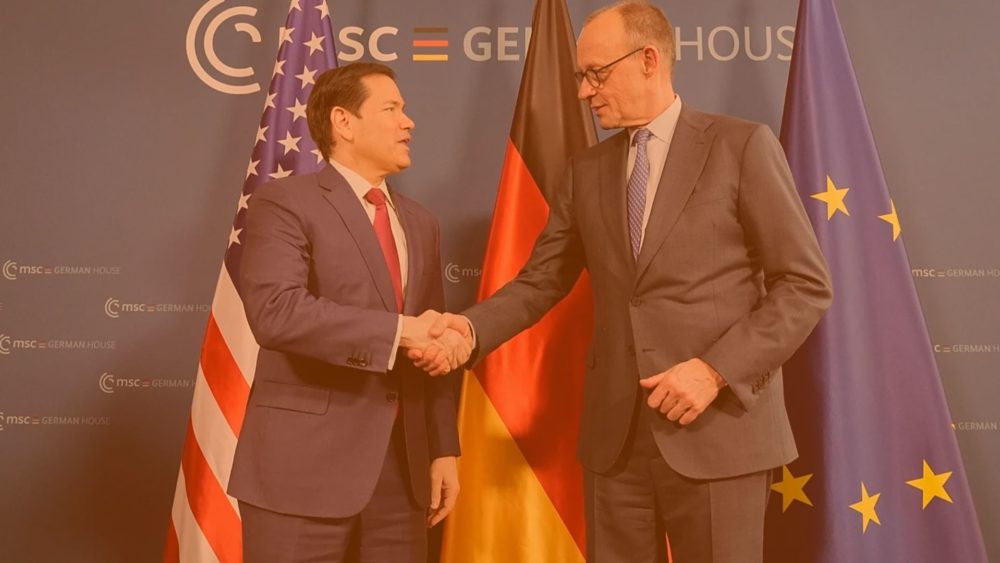
Led by Secretary of State Marco Rubio, the keynote speech from the Trump cabinet member, cited the shared history that connects the two continents, even stating the US and Europe have a “shared destiny,” which resulted in applause interrupting the speech.
However, similar to Vance’s speech from last year, Rubio noted that Europe must “be strong” and that President Trump demands “reciprocity”, a subtle suggestion to the White House’s demand for increased contributions by European countries to the NATO military alliance.
Target Iran?
In this new era of Big Power Politics and militarised economies, a question arises: how to use this might?
A potential target comes in the form of a country not invited to the event: Iran. Tehran has come under scrutiny due to the government’s crackdown on protests, including allegedly killing civilians.
Iran’s foreign minister Abbas Arraegachi expressed frustration at Europe over the conference and specifically Europe’s inaction where they once played a central role in negotiations over Iran’s nuclear program.
Iran did come up this year in Munich with the featuring of Reza Pahlavi, son of Iran’s ousted government leader known as the Shah. Pahlavi, a hopeful successor to the government, advocated for US military intervention in the country.
A mirror up to Europe
There’s been reporting that European members of NATO can be creative with their accounting to have this rearmament push result in domestic infrastructure. Von der Leyen even notes in her speech the benefit European car manufacturing can have for Ukraine.
And while the idea of Europe becoming independent through a booming domestic arms industry, there’s an Orwellian feeling the soul of Europe, which one reveled at the thought of a “peace divided” at the end of the Cold War, now embraces an Orwellian concept – war is peace.
Do you want to be informed of DiEM25's actions? Sign up here