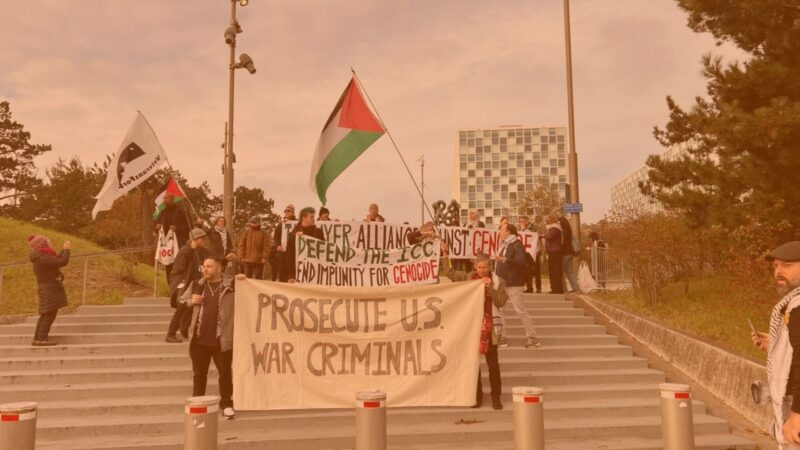
From the canals of Friesland to the streets of Brussels, from punk venues to city councils, the movement for a demilitarized Europe is growing
On June 6, Ilse Terheggen, coordinator of MERA25 Leeuwarden and candidate in the 2026 Dutch municipal elections, addressed the Global Women’s United Against NATO (GWUAN) webinar from the shadows of one of Northern Europe’s most active military installations. Ahead of an action month under the banner of Stop ReArm Europe her message was clear: the struggle against NATO expansion is neither abstract nor distant – it is happening in our neighborhoods, poisoning our water, and demanding our resistance.
“I’m speaking to you from Leeuwarden,” she told the international audience, “a few kilometers behind me is Leeuwarden air base, one of the most active, most toxic, and most symbolically important NATO military sites in Northern Europe.”
What followed was not merely a local complaint, but testimony to a global pattern. From Romania to Norway, from the Baltic states to the Mediterranean, NATO’s military infrastructure has carved sacrifice zones across the continent – communities where land, water, and public health are sacrificed to maintain “offensive readiness.” Ilse’s Friesland is one such place. There are countless others.
The machinery of militarisation
Leeuwarden Air Base functions as a frontline NATO hub, home to Dutch F-35 stealth fighters and the 322nd Squadron, permanently on standby for NATO rapid reaction forces. During major exercises like Ramstein Flag, the base launches up to 80 military flights per day – fighter jets, drones, and refueling planes that shake the surrounding flats and normalize war as daily reality.
“The United States military is embedded here,” Ilse explained to her global audience. “US F-35s and helicopter units regularly deploy to Leeuwarden. And this base is not Dutch, it’s NATO. NATO is, of course, an extension of US military strategy in Europe.”
This observation cuts to the heart of DiEM25’s position on European security: the demand for non-alignment and the rejection of a bipolar world order that treats Europe as a battlefield between competing empires. As DiEM25’s peace policy maintains, true security cannot be built through military escalation or subordination to any superpower—whether Washington or Moscow. Security requires demilitarization, diplomatic engagement, and the dismantling of the military-industrial complex that profits from perpetual tension at the cost of local communities.
The poison of “forever wars”
What official NATO communications omit is the environmental warfare being waged against local populations. For decades, the military used firefighting foam containing PFAS – “forever chemicals” that do not break down in nature. They accumulate in soil, groundwater, fish, livestock, and human blood.
In 2024, water authorities found PFAS levels 900 times above the legal limit in Jelsumer Faert, a canal adjacent to the base. Contamination has since been detected in surrounding waterways, in fish, and in local chicken eggs. Swimming and fishing are now banned in many places. As Ilse describes, the air base turns large parts of Leeuwarden into “sacrificial zones”.
The Netherlands cannot even process its own toxic waste – it lacks incinerators capable of destroying these chemicals, so the poisoned soil is shipped to Belgium.
“We export our poison,” Ilse stated. “We outsource our environmental crime.”
This is the antimilitarist analysis in action: recognizing that the military-industrial complex externalizes its costs onto working-class communities and the environment while privatizing its profits. It is a system that DiEM25 and MERA25 oppose, not merely on pacifist grounds, but on ecological and social justice grounds. The same logic that poisons Friesland’s water is the logic that drives arms races, fuels proxy conflicts, and blocks genuine climate action.
Global solidarity, local resistance
Ilse’s participation in the GWUAN webinar reflects a growing international coordination among women resisting NATO expansion across Europe and beyond. From Iceland to Greece, from the NATO headquarters in Brussels to the missile bases in Eastern Europe, a network of activists is exposing how “security” rhetoric masks environmental destruction, democratic erosion, and the diversion of resources from social needs to military hardware.
Her own resistance takes multiple forms. She has walked, marched, and demonstrated for years alongside groups like Geen Ruimte voor Defensie and Vlieg Op. She participated in a walking, biking, and skating tour circumnavigating the entire base perimeter – “slow, patient, visible resistance.” She helped organize a major demonstration last year bringing together peace activists, climate justice campaigners, and local farmers.
But Ilse also channels her politics through punk music. She shared lyrics from her band’s upcoming album with the global audience:
NATO power staring up the peaceful skies.
Fighter pilots ready to destroy thousands of lives.
American warheads authorize the threat.
More pollution, more weapons, more war, more murder, more profit.
“Punk is not just music for me,” she explained. “It is the sound of not accepting things. It’s fast, angry, joyful, and collective. Music reaches places that political speeches can’t.”
Stop ReArm Europe: Welfare, not warfare
Ilse’s testimony comes at a critical moment. As NATO and EU institutions ramp up military spending to Cold War levels – diverting billions from healthcare, education, and climate transition – grassroots resistance is coalescing under the banner of Stop ReArm Europe.
This month, demonstrations and actions are taking place across the continent opposing the militarization of European budgets and the escalation of tensions that threaten to turn Europe into a permanent war economy. In Leeuwarden, Ilse and a coalition of local organizations will take to the streets next week, joined by climate activists, peace campaigners, and farmers – an alliance that recognizes the inseparability of environmental justice from antimilitarism.
“NATO and the European Union are ramping up military spending to levels not seen since the Cold War,” she warned the GWUAN audience. “They call it security. I call it a suicide pact with the arms industry.”
DiEM25’s position is unequivocal: we oppose the militarization of Europe, the expansion of NATO, and the subordination of European foreign policy to any imperial power. We demand a non-aligned Europe that prioritizes diplomacy, demilitarization, and ecological transition over arms races. We stand with the women of GWUAN, with the activists of Leeuwarden, and with all those across the continent who refuse to accept that security can be built on poisoned water and fighter jets.
The sound of resistance
As Ilse prepares for next week’s demonstration – rehearsing with a choir to bring music to the streets – her message to the international community is one of solidarity and persistence.
“Leeuwarden Air Base is not just a military installation,” she concluded in her GWUAN address. “It’s a machine that produces war readiness and environmental destruction in equal measure. And it relies on our silence. But we are not silent. We talk, we march, we sing, and organize.”
From the canals of Friesland to the streets of Brussels, from punk venues to city councils, the movement for a demilitarized Europe is growing. And this month, under the banner of Stop ReArm Europe, it makes itself heard. 12 June MERA25 Leeuwarden together with many other organisations are filling the streets of Leeuwarden in protest to the increasing militarisation, recruiting of our youth and polluting our nature. 14 June is the main action of the Stop ReArm Europe campaign bringing dozens of European organisations to Brussels. MERA25 Netherlands will be there as well.
Do you want to be informed of DiEM25's actions? Sign up here