The beautiful game can unite the world, but the institutions that govern it too often serve power, profit, and politics before the people.
Football is one of the greatest art forms. The ability of a player to manipulate their body like the finest ballet dancer, to do what appears unnatural – a sudden change of direction, the power of a shot or header, athletic grace and strength – comes together in a free-flowing orchestra at its very best. Think of Spain’s tiki-taka that dominated international football from 2008 to 2012, or Brazil’s delightful football as they routed Italy in the 1970 World Cup final. Like master sculptors, the players at the World Cup dedicate every hour of every day to improving their craft through preparation, training, and discipline.
The best players on the biggest stage, cultivating their talents while inspiring national pride, have turned the World Cup into the most iconic sporting spectacle on earth, eclipsing the Olympic 100m final and, from an American perspective, surpassing even the most optimistic viewing figures for the Super Bowl or a Game Seven of the World Series.
Unfortunately, all of this attention naturally makes the world’s greatest football festival a target for the excesses of commercialism, with the game itself increasingly being shaped around the maximisation of corporate profits. The so-called hydration breaks conveniently allow for around two to three minutes of advertising time in the middle of both halves, almost directly paralleling the commercial breaks between quarters in an NFL game. Revenue from advertising during these breaks across the tournament’s 104 matches has been estimated at around $250 million in the United States alone.
There is, of course, a legitimate case for stoppages in games played in extreme heat, something that is likely to become an increasingly common reality at future tournaments. Yet the decision to make such breaks mandatory in every match, while simultaneously introducing unprecedented commercial slots, reveals where FIFA’s priorities increasingly lie.
This is not even to mention the companies emblazoned across our screens on official marketing products. Many of FIFA’s largest commercial partners have faced criticism from supporters involved in the Boycott, Divestment and Sanctions (BDS) movement because of their business activities relating to Israel and the occupied Palestinian territories. Coca-Cola, Hyundai, McDonald’s, and Reebok have all been subjects of such campaigns. Of course, FIFA bears the greatest responsibility for ensuring that football is not used to profit from suffering, but players, too, face difficult questions about sponsorship and advocacy. Lamine Yamal rightly earned plaudits for celebrating FC Barcelona’s LaLiga title win with a Palestinian flag, while also appearing prominently in McDonald’s advertising during the tournament.
As one of the finest players in the world, with a remarkable CV at only 18 years of age, Yamal’s footballing excellence deserves admiration. At the same time, we should be cautious about placing athletes on pedestals as complete moral figures. Few players will ever combine ideological consciousness and sporting brilliance in the way Brazil’s Sócrates did. Still, when footballers speak out for what is right, they deserve credit.
French star Kylian Mbappé has publicly warned about the dangers posed by the far right in France. This raises the familiar question of politics and sport: how much should we expect athletes to speak out on political issues?
On one hand, footballers are athletes, not political theorists. The level of devotion required to reach the summit of their profession can isolate them from broader social questions. On the other hand, players with enormous global platforms can use that influence to advocate for justice. Mohamed Salah did exactly that when he criticised UEFA’s response to the death of Suleiman Al-Obeid, the “Palestinian Pelé”, who was killed by Israeli forces in August 2025 while waiting for humanitarian aid in Gaza. FIFA’s tribute conspicuously avoided mentioning the circumstances of his death, prompting Salah to ask publicly: “Can you tell us how he died, where, and why?”
Even then, there are limits to Salah’s interventions, as he did not attempt to answer his own question. Footballers must also consider the consequences that political statements can have for their clubs and careers. Mesut Özil learned this after speaking out about the persecution of Uyghur Muslims in China, when Arsenal distanced itself by declaring that it was “apolitical as an organisation”. Years later, the club would sack former kit man Mark Bonnick over anti-Zionist social media posts. Yet Arsenal is also supported by figures as politically diverse as Zohran Mamdani, Jeremy Corbyn, and Keir Starmer. Such is the extraordinary pull football clubs possess in an age of deep political polarisation: football remains one of the few places where people from very different backgrounds can still unite behind a common cause.
Players and staff often face consequences when their words threaten commercial interests, while less controversial interventions can attract universal praise. Germany’s national team protested against Qatar’s anti-LGBTQ+ laws before their opening match at the 2022 World Cup, although after their early elimination Joshua Kimmich reflected that “politics is not our job”. Former Liverpool captain Jordan Henderson was widely applauded for supporting LGBT+ inclusion after Jake Daniels became the only openly gay male professional footballer in England, only to face criticism when he later moved to Saudi Arabia, where homosexuality remains criminalised. Daniels’ remark that “the money must mean more to people” remains difficult to dismiss.
This leaves a burning question: if politics is not the job of athletes, then whose job is it? Where should we draw the line between enjoying the beautiful game and confronting the harm that tournaments can inflict on the wider world? In Ireland, that debate has become increasingly prominent through the Stop the Game campaign, which has attracted significant support among football supporters and the wider public by calling for the Republic of Ireland not to play Israel.
The World Cup also raises environmental concerns. Millions of single-use plastic items are consumed in stadiums, while forty-eight teams and their supporters travel enormous distances across three host nations. Critics have described the tournament as potentially the most polluting World Cup ever staged, with projected emissions measured in millions of tonnes of CO₂. Climate researchers and campaigners have warned that the expanded format and extensive air travel undermine FIFA’s sustainability rhetoric.
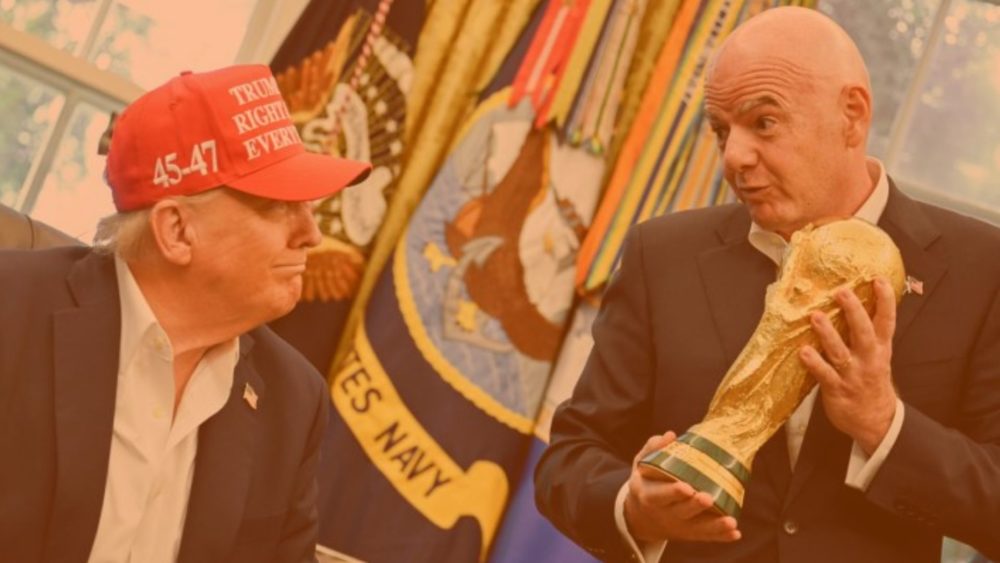
The plight of Somali referee Omar Artan, who was denied entry to the United States despite reportedly holding a valid visa, and the treatment of the Iranian national team illustrate another contradiction. Iran was forced to relocate its training base from Arizona to Tijuana because US authorities claimed they could not guarantee the delegation’s safety, while several Iranian officials were denied entry visas. Yet after their final group game, the Iranian players left behind a handwritten message that captured football’s better spirit: “May peace, respect and friendship prevail among all nations.” FIFA president Gianni Infantino later visited the team and spoke about football’s power to unite people, though such words often rang hollow against the political realities surrounding the tournament.
Do you want to be informed of DiEM25's actions? Sign up here