


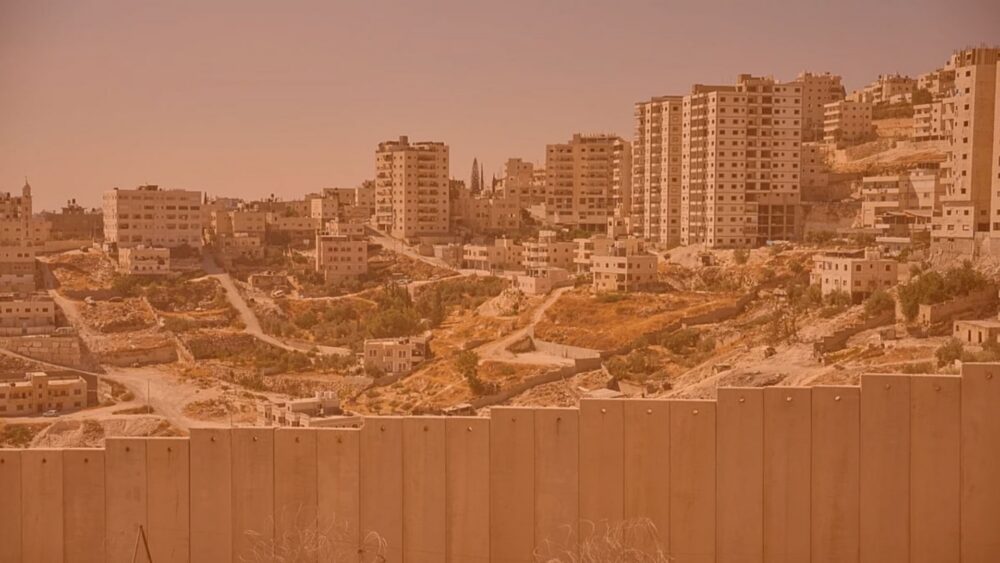
The E1 corridor between East Jerusalem and the illegal Israeli settlement of Maale Adumim in the West Bank illustrates Israel’s colonial project in Palestine. Its development as part of a unified Jerusalem metropolitan area has been a strategic imperative for Israel for over 30 years, and building plans have recurrently been invoked both as a threat to the international community and as a political asset at home. While some governments – most notably the UK – have announced tougher policies against illegal Israeli settlement activity, the inability of the international legal-political order to address situations of colonial rule remains a core obstacle for any livable future solution in historic Palestine.
“The complete and united Jerusalem is the capital of Israel,” Basic Law (Israel’s de-facto constitution), July 1980
“United Jerusalem would also encompass Maale Adumim as well as Givat Zeev as the capital of Israel under Israeli sovereignty,” Prime Minister Yitzhak Rabin, Israeli Knesset, October 1994
Yitzhak Rabin reportedly made this statement about Greater Jerusalem as the capital of Israel at a time when the world was giddy with the prospect of peace and a two-state solution through the Oslo Accords (in 1993 and 1995). Thirty years later – and almost three years into a genocide – the international community’s first reaction to the latest settlement drive was more of the same condemnatory statements.
Israel’s current plans to build thousands of housing units in the E1 corridor between annexed East Jerusalem and the settlement of Maale Adumim in the illegally occupied West Bank prompted a Joint Leaders’ Statement on the E1 West Bank Settlement Plan on 20 August, 2026, by 21 Western governments (not including the United States) and the European Commission, noting that “The E1 settlement will undermine the prospect of the two-state solution”, and “We reiterate our commitment to a comprehensive, just and lasting peace based on the two-state solution”. ‘Israel undermines, we reiterate’ has been the recurring theme for decades. It reminds me of the time I arrived in Palestine as a human rights worker from Europe more than 20 years ago.
The recent announcement by the UK on September 8, 2026, of stricter policies against settlement goods, corporate and financial activities in the settlements, and settler violence is a positive sign. Yet it fails to grasp the reality of Israel’s long-term strategy to control Palestine, of which the E1 corridor is a central component.
Settling the E1 corridor: A longstanding strategic imperative for Israel’s ‘security architecture’, or domination of Palestine
To start with an example, the current international outcry brought a random memory of an old NGO report to my mind. In 2004, the church-based development organisation Christian Aid – hardly a group of hardliners – issued a report titled Facts on the Ground: The end of the two-state solution? In the introduction, it says:
Without determined intervention by governments, including the United Kingdom, Ireland and their European partners, the vision of two states will surely disappear, condemning generations of Palestinians and Israelis to a future of crippling poverty and relentless insecurity. […] These settlements have all but destroyed the possibility of a viable Palestinian state. In the West Bank, settlements control 42 per cent of land. (p. 3)
Moreover, the 2004 report states:
Now a tunnel runs from Ma’ale Adumim to central Jerusalem, so that settlers do not have to travel through Palestinian areas of East Jerusalem. During the Barak government, an additional area called E1 was attached to Ma’ale Adumim in order to encircle fully Palestinian East Jerusalem with Israeli settlements. Construction of infrastructure has started in this area. In August 2004, the government announced a plan to build 600 new homes. (p. 21)
Needless to say, Palestinians understood the failure of Oslo much earlier, illustrated by the outbreak of the second intifada in 2000, after years of increasing movement restrictions and illegal Israeli settlement activity instead of progress towards Palestinian self-determination.
The Jerusalem Center for Security and Foreign Affairs (JCFA), an Israeli think tank, confirms in Understanding Israeli Interests in the E1 Area: Contiguity, Security, and Jerusalem (presumably published in 2012) that:
All Israeli governments since Yitzhak Rabin’s second tenure as prime minister in the 1990s have supported the program [of the development of E1], appreciating the need to create an Israeli urban continuity from Jerusalem to Maale Adumim, leading out to the Dead Sea and the Jordanian border.
The international community, including the EU as well as subsequent US administrations until Trump II, has consistently opposed Israeli E1 settlement plans as a red line. This is good, but it should not be treated as a great achievement. Israeli settlement in the territories occupied in 1967 not only contravenes the officially proclaimed goal of a two-state solution; it is illegal under international law. So, condemning Israel’s expansionist behavior in the West Bank is the least the international community can do to meet its own most basic obligations. In fact, it must take decisive action.
As mentioned above, there are positive developments, like the UK’s announcement of sanctions against Israeli settlements, which was seconded by Canada and France. According to UK Foreign Secretary Ed Miliband, the move marked the “beginning of a new approach” to the Israeli-Palestinian conflict, which “not only calls out injustice and suffering but acts”. He added, “Today I announce that the official view of the British Government is that the occupation is unlawful.” Even though it does nothing more than confirming existing legal standards, given the political realities, this potentially emerging policy can be an important signal.
Palestine and the unmaking of international law
With regard to the current condemnations and policy declarations, however, we should take note that we are almost three years into a genocide, which most of the countersigning governments have enabled with diplomatic cover and weapons shipments. In addition, many of these governments have recently signed major arms deals and cyber security cooperation agreements with Israel. Again, notwithstanding an ongoing investigation by the International Court of Justice (ICJ) for genocide, revelations of widespread torture, mass detention, ethnic cleansing, and arrest warrants by the International Criminal Court against Israel’s prime minister Benjamin Netanyahu for war crimes and crimes against humanity in Gaza.
Furthermore, two years ago, the ICJ concluded in its advisory opinion on the Legal Consequences arising from the Policies and Practices of Israel in the Occupied Palestinian Territory, including East Jerusalem of 19 July 2024, among other things, that:
- the State of Israel’s continued presence in the Occupied Palestinian Territory is unlawful;
- the State of Israel is under an obligation to bring to an end its unlawful presence in the Occupied Palestinian Territory as rapidly as possible;
- the State of Israel is under an obligation to cease immediately all new settlement activities, and to evacuate all settlers from the Occupied Palestinian Territory [highlight added];
- all States are under an obligation not to recognise as legal the situation arising from the unlawful presence of the State of Israel in the Occupied Palestinian Territory and not to render aid or assistance in maintaining the situation created by the continued presence of the State of Israel in the Occupied Palestinian Territory.
The above-mentioned 2024 advisory opinion of the ICJ also refers back to 2004, when it issued its opinion on the construction of the separation wall:
As regards Israel’s settlement policy (paras. 111-156), the Court reaffirms what it stated in its Advisory Opinion on the Legal Consequences of the Construction of a Wall in the Occupied Palestinian Territory of 9 July 2004, that the Israeli settlements in the West Bank and East Jerusalem, and the regime associated with them, have been established and are being maintained in violation of international law. The Court notes with grave concern reports that Israel’s settlement policy has been expanding since the Court’s 2004 Advisory Opinion.
So, all of this was already out in the open decades ago. By the way, back then, the separation wall was one of the biggest issues for Palestinians as its construction confiscated large swaths of land, destroyed the livelihoods of Palestinian farmers, and further disconnected Palestinian communities on both sides of the Green Line. It gave rise to the ICJ’s above-mentioned advisory opinion in 2004, and local mobilisation against the wall played a major role in the creation of the BDS (Boycott, Divestment, and Sanctions) movement. Does anyone still talk about the Apartheid Wall today? Not really. It has all but disappeared from the public discourse, its injustice has been eclipsed by ever larger land grabs deep inside the West Bank and the Gaza genocide.
This ongoing orgy of impunity led Israel’s Minister of Finance, Bezalel Smotrich, to announce the approval of tenders for the E1 settlement project in August 2025 (not 2026!) with: “This reality finally buries the idea of a Palestinian state, because there is nothing to recognise and no one to recognise.”
Shame on anyone who is still surprised by this. Or pretends to be shocked.
The same goes for the outrage over the recent remark by Israel’s Minister of National Security, Itamar Ben Gvir, that 30 – 40 Palestinians should be killed in Gaza every night. Let’s face it, since October 2023, Israel has killed more than 73,000 Palestinians in Gaza according to official figures – most likely a drastic undercount – including more than 1,300 since the so-called ceasefire last October. Meanwhile in Germany, the “government continues to take a cautious position in the debate over an EU import ban on goods produced in Israeli settlements in the West Bank.”
Different paradigms: law and the settler colonial dimension
While Israel’s total and unpunished disregard for international law is of great concern for the world as a whole, as longstanding international customs regarding the use of force and military conduct are assigned to the dustbin of history, it is not really a thing in Israel. The international-law discourse mainly addresses international audiences.
Israelis first and foremost live within their own domestic framework, which is in itself not unusual. The problem is that there is a fundamental contradiction between Israel’s (fading) reputation and self-image as a liberal democracy based on the rule of law within the 1948 boundaries – even if it is currently ruled by a right-wing extremist government – and a 21st-century settler colonial reality. Beneath the excesses, like widespread societal support for mass killings and expulsion, lies a foundational view of Jewish Israeli supremacy and righteousness. I want to give some anecdotal examples of conversations I had with Israelis back in the 2010s, who identified as leftist, liberal, or anti-occupation. This is not the category of ‘all Palestinians no matter their age are terrorists and must be killed’, but the liberal intelligentsia.
I remember an Israeli colleague of mine being completely dumbstruck when I said that East Jerusalem is Palestinian territory. I recall this conversation with a prominent human rights scholar, who generally opposed the occupation, explaining to me that according to the constitution (the Basic Laws), Jerusalem is the capital of Israel. That East Jerusalem is internationally considered occupied – or rather, annexed – territory was not on her radar at all. Another lawyer told me that construction without a permit is illegal anywhere in the world, so why should Israel allow Palestinian Bedouin in the Naqab (the Negev desert inside Israel) to build houses in unauthorised areas? The fact that they would never get a permit in the first place did not occur to him, nor did he understand why they would not move to one of the seven townships that Israel had built for them in the 1970s and 80s.
This peculiar Israeli understanding of legality also extends to the West Bank. While it is acknowledged that West Bank settlements are not under Israeli sovereignty, many are considered legal under Israeli law. According to the Israel Policy Forum,
There are 127 settlements in the West Bank that have legal status under Israeli law. Legal settlements must be built on state land, have building permits from the government, and be established by a government resolution. Settlements that do not meet those criteria are West Bank outposts, which are illegal under Israeli law. Most of the world also considers settlements to be illegal under international law.
International objections are noted, but rendered irrelevant. The JCFA further interprets that:
Under the Oslo Agreements, zoning and planning in these areas (Area C) is under the jurisdiction of Israel. Thus, Palestinian construction without any building permit along a main Israeli artery of this sort [in the E1 area] is a violation of the signed bilateral agreement and is thus illegal.
To support their argument, they titled a map of the area with “Oslo Agreement Map of Jerusalem Area Showing E1 Located in Area C (Israeli) and Not in Area B (Palestinian)”. So, this think tank, which introduces itself as “a leading independent research institute, serving as Israel’s global embassy for national security and applied diplomacy”, postulates that Area C – which makes up 60 % of the West Bank – is de facto Israeli.
This shows that we are dealing with completely different understandings of reality. Israelis across the political spectrum have a settler colonial view on the entirety of historic Palestine, including many of those who concede that Israel has erected an apartheid system (within the confines of the West Bank). Therefore, many critical UN positions or Joint Leaders’ Statements do not make sense to them, and Israel’s Western allies do not catch on to that because of their own colonial history.
The official Palestinian position, on the other hand, largely corresponds to the legal paradigms of the United Nations and the Geneva Conventions. Unfortunately, we have to conclude that it has not been helpful. First, because the interests of power have up to now been aligned with Israel, and second, because international law itself is not equipped to address situations of protracted colonial rule. Beyond the right to self-determination as a rule of international custom, there is not much to work with when the custom is violated, other than detours through international humanitarian law concerning occupied territories.
The negotiation approach: another mismatch for Palestine
This conceptual gap is also true for the political process: The negotiation framework to reach a two-state solution supposes that we are dealing with a conflict between two parties over contested land, where mutual concessions have to be made. Within the conflict logic, Israel can claim that it won a war, or rather multiple wars, and is therefore not obliged to make concessions unless it wishes to do so generously for the sake of peace. This does not reflect the situation in Palestine. The right to self-determination is not subject to negotiations, or conditioned on quid pro quos. It is true that today, self-determination is increasingly understood in a broader, more complex meaning, including indigenous peoples in post-colonial countries, or even independence movements in Europe. But this is not the case in Palestine, either. All the moral and material responsibility that Europe, and Germany in particular, carries because of the Nazi Holocaust does not change the fact that Israel is a colonial endeavor. It was openly described as such in the first half of the 20th century. It was also defined as a national liberation movement, but the colonial nature of it was not questioned by either the Jewish Zionists or by European governments of the time, most bluntly illustrated by the 1917 Balfour Declaration. It was not an issue then, just as it was not in Africa or other parts of Asia.
Treating the situation in Israel-Palestine as first and foremost a political conflict, territorial dispute or a war, overlooks the underlying power dynamics of colonialism where an ethnonationalist state has subjugated the indigenous population. As long as Palestine is not understood in the context of decolonisation, no political initiative or negotiation effort will bring about a livable solution.
Here, we can come back to the example of the E1 area as a political handle for Israel. It has arguably never considered relinquishing it, or East Jerusalem for that matter, in any negotiations. Towards the international community, E1 development plans have been used as a threat, or as punishment for perceived support of Palestine, while domestically, the recurring settlement pushes serve as a political asset for whoever announces them. It is relevant to point out that the latest settlement drive in E1 originated not last month, but one year ago. A September 2025 article in +972 Magazine, an outlet run by Palestinian and Israeli journalists, who oppose Israeli apartheid and occupation, described that:
[Israel’s Minister of Finance] Smotrich has framed the decision to move forward with construction in E1 as retaliation to the recent announcements by Western states, among them Australia, Canada, and France, that they plan to recognise Palestine at the United Nations General Assembly meeting in September [2025].
It further quotes Benjamin Netanyahu at a ceremony in Maale Adumim in September 2025 saying, “We are going to fulfill our promise that there will be no Palestinian state; this place belongs to us”.
While recognising that Israel’s brutality and resolve to put an end to the question of Palestine has reached a new level under the current Netanyahu government and with the ongoing genocide, this is still a familiar game. Whenever the international community takes a step that Israel perceives as support for Palestine, Israel plays the E1 card, which has so far been quite effective in dissuading the international community from acting on its mostly performative claims. The prominent Palestinian human rights group al-Haq writes:
On 29 November 2012 the United Nations (UN) voted to upgrade the status of Palestine to non-member observer State. Shortly afterwards, Israel, who had vociferously objected to the upgrade, announced the construction of an additional 3,000 units for settlers in the West Bank. This included construction in what is known as the “E1” area, which refers to a twelve square kilometre plot of land located in the West Bank, to the east of the Jerusalem municipal boundary and bordering the Ma’ale Adumim settlement.
This was echoed by Bt’selem, an equally prominent Israeli human rights organisation, who reported that “According to the media reports, these instructions were issued following the UN General Assembly’s recognition of Palestine as a state with UN observer status”.
Nothing is going to change in this cat-and-mouse game unless there is a serious reckoning. As long as European and other governments keep signing lucrative arms deals and security cooperation agreements with Israel, it has no reason to conclude that performative condemnations or even more hands-on policies against the settlements would lead to anything other than a slight setback, or delay here and there.
The latest twist: E1 in exchange for all of Palestine?
As Israeli society slips deeper into a genocidal spiral and becomes the super Sparta that Netanyahu evoked last September, it is less likely to be discouraged by international pressure unless it inflicts serious economic pain. While the world is scandalised by Israel’s recklessness, the current E1 drive is more likely part of the current election campaign for the October 2026 Knesset elections than directed towards an international audience. As reported by the Jerusalem Post, a recent poll by the Jewish People Policy Institute (JPPI) found that nearly 40% of Israeli Jews support West Bank annexation. At the same time, less than 1% of Jewish Israeli participants said that Palestinians should be given full Israeli citizenship upon annexation of the West Bank.
In a recent twist, Gadi Eisenkot, former Chief of Staff of the Israeli army and the main electoral challenger of Benjamin Netanyahu in the upcoming elections, introduced a new narrative, which may well be at least partly addressed to the international community. According to the Times of Israel, an Israeli English-language outlet, he said that anyone who still believes in the two-state solution following the October 7, 2023, Hamas attack is ‘delusional’. At the same time, “he criticised that the E1 settlement project – which supporters have said is intended to block a path to Palestinian statehood – was a ‘mistake’ costing Israel on the international stage.”
So maybe this time, pausing the E1 settlement project will be Israel’s trump card (no pun intended) to end international insistence on the creation of a Palestinian state altogether? Hyperbole aside, this would indeed be a logical outcome of Israel’s long-term strategy and the abysmal international reactions to it over time.
Unless there is a paradigm shift towards recognising the colonial nature of Israel’s behavior, there will be no end to the violence. Palestinians have used all possible means to resist colonial oppression. Notably, the reliance on international legal remedies, a negotiated process, or civil disobedience have so far come to little avail – without downplaying the tremendous efforts and important milestones. In recent years, the global citizenry, particularly but of course not only in Western countries, has stood up against Israeli aggression and Western complicity. There is a growing feeling that the fate of Palestine mirrors our common future in an increasingly dystopian world. Palestinians have already paid a horrific price for this – and they are certainly not the only ones – and this will continue until we break the imperialist mindset.
Do you want to be informed of DiEM25's actions? Sign up here