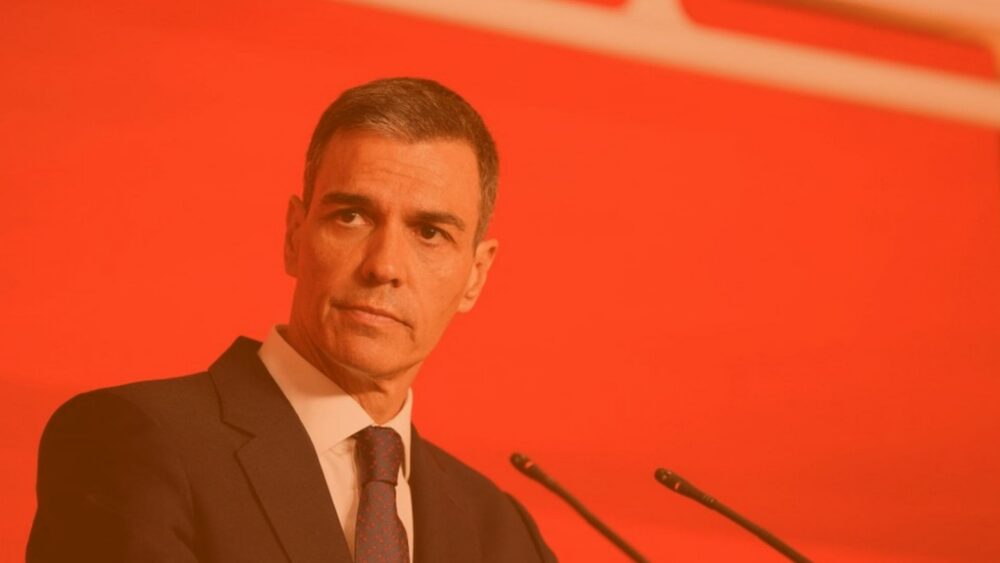
If the protests over the housing crisis in Spain have already led to the calling of general elections and a general strike, will they also succeed in changing the very nature of the Spanish left?
In late September, Pedro Sánchez stated, regarding the housing decrees his government intended to pass, that “the moment of truth has arrived. The Partido Popular, Vox, and Junts per Catalunya must choose: either they stand with the social majority or with the speculators. Tomorrow, their vote will reveal their true colors to entire generations,” even though votes against the measures by the PP, Vox, and Junts per Catalunya had already blocked four decrees and four housing-specific laws since the last general election. It is hardly news in Spain that Junts per Catalunya, the Catalan pro-independence party led by Carles Puigdemont, defends the interests of property speculators. What may surprise international readers, however, is that Pedro Sánchez’s coalition government depends on Junts’ support to pass legislation, despite the party’s alignment with positions also defended by Spain’s right-wing and far-right parties. These are the same parties that Junts portrays as responsible for the problems afflicting Catalonia.
The encampments set up in Madrid’s Puerta del Sol, Barcelona’s Plaza de Catalunya, and many other cities across Spain to demand government intervention did not appear out of thin air either, although the scale of these sudden demonstrations is a new development. The Tenants’ Union, which is leading these protests, has been fighting for its ideals since 2017 (before Pedro Sánchez was sworn in as Prime Minister) and has been demonstrating tirelessly throughout Spain; groups and associations of all kinds are also participating—more than 40 in Madrid, for example. Most Spanish unions have backed the call for a general strike on 11 November demanded by the Tenants’ Union, stating that “it is a cry against the job and housing insecurity that weighs down on millions of people, especially women and migrants affected by economic vulnerability.”
However, Pedro Sánchez’s decision to call for general elections on November 29—when he could legally wait until August 22, 2027 – is a political maneuver based on the PSOE’s medium-term interests. It could mean that he believes now is the best time to win over undecided voters and limit abstention by mobilising the electorate around this cross-cutting issue: housing. This would thus lead to securing a parliamentary majority that is not subject to blackmail by right-wing secessionist parties. But it can also be interpreted as a measure aimed at avoiding a double electoral debacle by creating a six-month window between the early general elections and the regional elections scheduled for May 2027. Mobilisation in its favor during the regional elections would be bolstered by the impact of nearly half a year of right-wing coalition government – enough time to demonstrate the disconnect between its campaign promises and the results of its governance.
Although the course of the general election campaign remains to be seen, it is unlikely that left-wing voters will forget the corruption cases surrounding the PSOE that are currently under judicial investigation, the loss of purchasing power in real wages (-2% between 2021 and 2026 according to the OECD) even as Spain leads the way in GDP growth among Europe’s major economies, or the de facto impossibility in many cases of accessing social benefits approved by the government due to administrative barriers and requirements that border on the absurd, delays caused by staff shortages in government agencies, or the limitations of the IT system in use. A prime example of the ethical failure of this government – which claims to be left-wing – was its approval of the expansion of Spain’s major airports, effectively renouncing its commitment to meet agreed-upon greenhouse gas emission targets and, in the long term, worsening conditions in the property market, thereby undermining the effectiveness of any government intervention aimed at ensuring decent housing for all, not to mention its impact on citizens’ living conditions. Just as Pedro Sánchez sought to portray Junts, the PP, and Vox as supporters of speculators, the PSOE was exposed for its inability to fight for the transformation of a system that harms the majority of citizens for the benefit of a few.
Our co-founder, Yanis Varoufakis, recently stated in an article that “centre-leftists chastise my unwillingness to support them, painting me as a handmaiden of the Right. I would reply that the Left has a duty to remain in opposition until we get our act together; until we have a plan and a mandate for unseating the oligarchy and implementing a workable, progressive agenda.” Perhaps the support from the left – further to the left than the PSOE (Izquierda Unida and Podemos at this time) to the motion of no confidence against Mariano Rajoy – which led to Pedro Sánchez’s 2018 investiture as Spain’s seventh Prime Minister – has thwarted the development of this authentic left, condemning its governing partners to suffer the consequences of the center-left’s systematic acquiescence to the development model championed by the right.
The Frente Amplio, the “Spanish left-wing electoral coalition project promoted by the parties Movimiento Sumar, Izquierda Unida, Más Madrid, and Catalunya en Comú with the aim of running jointly in the general elections on November 29, 2026” according to Wikipedia, seems more concerned with the shortage of available seats indicated by the polls than with drafting a viable and progressive platform. If Pedro Sánchez truly believed that a new left-wing governing coalition were possible, he would be interested in having a strong partner to form it, but the very fact that he dissolved the Congress of Deputies while casting himself as a defender of the activists camping out in the squares of Spain’s cities – most of whom are positioned further to his left – proves the opposite. It appears that the the real interest of the PSOE’s secretary-general lies in securing as many seats as possible – even if this means taking them away from his government’s coalition partners—in order to go down in history as a figure who built up the party and laid the groundwork for its revival following its ultimate defeat.
Although developments during the election campaign could completely change the situation, the prospect of a PSOE defeat should serve as the wake-up call that the parties further to its left need to revive themselves. Developing a long-term platform and strategy that allows them to secure a mandate from the people – rather than continuing their historical trajectory of defending their compatibility with the PSOE’s reformism – would give meaning to the rollback of the welfare state and social rights that an electoral victory by the right-wing coalition would entail. Although no major innovations are expected in the electoral programme they must now put together, there remains the possibility that their campaign might end up surprising us.
Do you want to be informed of DiEM25's actions? Sign up here