

From stadiums to courts, Israel’s presence turns international sport into a theatre of privilege and denial
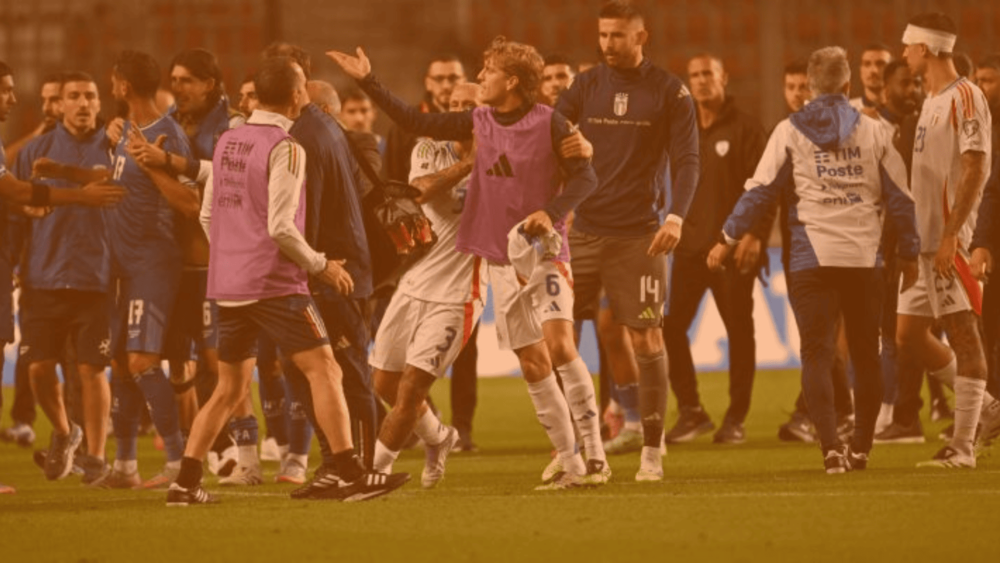
Debrecen, Hungary, September 8: the stage was set for a surreal yet telling performance. In an almost empty Nagyerdei Stadion, what took place was far more than a football game under the international spotlight. On Matchday 6 for Group I in the European Qualifiers, Israel faced Italy in preparation for the 2026 World Cup – a match whose score mattered less than the spectacle’s contradictions and the context of institutional immunity that emerged.
Leading up to the match, the Azzurri arrived preoccupied not only with the risk of missing a third consecutive qualification. Parts of the public were calling for a boycott, seeing the game as played under a distorted sense of normality that barely concealed the surrounding controversies. The referee’s opening whistle silenced all those murmurs, as if there were no ongoing colonial project, no genocide carried out by Israeli forces.
For once, it was not the result or its implications for the competition that deserved the headlines. Yes, Italy gained three tortuous and crucial points, but the unpredictable 5-4 stoppage-time winner grotesquely mirrored the climate of irrationality that permeated the evening, transcending the beautiful game itself. The absurdity of it all took the limelight in Hungary, as on an almost unrepeatable night, nine goals were not enough to make Israel–Italy feel like a football match.
Leaving aside on-field reports and game-related discussions, what echoes from Debrecen is a more complex question: the legitimacy of Israel’s right to participate in international sport. Their participation is secured by institutions which embody a broader logic of denial towards the atrocities pursued by Benjamin Netanyahu and his government, even as public opinion remains deeply polarised.
Immunity and privilege: When disqualifications fall short
Israel competes in European sports federations and tournaments: a shift that began after exclusions from Asian competitions in the 1970s and solidified in the 1990s. This inclusion has provided Israel with a stable, protected environment at the global level, deliberately not accounting for violations of international law and human rights in Gaza and the West Bank. This degree of protection, increasingly criticised, has already made its entrance on the football pitch.
Privilege has long been normalised through institutions, as evident in the way the International Federation of Football Associations (FIFA) attempts to bury controversy through diplomacy. Today, this treatment appears more absurd than ever. Despite occupying and bombing Palestinian territories, Israel freely plays in the World Cup Qualifiers, with ally countries like Hungary offering to host its games. In contrast, Palestine was recognised by FIFA as a national team only in 1998. These double standards are about geopolitical shielding, allowing international sport to reproduce broader political inequalities and structural imbalances.
But this goes well beyond football. Major sports seem to dogmatically enforce the same agenda. A fresh display of this European hypocrisy is the 2025 EuroBasket competition, where Israel has reached the round of 16 for the first time in a decade. With the International Basketball Federation (FIBA) hiding behind its claim of being “strictly apolitical,” the outcome is once again a statement of indemnity for Israel. The tournament, which began in late August and is now entering its final phase, unfolds in the same atmosphere of detachment from reality as in Debrecen, leaving audiences to wonder whose game is actually being played. The same structures that shield Israel in football operate here too, turning the tournament into a reaffirmation of institutionally granted privilege, disguised as apoliticism.
Within this state of rejection of morality and intervention, potential sanctions against Israel remain a distant mirage. What is even more striking is that some violence triggers global alarm, while others are quietly tolerated. The disqualification protocol has been explored before and is currently applied to Russia, following the Ukraine war. Meanwhile, not a single step has been taken to dismantle Israel’s privilege. DiEM25 firmly calls this out, demanding Israel’s suspension from international sports and exposing bodies like FIFA, FIBA, and the International Olympic Committee as complicit enablers, giving a free assist to the colonising apartheid regime.
As sport evolves, with rules bending to the pressures and developments of the world around it, so too should the idea of preserving its integrity — by refusing to stage games of non-football or by excluding Israel from international competitions altogether. At last, international audiences are beginning to see the farce for what it is and realise it cannot be allowed to continue.
It is bigger than a game
With the Palestinian genocide starting to break through into global media coverage, sports fans worldwide are growing increasingly restless at the idea of having their team share the pitch with a nation still treated as untouchable, spared any real responsibility for its colonial project in the Middle East.
At Debrecen, the few Italian fans in the Nagyerdei Stadion sent a strong message to the federation, an attempt to reclaim a reality long buried under official denial. Holding up stop signs before kick-off, turning their backs and booing during the Israeli national anthem may seem like small gestures, yet they show how, as sport teaches, even when the match looks lost, there is always room for a comeback. Acts of protest like these keep a spark alive in the darkness, reminding us that the game is not truly over — though this one should never have been played in the first place.
A similar moment caught public attention at EuroBasket, when NBA Slovenian superstar Luka Dončić was not standing on the court during the Israeli national anthem before the tip-off. He later explained with a plausible yet curious excuse that he had simply been in the bathroom, but the symbolism had already escaped his control. Many treated his absence as a quiet boycott. Whether intentional protest or genuine toilet break, what matters is that even the smallest slip or silence is now read as dissent, amplified by audiences who refuse to accept Israel’s privileged place in international sport.
Episodes like these expose just how polarised the debate has become. Online, some hail figures like Dončić as heroes standing with the oppressed in Palestine, while others instantly label them as anti-Semites. There is no middle ground: one side, as seen in Debrecen, refuses to tolerate Israel’s unchecked presence in international sport, enraged by the persistent denial of accountability for brutality. The other clings to the idea that politics must stay “out of the game,” even when the game itself is built on structures of privilege and impunity.
Keeping politics out of sport – how is that even possible? One must embrace and be abandoned by the absurdity of non-football games like the recent Israel–Italy match, all while drone attacks on the Global Sumud Flotilla and an airstrike on Qatar targeting Hamas leaders occurred just hours after the final whistle. Meanwhile, cruelty and starvation in Gaza and the West Bank do not even pause for a time-out. This has to stop. Israel’s continued participation in international sport is a disgrace, a daily insult to the dignity of those who keep dying under occupation.
Do you want to be informed of DiEM25's actions? Sign up here