

The Dutch defence apparatus does not act alone. While the state provides the legal framework for legitimate use of violence, matters of national security and peacekeeping are embedded and intertwined in a larger transnational capitalist structure of profit-seeking. The line between public and private becomes blurred as banks, pension funds and insurance companies reap the benefits of global armed conflict.
The Netherlands is a major arms exporter in the world economy relative to its population size and GDP. Ranking as the 12th largest arms exporter in the world in the period 2020-24, making up 1.2% of the total share of global arms exports. Though it pales in comparison to the 46% share of the United States, its role in sustaining global armed conflict is nonetheless significant as arms exports soared from $250 million in 2023 to $392 million in 2024, an increase of 56.80%. Of note in this particular case are the ties between the Dutch public and private sector.
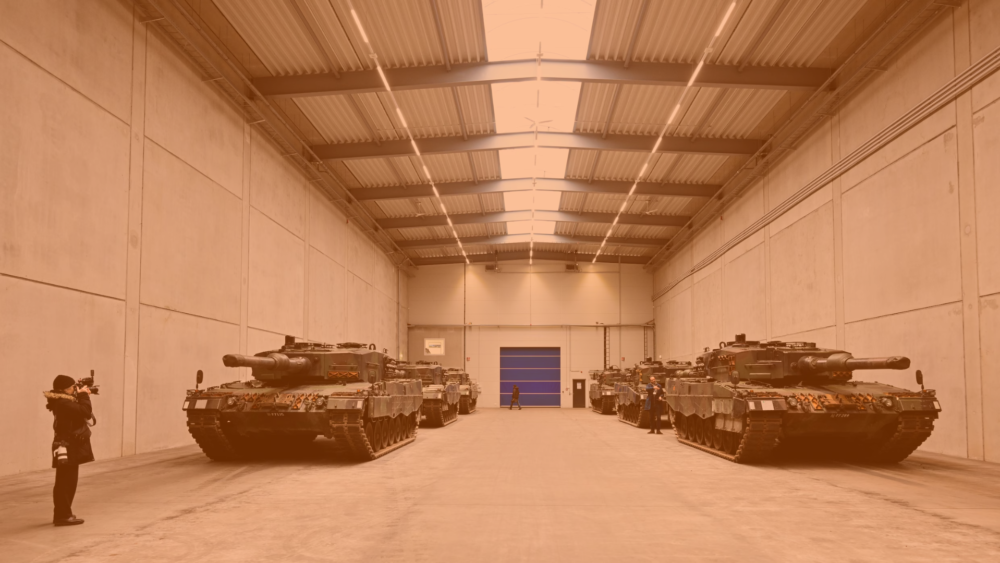
Major financial investments flow to various defence manufacturers, both domestic and foreign, to supply arms to active conflict zones. The Netherlands has supplied Major Conventional Weapons (large weapons such as missiles and artillery; armed and armored military vehicles; and other large military items like engines, sensors and satellites) to active participants in Afghanistan, Chad, Colombia, India, Iraq, Libya, Myanmar, Somalia, Turkey and Yemen. The government has also continued to supply F-35 fighter jet parts to Israel despite a court order to halt shipments passing through Rotterdam claiming that the shipments are ‘untraceable’.
It is not uncommon for arms to end up in the hands of states that commit systematic human rights abuses. For instance, it is alleged that M-113 and YPR armored vehicles were used by the police in Bahrain during the 2011 protests supplied by the Netherlands between 1994 and 1997. The political class can easily push for defence spending under the guise of national security as is the case for the EU-wide Readiness plan (formerly: Rearm Europe) that seeks to spend an additional €800 billion on defence spending. Private entities on the other hand, often fulfilling a public function, are able to acquire a steady return on investment through sustained armed conflict by investing large sums in companies that produce weapons of war.
One such company is Lockheed Martin, the world’s largest defence manufacturer by revenue and is best known for its production of F-16, F-22 and F-35 fighter jets. The company is headquartered in the US where it has amassed an astonishing $71 billion revenue in 2024. 73% is attributed to sales to the US federal government and its largest program is its sale of F-35 fighter jets, comprising 26% of its total consolidated net sales. As a profit-seeking private entity and in addition to its deep financial ties with the US state apparatus, it has spent over $7 million on federal lobbying in 2025 and over $4M on campaign contributions in 2024 between both Democrat and Republican politicians. Despite its firm integration into the US state apparatus, Lockheed Martin operates as a transnational corporation.
The production of various parts, their subsequent transport and assembly form part of a global value chain that stretches all corners of the earth. This international division of labor is characteristic of modern capitalist development as corporations seek never-ending profits while providing states with the means to engage in military endeavors. States in turn, with their monopoly on violence, play an integral role in enabling defence manufacturers to pursue their profit-seeking behavior. There is therefore a clear dependence between the political and economic sphere. In other words, it is not surprising that both the Dutch government and corporations have a stake in Lockheed Martin and the defence manufacturing industry more broadly.
In 2021 the Dutch Department of Defence formalised an agreement to purchase the PAC-3 Missile Segment Enhancement (MSE) weapons system [10] designed to incapacitate a range of airborne threats including aircraft and missiles. This purchase adds to the arsenal of PAC-2 missiles to form the Phased Array Tracking Radar to Intercept On Target (PATRIOT) air defence system which the Department of Defence has maintained since 1987. It was deployed in the Gulf war in 1991 in Turkey and Israel, and in Sliaç, Slovakia, in 2022 following the Russian invasion of Ukraine. In addition to simple weapon purchases the government is also involved in the manufacturing of weapons systems.
Lockheed Martin Skunk Works, or Lockheed Martin Advanced Development Programs (ADP), is a subdivision of the defence manufacturer with an interesting history (to say the least) in the development of aircrafts stretching back to the days of the Cold War. In 2024 the non-profit Royal Netherlands Airspace (NLR) entered a partnership with Lockheed Skunk Works called a Memorandum of Understanding (MOU) that “aims to strengthen European strategic autonomy, enhance military operational analysis, and increase the integration of Dutch industry into defence projects”.
The details of this strategic partnership remain vague however, highlighting the confidential nature of all matters related to defence. It is not a stretch to assume that this partnership furthers the development of weapons systems as the NLR provides support to the Royal Netherlands Air Force “including technical and operational support for air defence platforms, lifecycle management of military air and space systems, and support for determining and implementing military aviation standards”.
Besides development another important aspect of the defence industry is funding. Generally speaking the most visible defence spending comes from the state, however the private and public sector often work in tandem to achieve their economic and political goals. In the case of the Netherlands the lines are blurred as institutions with public functions while acting as private corporations through extensive liberalisation efforts provide major financial flows to defence manufacturers. Two of the three largest banks, ING and ABN AMRO, in the country are considered too large to fail and received handsome bailout sums in the wake of the 2008 financial crisis, amounting to €10 billion for ING and €21.7 billion for ABN AMRO. This injection of cash saved the banks from collapse at the expense of the taxpayer and allowed them to profit off of the misery of people elsewhere. In 2016 the Dutch parliament voted to ban weapons exports to Saudi Arabia due to concerns over human rights violations. Yet despite this ban both banks, in addition to Van Lanschot Kempen, invested approximately €640 million into businesses tied to the arms industry involved in the Saudi-led coalition’s war on Yemen. The years-long assault led to a manufactured humanitarian crisis and the UN estimates that 60% of all deaths in Yemen between 2015 and 2022 were due to indirect causes such as food insecurity and lack of accessible health services.
ING and ABN AMRO invested an additional $137.5 million in the French aerospace corporation Airbus that went on to deliver a range of weapon systems, including missiles and helicopters, to Saudi Arabia, Egypt and the UAE. Besides banks, Dutch pension funds and insurance companies invest substantial amounts into the arms trade. Allianz, Aegon, ABP and PFZW combined invested over €5.7 billion into various defence manufactures including but not limited to Lockheed Martin, Airbus, BAE Systems, Boeing, Northrop Grumman and Raytheon. Allianz en Aegon lead the charge, investing to the tune of €4.3 billion and €1 billion respectively. They occupy a bizarre position in that they, on the one hand, provide a service that is meant to sustain life while enabling the destruction of life on the other.
In conclusion, Dutch involvement in the defence industry takes on many forms and this piece touches on but a few of them. Out of security interests the state is able to legitimise warfare and thereby enables private defence manufacturers to embed themselves in national contexts either as standalone divisions or through partnerships with existing defence manufacturers, including companies that are adjacent to the defence industry. Additionally, private corporations are able to influence policymaking through lobbying efforts that transcend state borders. In the Dutch context we see the likes of banks, pension funds and insurance companies investing heavily in defence manufacturers that actively fuel global armed conflict and in states that are implicated in human rights abuses.
These are institutions that arguably, and in principle should, provide public services while profiting heavily off of death and despair. Although an incomplete picture is presented here of the defence industry in the Netherlands, it is clear that it remains an incredibly lucrative business that benefits from the increasingly volatile world we live in. As DiEM25’s own Lucille Cornelius said at the Global Women for Peace – United Against NATO gathering: “One day, all the money in the world will mean nothing – when the planet is destroyed, and the people who inhabit it are erased.”
Do you want to be informed of DiEM25's actions? Sign up here