

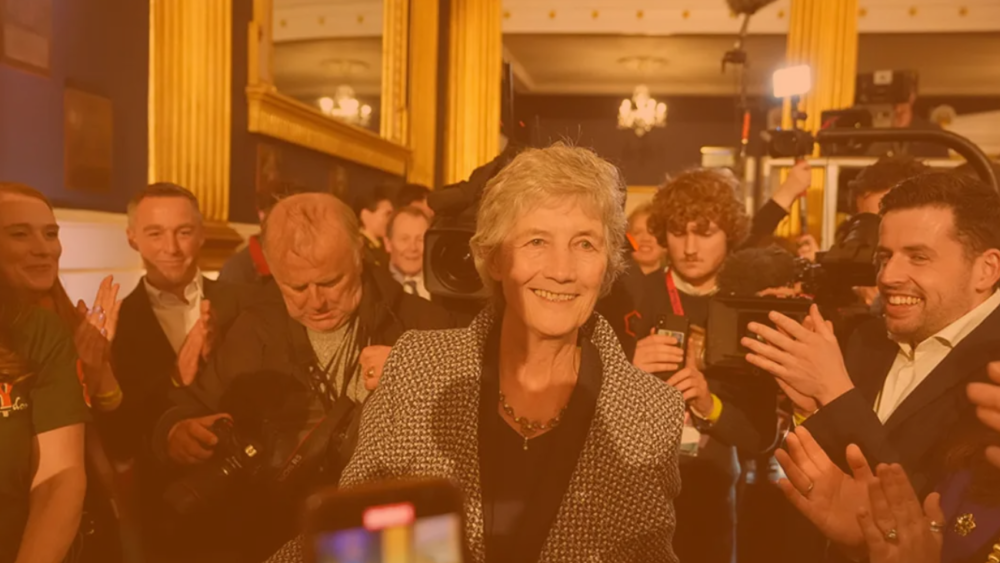
Catherine Connolly’s election as Ireland’s new president marks a profound shift in the country’s political mood. The election of the independent representative to the office of Uachtarán na hÉireann has shown that a real desire for change exists among the people.
Her election with 63.36% of first-preference votes, representing about one-third of the electorate, is another indicator that many people are seeking a new way of conducting politics – one that serves the democratic majority, encompassing working people, rather than the self-serving interests of the undemocratic millionaire and billionaire classes.
A conversation has started with the aim of working towards a unified programme for government, promoted by all the political forces, parties, and civic society groups that supported Connolly’s campaign.
Potentially, this could be a People’s Programme of Government, worked out and drafted by the broad mass of people at people’s gatherings. To achieve this, discussions, events, and conferences could be held in all four provinces of Ireland in the lead-up to the next general election, due in 2029.
Activists in the election campaign believe that what was achieved together was remarkable – people from different places and viewpoints working side by side with a collective aim and a common, immediately achievable purpose.
Teams around the country knocked on over 800,000 doors as part of 44 local groups, which emerged from over 15,000 people signing up to support the campaign.
People’s organisations also came on board, including seven ‘Affinity Groups’ of Artists, Disabled People and Carers, Trade Unionists, and Gaeilgeoirí. These groups had a cumulative membership of just over 4,000 people.
Fourteen groups united for peace supported Connolly’s stance on peace, Irish neutrality, the Constitution, and the Triple Lock. All this added up to make the election campaign a true movement of people on the ground.
When Connolly announced her candidacy, she said she believed the president should be “a unifying presence and a moral compass in a world increasingly driven by profit and spectacle”.
She wants to be a president who speaks for peace and stability at home and abroad. Within Ireland, this includes how we treat one another and how we care for the most vulnerable in society.
It also means making space for disagreement without division. She believes in neutrality as an active, living tradition of peace-making, bridge-building, and compassionate diplomacy.
Taking into account the growing movement of young Irish-language activists, she wants an Ireland where An Gaeilge is seen not only as a link to our cultural heritage, but as a way of seeing the world that “centres interdependence, nuance, and beauty”.
These are messages that resonated with over 914,000 voters. They have fuelled an inspiration that, although we are living in “troubled times”, as Connolly called them, we can build a society in which caring for the Earth and caring for each other are our primary motivations.
This feeling has been expressed in news coverage and commentary by progressive people buoyed by her victory in the election, in other parts of the world as well. Headlines such as “Ireland’s new president boldly opposes austerity, militarism, and the genocide in Gaza” reflected the hope generated internationally by the result.
There was also recognition that her election was due to her long-standing and ongoing active support for achieving self-determination and justice for the people of Palestine, liberated from occupation, colonisation, and apartheid.
Recently, in one of his last public engagements before leaving office, President Michael D. Higgins also expressed heartfelt support for Palestine, condemning the famine in Gaza by saying: “Those who are responsible must be stopped, and they must be excluded from international organisations where international law has to be respected and where there are basic moral principles.”
Echoing the themes Connolly raised in her campaign, he also said: “We have to stand together in opposition to the destruction of our moral world by large corporations that have no responsibility,” adding that eventually, unlimited greed would be swept away.
During her campaign, Connolly clearly reiterated that she will carry out her duties as president in accordance with the Constitution of Ireland, Bunreacht na hÉireann, and will dedicate her abilities to the service and welfare of the people of Ireland.
She knows that her role as president is clearly defined by the Constitution, but she wants to emulate recent past leaders – especially Higgins – who have worked effectively to advance the cause of justice, equality, and peace at home and abroad.
In a recent interview on RTÉ’s Raidió na Gaeltachta, she said: “This win is not for me, but for us.” She again spoke of “a new United Republic where everyone is valued”, describing herself as a symbol for the new movement to achieve this.
The new president will take office on November 11. When she enters Áras an Uachtaráin, the president’s residence, she will do so with an understanding that her predecessor, Higgins, has contributed positively to Ireland’s reputation for maintaining peace and human rights in the world.
She can continue that good work as a symbol for the new movement, motivated by the words in one of the last public speeches by the outgoing president:
“New forms of democracy will emerge, and as well as that, international law will be redefined – but it will be redefined by all of the people on the planet.”
Do you want to be informed of DiEM25's actions? Sign up here