







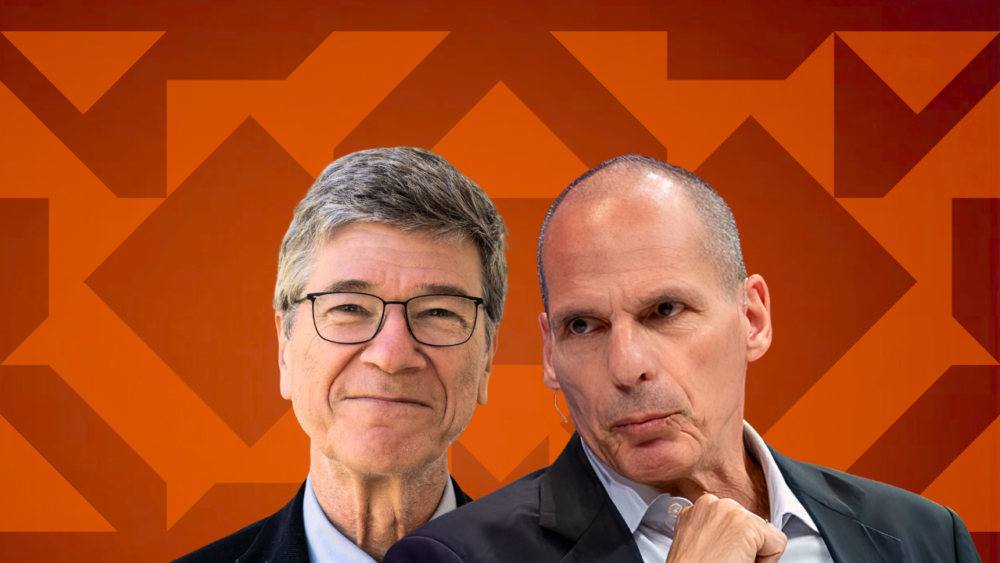
In our latest DiEM TV livestream, Yanis Varoufakis spoke with renowned economist Jeffrey Sachs about the dramatic shift underway in Europe: from a self-described “peace project” to what increasingly resembles a war project.
Reflecting on the recent Munich Security Conference, Sachs did not mince his words. It was, he said, “the most pathetic meeting imaginable,” a gathering defined by groupthink and belligerence rather than serious diplomacy. Instead of strategic reflection, he observed, the dominant tone was: “How should we go to war? Who should we fight?”
For Sachs, the problem runs far deeper than one conference. He traced Europe’s current trajectory back to the post-1945 consolidation of United States global hegemony. After Franklin D. Roosevelt’s death, Sachs argued, Washington abandoned the possibility of genuine global cooperation and embraced a strategy of dominance. “They didn’t want peace,” he said of the post-Cold War moment. “They had won. What they wanted was now fulfilling the global dominance.”
The collapse of the Soviet Union in 1991, Sachs insisted, presented a historic opportunity for a cooperative security architecture in Europe. Instead, the US chose NATO expansion. He pointed in particular to the 2008 Bucharest Summit, where NATO declared that Ukraine and Georgia “will become” members. Angela Merkel initially resisted, Sachs noted, but ultimately relented. “That, to my mind, was the end of Europe,” he said. Had Germany firmly refused, “she would have carried the day.”
Varoufakis expanded the critique, focusing on Europe’s internal failures. The European Union, he argued, was never designed for genuine sovereignty. From the outset, accession required NATO membership, tethering Europe to US military hegemony. Economically, the eurozone’s architecture entrenched austerity, stagnation and dependency on US demand.
The result? Two decades of declining net investment, deindustrialisation, and widening internal divisions. “That’s how the peace project becomes a war union,” Varoufakis said, describing how shuttered car factories are now retooled for weapons production.
Both speakers rejected the notion that Europe’s militarisation reflects popular will. “The people in Europe are not in this line,” Sachs stressed. Europe’s leaders, many with collapsing approval ratings, are doubling down on confrontation despite widespread public disillusionment.
Varoufakis was equally blunt about current talk of “strategic autonomy”. “Absolutely not,” he said when asked whether Europe can achieve sovereignty under present arrangements. “They don’t mean it. They’re lying through their teeth.” Instead of non-alignment and diplomacy, Europe’s elites seek what he called a “forever war” – a simmering conflict that justifies militarisation and preserves their political relevance.
Sachs argued that Europe’s subordination has also been economic. For decades, he said, Washington ensured that Europe would not emerge as a serious technological competitor. Even strategic firms, he noted, are effectively subordinated to US geopolitical priorities.
Yet both men insisted that this trajectory is not inevitable. Sachs expressed hope that a single major European leader could change course. “We just need one German chancellor that says, ‘I’m picking up the phone and calling President Putin,’ and everything could look different. Everything.”
Varoufakis, while less optimistic about spontaneous reform, emphasised organised resistance. Change will not come from waiting for elites to rediscover rationality. It must come from movements.
Europe’s future, the discussion made clear, hinges on whether citizens accept the transformation of the EU into a militarised bloc – or mobilise to reclaim it as a democratic peace project.
Do you want to be informed of DiEM25's actions? Sign up here