


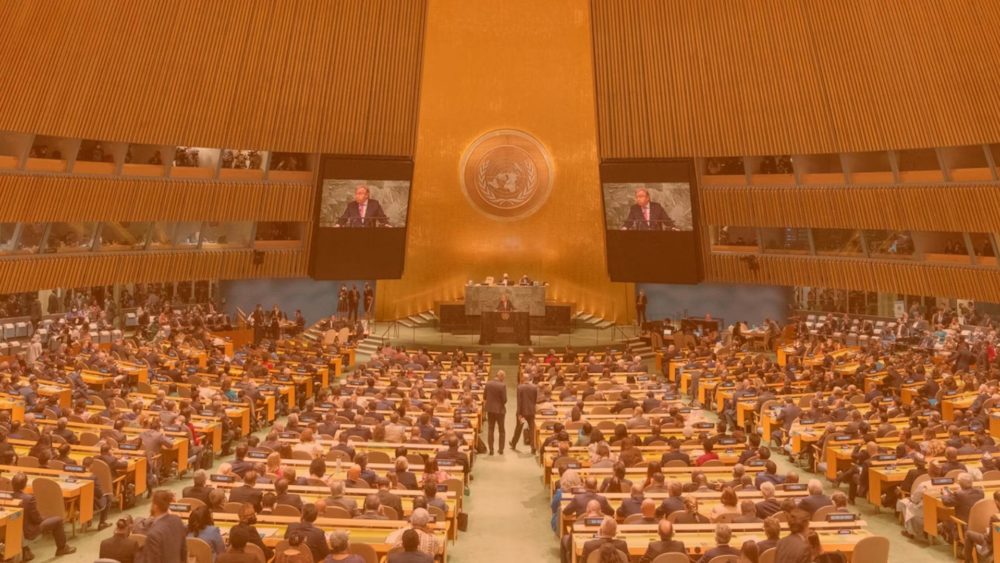
On March 25, the International Day of Remembrance of the Victims of Slavery and the Transatlantic Slave Trade, the UN General Assembly adopted a resolution recognising the transatlantic slave trade as the gravest crime against humanity and calling for accountability and global reparatory justice.
With an overwhelming majority, 123 countries supported the resolution, proposed by Ghana. The text emphasised that “the trafficking of enslaved Africans and racialised chattel enslavement of Africans as the gravest crime against humanity by reason of the definitive break in world history, scale, duration, systemic nature, brutality and enduring consequences that continue to structure the lives of all people through racialised regimes of labour, property and capital.”
Three countries – the United States, Israel, and Argentina – voted against it. The US expressed frustration with the United Nations, accusing it of advancing narrow agendas and creating additional mandates. It also reiterated that it does not accept a legal obligation to provide reparations for past actions that were not illegal under international law at the time they occurred.
But what of the European countries – the principal perpetrators of a system that led to the enslavement of more than 15 million Africans over four centuries?
All 27 members of the European Union, along with the United Kingdom, abstained.
The European Union justified its position by arguing that the resolution introduced a hierarchy of crimes against humanity that does not exist in international law and could risk diminishing the suffering of victims. It also criticised the inclusion of selective and contested historical references, warning that such elements depart from established UN practice, risk division, and exceed the General Assembly’s role.
Finally, it objected to what it described as flawed legal claims, including the retroactive application of international law and assertions of a right to reparations, which it maintains lack a sound legal basis and contradict the principle of non-retroactivity. The EU’s selective understanding of international law is now par for the course and their positioning was to be expected.
Importantly, this abstention reveals a deeper issue that demands urgent attention: Europe’s colonial aphasia—the structural inability to fully remember and articulate the realities of colonialism, sustained by the deliberate obscuring of historical knowledge and the distortion of language.
As Ghana’s president John Mahama stated at a high-level UN event on reparatory justice, “the entire transatlantic slave trade was designed to deny African people their humanity,” rooted in a fabricated racial hierarchy that justified unimaginable violence and exploitation. The resolution, he argued, offers an opportunity for the global community to bear witness to the suffering of millions whose lives, identities, and futures were stolen across centuries.
The transatlantic slave trade is not merely a chapter of the past. Its consequences remain deeply embedded in the present. The descendants of enslaved people continue to face structural inequalities shaped by colonial legacies. European modern welfare systems and “advanced” economies were built on the extraction of unpaid labour and the exploitation of the Global South. Systemic racial discrimination persists across European societies and institutions, affecting access to resources, opportunities, and justice.
As Mahama further noted, the contributions of Africa to the wealth of Europe and the so-called New World are met not with recognition, but with silence – “a silence so profound it borders on mythology.”
The Global Repair Campaign: Caribbean-led reparatory justice
It is in recognition of these enduring realities that DIEM25 supports initiatives like the Global Repair Campaign, a Caribbean-led effort advocating for reparatory justice and addressing the ongoing legacies of European colonialism.
Aligned with the CARICOM perspective, the Repair Campaign expands and strengthens the Caribbean Reparatory Justice Movement by compelling governments, institutions, and individuals to acknowledge their roles in the transatlantic trafficking of enslaved Africans and the enduring colonial legacies that followed. The campaign amplifies the voices, experiences, and urgent calls for justice from CARICOM member states, while developing concrete Socioeconomic Reparatory Justice Plans that serve as actionable, long-term roadmaps for reparatory justice.
In recent years, the global call for reparations has gained momentum, led in part by the African Union and the Caribbean Community. Yet European amnesia persists.
The fight against European amnesia
Decolonisation is not a metaphor. It requires confronting historical truths and accepting their material consequences. While formal acknowledgment is an essential first step, it is far from sufficient. Addressing the legacies of slavery and colonialism demands concrete action: full formal apologies; repatriation initiatives; investment in public health systems; programmes to eradicate illiteracy and expand educational access; the restoration and protection of cultural heritage; psychological rehabilitation to address intergenerational trauma; and technology transfers and economic measures to close the persistent development gap.
It also requires cancelling unjust debts and supporting the right of affected communities to sustainable development. Only through such comprehensive measures can the structural foundations of racial injustice begin to be dismantled.
At the European level, it also implies adopting policies that tackle inequalities in public health, restore and protect cultural heritage, and dismantle the structural foundations of racial injustice.
This is neither a simple nor a short process. But reducing it to symbolic gestures or commemorative statements, without accepting demands for reparatory justice, risks perpetuating the very silences the resolution seeks to break.
Do you want to be informed of DiEM25's actions? Sign up here