

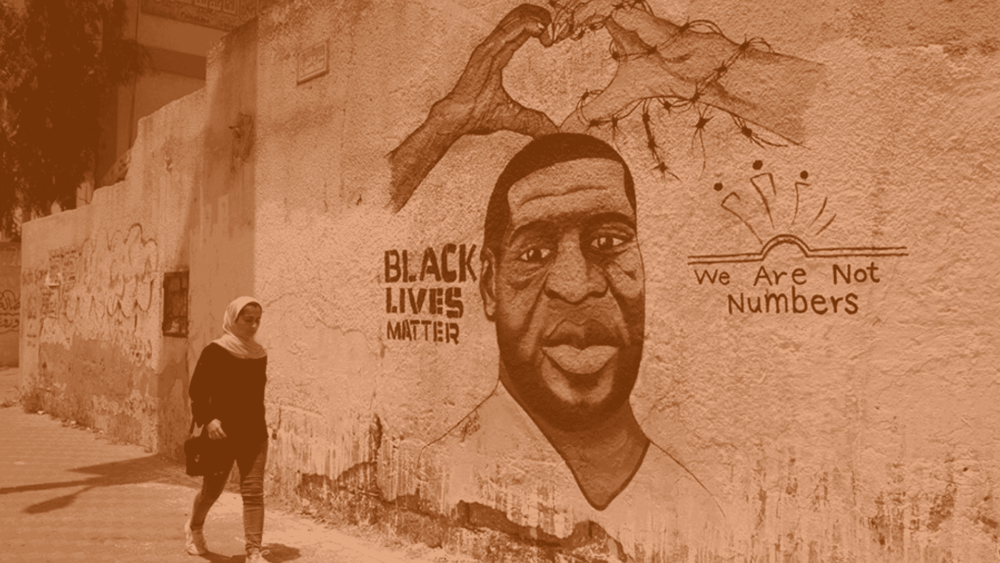
Today is the anniversary of George Floyd‘s death – nine minutes and twenty-nine seconds on a Minneapolis pavement, a knee on his throat, his chest pinned, his cries for breath answered with more pressure, the paramedics kept back. He was killed because killing is what an apparatus of racialised disposability does.
We know what his death sparked: the largest protest movement in United States history. It produced, briefly, a political vocabulary capable of naming things – defund, abolish, systemic – that needed revolutionary change. At its peak, approximately 26 million people in the United States were participating in various ways to demand change.
And then in July 2020, barely a few weeks after George’s murder, corporations began donating heavily to causes that supported social justice. The names are familiar to anyone aware of the boycott lists: Amazon, Coca Cola, Intel, Airbnb and so forth. Black Lives Matter Global Network Foundation, for example, received over $90 million in 2020. Parts of the funds were used to support their grassroots chapters, but, controversially, large sums were used for real estate and stock purchases, the latter to the tune of $32 million. Others of course tried to move beyond stock purchases and gave their lives for the cause: Manuel Esteban Paez Terán, better known as Tortuguita, was killed obstructing the construction of Cop City in Atlanta, Georgia. Other groups sought to press their demands – one might argue naively – on the Democratic Party. But the superstructure of domination was left intact, in fact invested in through the stock market, all the while the killings continued at roughly the same rate it had before.
The mechanism is consistent: the apparatus of power, private or public, learns the language of the movement, funding it even, while leaving the superstructure intact – all the while offering a feeling of hope to the general population.
Consider the Spanish government under the prime ministership of Pedro Sánchez. It has used the word genocide and spoke it from the floor of the United Nations. It recognised the State of Palestine in May 2024. It joined South Africa‘s case at the International Court of Justice. In September 2025, it announced a package of nine measures including a total arms embargo on Israel covering exports, imports and dual-use technologies, which Parliament enshrined into law the following month. These steps, while laudable, maintain the superstructure. Spain has not withdrawn from NATO. The US military bases at Rota and Morón have not been shut down. And police repression, trained through Israeli ties, continues. On 23 May 2026, returning Sumud flotilla members were beaten and arrested by the Basque regional police, with one activist saying: “It’s chilling to see how the knee placed down on our volunteer’s head was done exactly the same way the iOF used to immobilise us.”
Ireland is another case. A state with a long popular attachment to neutrality and recognised Palestine in 2024. It has consistently used sharper language about the conduct of wars than most of its European peers – and has called for a ban on trade with illegal Israeli settlements. Shannon Airport however continues to serve as a refuelling and transit hub for US military aircraft, including flights connected to the resupply of Israeli forces. In addition, the government is moving to dismantle the Triple Lock – the requirement, in place since the foundation of the state, that Irish troops may be deployed abroad only with the authorisation of the United Nations alongside the government and the Dáil. Removing it opens the road to Irish participation in EU and NATO-led operations without UN mandate.
Solidarity with Palestine through discourse; deeper integration into the war machine through logistics and legislation.
It keeps repeating
On 15 May 2026, Yves Sakila – a 35-year-old Congolese-born man raised in Galway and Dublin – was pinned to the pavement by at least five private security guards for almost five minutes on a busy shopping street in Dublin. At one point a guard appeared to kneel on his head or neck. He became unresponsive at the scene and died shortly after at Mater Hospital. His former classmate David Kaliba, speaking to Reuters, called it a George Floyd moment. Protests and vigils have been held since to demand a full and independent investigation.
What killed Yves Sakila on a Dublin sidewalk and what killed George Floyd on a Minneapolis pavement was not, in the end, the choice between public and private uniforms. It was force summoned to protect capital – and dispense violence with impunity. Minneapolis police were called over an alleged counterfeit twenty-dollar bill. Private security acted over an alleged shoplifting. In other words: Killing in the line of Capital Duty.
What, then, breaks the pattern?
After ICE agents killed Renée Good and Alex Pretti in Minneapolis in January 2026, a coalition of community organisations, students, faith groups and workers called Minnesotans to withdraw – from work, from school, from shopping – for a single day. Thousands participated and hundreds of businesses closed across the city. The flame of resistance was lit and spread beyond the state of Minnesota. Within three weeks, the Trump administration announced the end of Operation Metro Surge, the federal operation that had unleashed ICE on Minnesota. The federal raids stopped because the community moved onto the economic front – and hit capital, the spine of the superstructure, head-on.
This system, after all, is built on our backs, on our labour, on our consent. The buck, indeed, rests with us. An honest assessment tells us that the people of Europe are not yet sufficiently organised to exercise our power to withdraw, en masse, as the people of Minneapolis did. This is yet to come.
That is why on 14 June in Brussels, and throughout the month across Europe, Stop ReArm Europe is calling on the public to join the campaign and strengthen the anti-militarisation movement across borders.
Why this is crucial
Rearmament touches every facet of life. It pulls public spending away from housing, healthcare, education, climate and welfare – redirecting it into the firms whose share prices rise as cities are flattened elsewhere. It demands the militarisation of borders, of universities, of research, of the everyday administrative texture of European life. It builds the political climate in which dissent is reframed as disloyalty, and in which racialised populations – at home and abroad – are made into the threats the new weapons are sold to address.
Precisely because it touches everything, resisting it is the work that brings everyone into contact with one another. The dockers refusing to load arms shipments. The rail workers refusing to move military cargo. The teachers refusing the recruiters at the school gates. The healthcare workers naming what was lost when the budget went elsewhere. The students, the pensioners, the climate organisers, the migrant rights coalitions, the Palestine solidarity movement, the trade unions whose own members are being asked to manufacture the weapons.
Across borders, across sectors, across the lines of division the apparatus relies on to keep us atomised, the anti-militarisation moment is the one where the constituency for a future general strike can actually be built.
This is the work of 14 June and of the months that follow. Not a single day of protest, but the slow construction of a coalition with the scale, the trust, and the muscle to do what Minneapolis has shown is possible – and to do it on a continental scale, against the infrastructure of capital.
We build now, so that when the moment comes to refuse, we are organised enough for the refusal to land. This is how we can prevent a future George, Yves, Renée or Alex from succumbing to an early death – and ultimately ushering in what Bobby Sands dreamed of: ‘the laughter of our children.’
Do you want to be informed of DiEM25's actions? Sign up here