

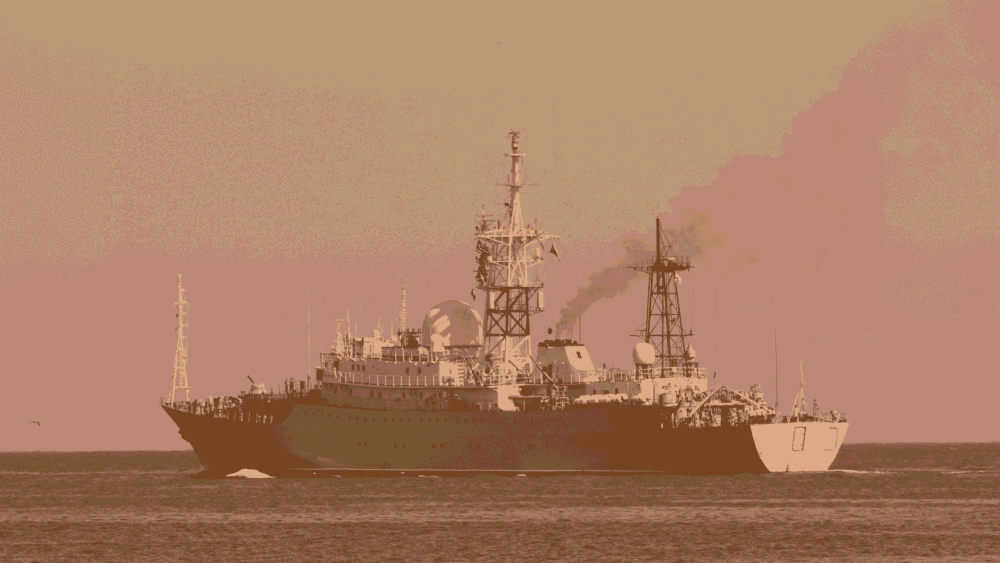
Story after story has appeared in the Irish and British media over the last couple of years about a supposed threat to undersea cables running through the territorial waters of the Republic. In 2024, The Guardian reported a Russian oceanographic research vessel being briefly observed in Irish waters. The piece described this as a ‘spy ship’ but the details provided didn’t really add up to much.
Considerable effort was put into attempting to write up a series of non-events into a nebulous threat. On the information provided, at its closest the ship in question never came within more than five kilometres of a cable. The British navy were said to be monitoring it and were even quoted as explicitly saying the vessel was unlikely to be involved in sabotage.
Wave after wave of such stories have followed, each as flimsy as the preceding one, but through sheer force of repetition an impression has been built that something sinister is afoot. Recently, yet another Guardian story asked: ‘Is Ireland’s unprotected ocean the weak link in European defence?’ Again, the detail is thin and, on close scrutiny, unconvincing.
We are told that more Russian vessels have been seen of late in Irish waters. But, as the article itself explains, this is because they are avoiding British and French waters after the UK seized Russian merchant ships in the Channel. This breach of international maritime law imitated similar actions by the Trump administration and was a desperate act of political theatre in the dying days of Starmer’s premiership.
But merely from the very presence of Russian ships passing through Irish waters, The Guardian concludes that Ireland ‘is really on the frontline’. This is desperately thin, yet repeated enough times to a public not paying close attention, a substantive threat is conjured up.
Although it is stated that Ireland’s neutrality is not threatened, the story paints further cooperation with other EU states that are members of NATO as inevitable. Many Atlanticists are keen for the Republic to join the alliance but they know that public opinion is strongly behind the country’s historic neutral status. Thus instead of attempting to directly challenge Ireland’s neutrality, they seeking to normalise close cooperation with the forces of NATO member states.
The cable stories are part of a much large public relations war that has been conducted in Europe over the same period which seeks to convince European publics that Russia poses a direct threat to countries other than Ukraine. The hybrid war narrative – which I debunked in an essay earlier in the year – proceeds most often by unspoken insinuation rather than substantive demonstration. Prominent assertions, such as the claim that von der Leyen’s plane had its GPS jammed or that a DHL plane was downed by the Russians in Lithuania, have turned out to be false.
One phenomenon which does appear to have substance are incidents of ‘anchor dragging’. But these only began in October 2023 and might be suspected as a low level response to the destruction of the NordStream pipeline carrying Russian gas to Europe. The constant chatter about a threat to transatlantic cables was perhaps inspired by these only too real incidents. But it should be stressed that Russia has no quarrels with neutral Ireland and no reason to attack its infrastructure.
The most immediate security threat to the Republic is not Russia. It is hiding in plain sight and almost never remarked. It is the events that could be consequent on a hastily called border poll on reunification with Northern Ireland. One conducted in haste and won by a slim margin poses considerable risks to security on the island.
Few will need reminding of the strong sentiment manifested in the UK in the wake of the Brexit referendum in 2016, which was won by Leave by a mere two percent. The consequence was political paralysis for three years and a vitriolic debate, more highly polarising than any political event in living memory.
A similar outcome in a province that has a long history of physical force politics would be fraught with danger. A whole generation has grown up knowing only peace in northern Ireland. This state of affairs has come to be accepted as a given. Events on the Garvaghy Road in the early autumn demonstrate that old animosities remain.
It needs to be stressed that the paramilitaries have not gone away. They are still there, deeply embedded in communities, often actively engaged in criminality. Intelligence sources estimate there to be currently 12,500 active members of loyalist paramilitary groups. Anti-immigration riots have demonstrated that loyalist communities are very capable of flexing their muscles should they wish to. Polls show that 23% of Unionists currently think that a united Ireland is ‘almost impossible to accept’.
The history of the province demonstrates that a relatively small number of people can make it extremely difficult to govern should they choose to assert themselves. The British army failed to contain the IRA during the Troubles. There is no likelihood that the Irish Defence Forces, no matter how well equipped, could manage a situation where even a relatively small loyalist force actively sought to resist government from Dublin.
To say this is not to oppose a border poll. It is to make an objective assessment of the security threats that the Republic faces and should be planning for. Although security threats are historically understood in terms of military force, in the contemporary world matters are more complex. The most significant threats are often not tanks rolling across a state’s border but processes like climate change.
The biggest security threat the Republic faces is not from Russia, a distant great power, but from its historical demons coming back to haunt it. There is a quite plausible scenario in which the internal politics of the UK leads speedily, and without sufficient preparation, to a rushed referendum on a united Ireland which, in turn, sees the Troubles reignited; this time with hold-out loyalists engaged in terrorism against a Dublin government.
The Republic needs to plan for the real dangers it faces, not imaginary ones. Achieving security for the state means forestalling the reemergence of violence in Northern Ireland. This can be done by properly preparing for any future border poll. This will necessitate a long period of engagement with loyalist communities with a wide-ranging discussion hopefully leading to a consensus which all can assemble around.
Above all, there should be no rush to declare a referendum largely on the basis of the political contingencies of the moment, as David Cameron did with Brexit. Not every security problem is solved by buying arms and munitions. The Republic can best achieve the security of the state by remaining neutral and carefully preparing for an eventual plebiscite on reunification.
Do you want to be informed of DiEM25's actions? Sign up here