







An anti-fascist protest in Utrecht exposed growing tensions between the far right, police repression, and the Dutch left’s struggle to organise effectively
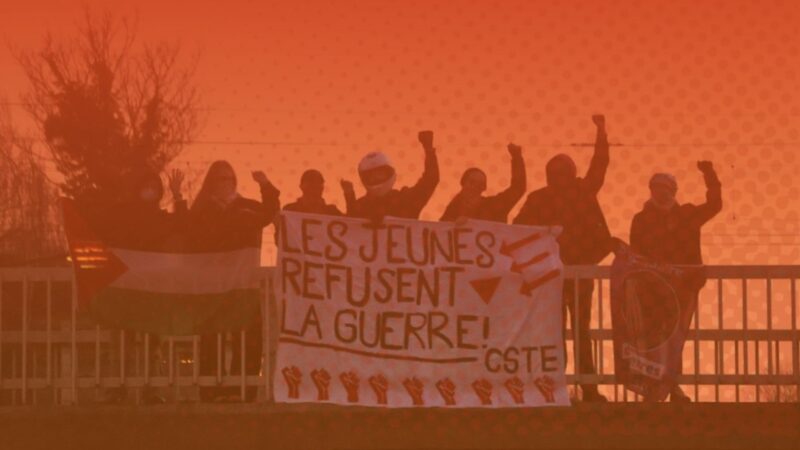
On Thursday, February 26, I joined an anti-fascist protest in the lovely, relatively politically left-wing city of Utrecht (relative to a very right-wing country, admittedly), with a fairly healthy anarchist, anarcho-communist and communist community (mainly students). It is well connected nationally and forms the backbone of our local and national anti-fascist movement.
That evening, we gathered in Moreelsepark at the statue of the local anti-fascist and union-organiser hero, Truus van Lier. The statue still had white carnations lying in front of it from the remembrance services earlier that day and the day before, commemorating the heroic stance of union members on February 25, 1941. On that day, a general strike was called and the masses were mobilised after months of organising. This happened mainly through the Dutch Communist Party (CPN) at the port of Amsterdam, or close to it. The only port that might have rivalled it was Antwerp and, therefore, Amsterdam was crucial for the German war effort. The strike was a reaction to what was happening to Dutch Jews under the German occupation.
The police had a Riot Unit van standing right behind our small gathering place and around the corner in the street leading into the lively centre of Utrecht on the weekly student night. There were five more of these vans around. In other words, the police came out in force. We all knew the police were not our friends since we had protested against fascists coming to the city before, but we could sense it in the air: this time was truly different.
What sparked the anti-fascist protest in Utrecht?
What made this situation different? The openly fascist group Defend Netherlands (known for trashing our political capital, The Hague, during a protest where they claimed to defend our country from “foreigners”) announced a “memorial march to remember our dear brother and comrade Quentin Deranque, who was cowardly murdered in cold blood by Antifa”.
They announced that they would march through the city centre at a time when the left usually receives a bit more recognition than normal for its heroic last stand when fascism was quietly deporting people’s neighbours to concentration camps.
This Dutch fascist group also wanted to march on the most well-known leftist café and former squat in the city, ACU, which also functions as an anti-fascist organising, fraternising and cultural hub.
What was the response of the city council?
The left-wing parties LINK – which, unfortunately, is no longer represented on the municipal council – and BIJ1 asked several critical questions of the municipality and the mayor.
The questions by LINK were:
- Is the city council familiar with the announced demonstration by Defend Netherlands marching towards ACU and the city centre in general?
- Does the Council share the opinion that organising a far-right demonstration near a left-wing cultural space could be considered provocative and intimidating? If yes, how is this weighed in the risk assessment and decision-making process?
- How does the Council assess the use of far-right/white supremacist symbols like the Celtic Cross during demonstrations and in public spaces, and what role does this play in its safety evaluation?
- Can the Council elaborate on how this situation relates to previous demonstrations in Utrecht where conscious consideration was given to location and possible intimidation, such as anti-abortion demonstrations at the abortion clinic on the Biltstraat and the extreme right-wing demonstration at the asylum seekers’ centre on the Europalaan? What lessons have been learned from this and how are they being applied here? Does this play a role in the security assessment?
- Has the Council or the police been in touch with ACU about the announced demonstration? If so, what was discussed and what arrangements were made regarding safety and accessibility? If not, why not? What is the police assessment of the risk of violence during the demonstration? If there is a risk of violence, what measures will be taken to prevent it? If not, why not?
Mayor Dijksma and her aldermen did not explain their position or their plans for keeping the public safe while overt white supremacist hooligans roamed the streets of the city. I have to say, this was very noticeable in the illogical and chaotic tactics and actions of the police, which endangered both protesters and bystanders during the demonstration.
Chaos, repression and ideological obstacles to combatting the threat of fascism
It seemed that both the police and the anti-fascists who organised the protest had not been in any form of communication at all. In my assessment, this was because of the ideological convictions of most Black Bloc participants, who tend to be anarchists, anarcho-communists or communists from various groups.
They consider the police to be an oppressive institution in its role as the armed wing of the state. In principle, this is factually correct, but it makes anti-fascist protesting a hazardous, over-policed and tense situation because it provokes a strong response of animosity from the police, especially the Riot Police, who are often tightly wound and overeager to engage in violence and arrests.
Another fact that does not help build trust is that the police are widely regarded among leftists as being deeply infiltrated by fascists, particularly within more militarised units like the Arrest Teams (ATs) and Mobile Units/Riot Units (MEs), which is not exactly inviting to less “radical” participants.
The revolutionary potential of anti-fascist protest and the general lack of communication with the public
I personally think that the left needs to embrace the idea of doing propaganda in direct competition with fascism, directly for the general public’s attention, and therefore truly getting stuck in.
To me, this means that every protest is a public messaging and image contest. I firmly believe in talking to the public – before, during and after protests or any other form of action – because the general public often does not know what we stand for or why, and those who do are frequently severely misled.
The reaction of the police, as mentioned before, is not particularly helpful either. They continuously attempt to escalate situations and refuse meaningful dialogue unless somebody speaks their jargon – in other words, legalese – such as former police officers, lawyers, legal workers or law students who volunteer and often face repression and intimidation for doing so.
Alternatively, protesters sometimes pull out their phones en masse and livestream police violence, which can in some cases escalate the situation further. On those occasions, the police may consider backing off, standing down or refraining from beating the daylight out of people, as was once expected in most “liberal democracies”.
In my experience, one of the most successful ways in which the debate against Zionism was won by the popular movement for a free Palestine and an end to the ongoing genocide in the Netherlands over the past few years was by keeping the message simple, straightforward and grounded in humanitarian, humanistic and, yes, religious values.
This was packaged in numerous displays of kindness, diversity and non-violence, but above all solidarity.
In my view, one of the main reasons for shifting public opinion – although in this country this remains largely limited to the big cities with large Muslim populations, people of migratory backgrounds, and some left-wing representation in local councils – was message discipline and the willingness of many people to endure repression and alienation in their daily lives because of their political beliefs; in other words, true dedication to the cause.
My personal frustration with many anti-fascists is that many of these tactics go right out of the window in the anti-fascist struggle, and many are unwilling to explain their actions or even engage with the wider public.
On several occasions, I have experienced some Black Bloc activists being openly hostile towards more “liberal” or social democratic types who occasionally show up when actions receive more than average media coverage. These people are often derided as class traitors, covert neoliberals or “social fascists”, while, in my opinion, the importance of class education and, above all, class solidarity is forgotten.
In fact, I am fairly certain that many of those activists themselves have benefited from class solidarity at some point in their lives, leading them to a greater awareness of their own position in the struggle of the working class against oppression by the wealthy through this monstrous political-economic system.
Towards the end of that fateful and intense night on the Voorstraat in Utrecht, when the police and most protesters were heading home and those remaining were semi-celebrating – and I was about to leave too – one comrade nearly provoked an officer into arresting him by loudly expressing his low opinion of him before finally pushing the officer past his patience by insulting him again.
This sparked an escalation by the police, a brief moment of confusion among the remaining protesters, and retaliation by the Black Bloc. They first protested, then approached the police and finally became involved in a scuffle. This ended in three arrests and some bruises here and there. Fortunately, due to a movement-friendly lawyer, they were released the next day without serious charges.
Whilst this mayhem unfolded, I was having a friendly conversation with a curious couple who had been having drinks in a bar on the corner between the Voorstraat and a small side street leading towards another parallel street where the fascists had stood.
They were very interested in the ins and outs of why all this was happening and, when they discovered that the side in front of ACU was anti-fascist, their minds were quickly made up regarding who deserved their sympathy. There remains a strong cultural memory of the Second World War fascist occupation in our country.
I was, of course, more than willing to answer their questions about why the Black Bloc insists on wearing face coverings and why the situation escalated at the end of the night.
I make sure to cover my face during these more contentious protests because of the threat of doxxing and other unsavoury acts by fascists. Although I am fairly convinced that I am already on some form of government watchlist as a “possible troublemaker” and that they probably possess extensive video footage and files on me. So, as far as preventing government repression goes, that specific ship has probably already sailed.
The couple thanked me, emphasised their admiration for everybody’s bravery that night, and wished me goodnight.
I sincerely believe in the power of these kinds of interactions and think they hold the key to breaking the neoliberal/neofascist stranglehold the right has over our politics. Therefore, I would like to see much more of this happening on a more organised and regular basis.
In other words, I want to strongly encourage all organisations with credible anti-fascist credentials — or those aspiring to develop them — to begin engaging in person-to-person organising and encouraging their members to actively contribute towards making society better rather than worse.
Another integral part of preventing or combatting fascism is political education, deepening democracy, solidarity and left-wing politics within our society, combined with a healthy dose of radicalism.
It’s do or die for the labour movement and democracy
If necessary, we should consider that the FNV, the national trade union federation in the Netherlands, with about 870,612 members (as of 2022) and traditionally the heart of labour organising in this country, may no longer be up to the task it faces. Unfortunately, it appears to be in terminal decline.
As a left, we may need to think about alternatives as a “radical” flank of the labour movement capable of building a movement equal to the challenge. This could include unions like the IWW (Industrial Workers of the World/Wobblies) or other forms of solidarity unionism.
Although that last example may be somewhat unrealistic to achieve or meaningfully apply within our deeply atomised society, especially given the limited time we have in the face of rising fascism and a climate catastrophe that shows little regard for human society or its limited ability to adapt to existential threats.
DiEM25 could become a powerful teacher in the application of democratic structures within the Dutch labour movement. Judging by my experiences within that movement, this is sorely needed for the country, Dutch unions and society at large.
In my opinion, it may be one of the few ways to save our labour movement and democracy from a painful decline.
Do you want to be informed of DiEM25's actions? Sign up here