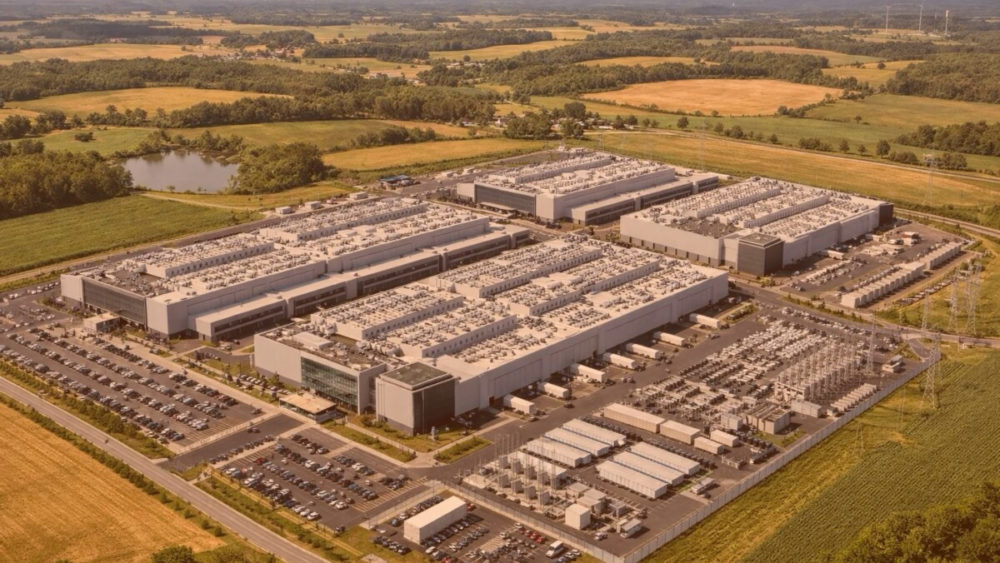
MERA25 United Left warns that the proposed Larissa data centre threatens water resources, agriculture and local communities, while raising serious transparency concerns
The proposed construction of a large data centre near Larissa is already being promoted as a “flagship investment”, promising technological development, new infrastructure and hundreds of jobs.
MERA25 United Left rejects the idea that data centres represent a sustainable model of development. They consume vast amounts of energy and natural resources, require enormous capital investment, and create very few permanent jobs.
According to publicly available information, a data centre with a capacity exceeding 200 MW is being considered, in connection with the planned natural gas plant in Larissa. Yet no comprehensive public information has been provided about the facility’s actual capacity, its cooling technology, its water and electricity consumption, or the number of permanent jobs it is expected to create. Once again, the announcements come first, while meaningful information for the public comes later – if it comes at all.
Thessaly water resources already stretched
Thessaly faces a chronic water shortage, depletion of groundwater aquifers, growing irrigation needs, and increasingly frequent periods of extreme heat and drought. Yet this is precisely where a facility is being planned that, depending on the cooling technology used, could consume enormous quantities of water.
For a hypothetical net capacity of 200 MW, annual consumption could range from approximately 175,000 cubic meters, in a system with very low water usage, to over 5 million cubic meters in water-intensive technologies – enough water to supply an entire city. Peak water demand would come during the summer, exactly when farmers need irrigation most and water resources are already under maximum pressure. Farmers cannot be told there is “not enough water” for agriculture while millions of cubic metres are being earmarked to cool private data centres.
An energy black hole
A data centre with a net load of 200 MW consumes approximately 1.75 TWh of electricity per year just for its computing equipment. When combined with cooling, UPS systems, and pumps, total consumption can exceed 2 TWh per year – a massive, continuous, and concentrated load. The fact that the project is tied to a new natural gas power plant exposes the myth of a “green digital transition”. Artificial intelligence and cloud computing do not become sustainable simply because the smokestacks stand somewhere else. Behind the sleek digital image lies a heavy industrial operation – one that depends on fossil fuels, consumes water, occupies land and places additional pressure on the environment.
The job creation myth
As always, the project’s main selling point will be jobs. International experience, however, shows that there are many temporary jobs during construction and very few permanent ones once the facility is operational. In the United Kingdom, for an Equinix campus exceeding 250 MW, approximately 2,500 construction jobs were announced, but just over 200 permanent ones. In Attica, Microsoft announced around 350 jobs during the construction phase, but expects only 34 permanent employees and contractors once the project is fully operational.
This is the reality: billions of euros in investment, enormous energy consumption, and likely millions of cubic meters of water, but only a few dozen or a few hundred permanent jobs. Press releases routinely bundle together temporary construction work, contractors, indirect employment and speculative “induced” jobs before presenting the total as permanent employment. We do not underestimate any job – but we reject deception and deliberate misrepresentation.
The commodification of common goods is not development
This debate goes far beyond a single investment project. Data centres are part of an economic model that transfers control over energy, water, land and public infrastructure to a handful of global technology corporations: the costs are borne by society – strain on infrastructure, depletion of natural resources, environmental damage, competition with agriculture and higher prices – while the profits remain private. This is not digital development; it is a new form of extraction of water, electricity, and land. Thessaly has already paid a heavy price due to floods and high energy costs; it cannot now be turned into an energy and water colony of technology conglomerates.
The position of MERA25 United Left is clear:
No to the data centre in Larissa.
No to turning Thessaly into a site for energy-intensive and water-intensive facilities.
No to handing over water, energy, and land to the digital profits of the few.
No to the deception of the so-called thousands of jobs.
Water, energy, and land are common goods. Thessaly needs support for agricultural production, public water management, energy democracy, and secure, long-term employment – not yet another “flagship investment” that leaves behind little more than a handful of permanent jobs, enormous resource consumption and even greater dependence on corporate interests.
Do you want to be informed of DiEM25's actions? Sign up here