

A broad coalition inside Iran rejects both state violence and foreign intervention – while authorities arrest those who refuse to stay silent
The arrests keep coming. Nobel laureate Narges Mohammadi has been handed another lengthy prison sentence. Reformist activists Azar Mansouri, Ebrahim Asgharzadeh, Mohsen Aminzadeh, Javad Emam, Ali Shakourirad, and Hossein Karroubi have been detained. Before them came Vida Rabani, Abdullah Momeni, Mehdi Mahmoudian, and Dr Ghorban Behzadiannajad. The pattern is clear: speak out against the killing of protesters, and the regime comes for you.
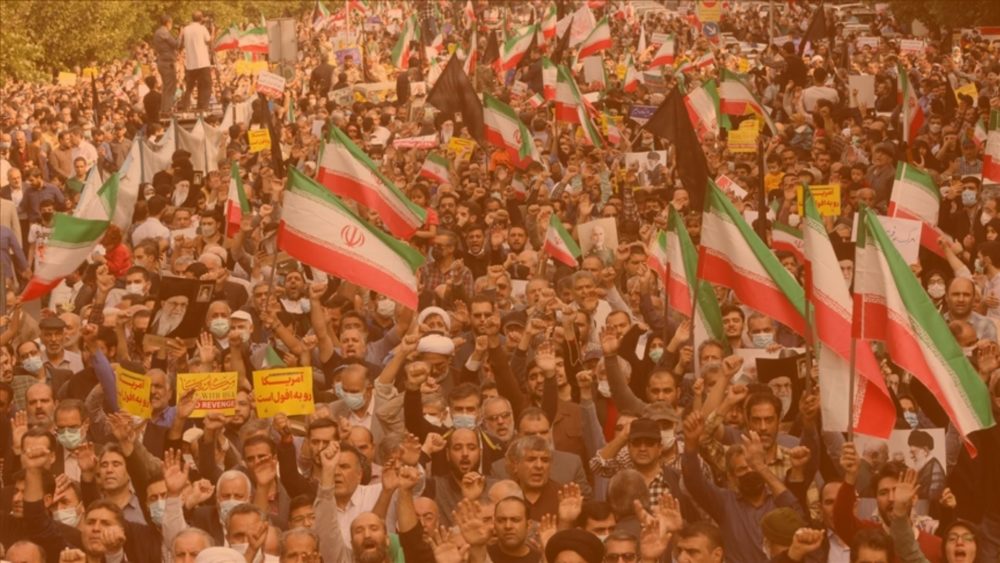
Today, 416 Iranian political activists, civil society leaders, and intellectuals published a joint statement condemning this wave of repression and demanding accountability.
Their demands include:
- Immediate release of all detained activists and protesters;
- Freedom for political prisoners;
- The formation of an independent committee to investigate the killings;
- Opposition to the death penalty; and
- An end to criminalising peaceful dissent.
As the 40th day of mourning approaches – a significant moment in Iranian culture – they urge the public to persist in demanding justice and to reject the government’s narrative.
The Iran Salvation Front
Beyond protest, the statement endorses veteran reformist leader Mir-Hossein Mousavi’s proposal for an Iran Salvation Front – a broad coalition of “all national tendencies”, anchored in three principles: no foreign intervention, rejection of domestic tyranny, and a peaceful democratic transition linked to a constitutional referendum pathway. It is presented as a route out of political deadlock – a mechanism for structural change through civic means rather than violence or external imposition.
Instead of opening dialogue with civil society on this basis, the regime has chosen an aggressive response that is doomed to fail. Prosecutors in Tehran, for example, have accused political detainees of acting “in league with the US and Israel” and of “creating secret subversive mechanisms”. Such allegations mirror what the 416 describe as “amateurish, repetitive, and threadbare” scenario-building.
The irony is stark. Those who most loudly warn of foreign interference are presiding over policies that deepen vulnerability.
Decades of repression and economic mismanagement – compounded by unilateral coercive sanctions that squeeze society far more than the powerful — have weakened institutions and eroded public trust. In this environment, external actors find openings to exploit. Some Iranians, out of exhaustion and desperation, have thus unfortunately turned towards authoritarian opposition groups abroad or foreign powers offering a different form of subordination.
The 416 reject both trajectories. They argue that genuine sovereignty cannot be secured through repression, nor through dependence on outside patrons.
Between theocracy and empire
The diversity of the signatories – reformists, civil society activists, journalists, academics – challenges the regime’s claim that dissent equals treason. They emphasise civil methods and collective resistance, rejecting violence while insisting on sustained mobilisation. For them, national cohesion requires structural change: ending political closure, ending the securitisation of public life, and guaranteeing fundamental rights.
The regime’s escalating repression reveals its weakness, not its strength. But state fragility doesn’t automatically lead to democratic transition. It can just as easily produce increased violence or create openings for external powers to impose their preferred outcomes. This is why keeping Iran’s civil society alive, out of prison, and able to organise matters so much.
As they mark 40 days since the Dey killings, the 416 conclude with a vision:
“In our view, sustaining a national consensus – and the internal cohesion of Iran’s unified yet diverse society – requires changing the structure of power; ending political closure and the securitisation of public life; and creating the conditions for a transfer of power to the people by guaranteeing basic rights: freedom of expression and assembly, media freedom, the free circulation of information, genuine political opening, and respect for human rights standards.”
That vision rejects both domestic authoritarianism and externally imposed futures. It insists that Iran’s democratic future must be shaped by Iranians themselves.
Do you want to be informed of DiEM25's actions? Sign up here