

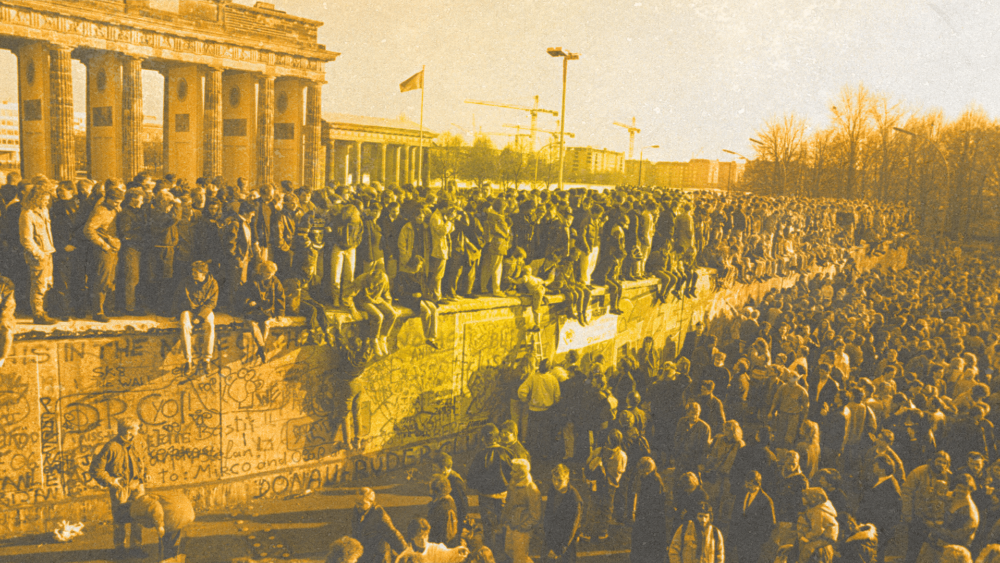
German Unity Day is meant to commemorate German reunification, which was ‘completed’ when the GDR joined the Federal Republic of Germany on October 3, 1990. At midnight from October 2-3, 1990, the newly founded East German states – Brandenburg, Mecklenburg-Western Pomerania, Saxony, Saxony-Anhalt and Thuringia as well as Berlin – joined in the scope of the Basic Law.
But was it a day of unity for all residents from both parts of Germany? No, at least it was not a day on which all residents were involved in deciding which constitution they would like to have. The accession of the newly founded East German states wasted a great opportunity: the drafting of a joint constitution by West and East Germans, which was and is actually provided for in West Germany’s Basic Law in the event of reunification.
As a result, neoliberalism began its triumphant march, meeting little resistance in the absence of systemic competition. East German state-owned enterprises were privatised in favour of West German capital at junk prices and in many cases simply closed down. The result: the economic and social decline of hundreds of thousands, mass unemployment, hopelessness and large migration movements from East to West.
Thus, the day of German unity is unfortunately a day for the few, namely those who were and are in possession of this capital. All this could have been avoided by a jointly elaborated constitution. If the people in both parts of Germany had been asked, the question of ownership would have been raised, especially by large industrial companies. For in the decades before there were also large protest movements in West Germany against the ruling policies.
In West Germany after the end of the war, for example, people were eager to expropriate war criminals and to distribute property fairly overall. “On 1 December 1946, 72 percent of the people of Hesse voted for the expropriation of large-scale industry. The citizens of Hesse had decided in favour of a true people’s constitution. In doing so, they were responding to the overwhelming will of all Germans. Wherever there were referendums on the same question in the same year, whether in Berlin, North Rhine-Westphalia or Saxony, between 70 and almost 80 per cent voted for common ownership of big industry.” (From Politikum 17 June by Daniela Dahn)
So, on the day of German unity, let us remember the many who fell by the wayside before and after the accession of the East German states and let us work for a democratic revolution. By means of a new constitution, and on a European level, the day of European unity can replace the day of German unity and become a day of unity for the many.
As the MERA25 Germany manifesto states: “Towards a European Republic: Europe must be democratised or it will disintegrate. Therefore, we advocate the further development of the European Union into a federal European Republic with the basic pillars of freedom as non-domination, legal equality, separation of powers and civil society participation. The citizens of Europe should be able to elect a common parliament and other legislative bodies. The regulatory framework should no longer be the nation state, but regions and cities. A constituent assembly should draw up and adopt a new social contract for the establishment of the European Republic.”
Do you want to be informed of DiEM25's actions? Sign up here