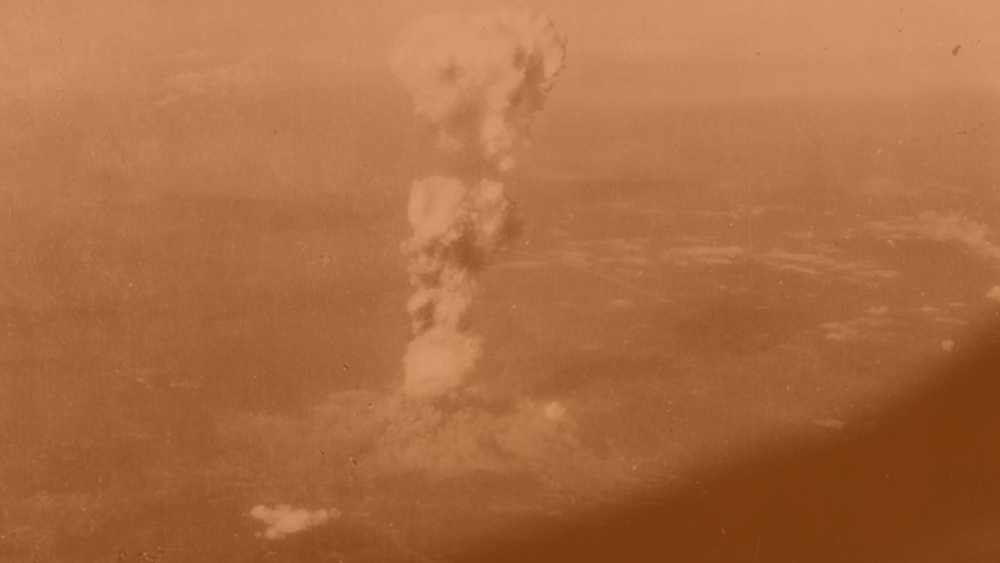
Eighty years after Hiroshima, nuclear weapons remain tools of imperial power, cloaked in the language of deterrence and self-defence
On 6 August 1945, the United States dropped an atomic bomb on the Japanese city of Hiroshima, aiming to force Japan’s surrender in the Second World War and to showcase the devastating power of nuclear weaponry. By the end of that year, more than 140,000 people had died – either instantly or from radiation exposure in the weeks and months that followed.
Roughly 70 per cent of the city’s buildings were destroyed. Tens of thousands more suffered long-term effects from radiation, including cancer, birth defects, and chronic illness. The psychological trauma and environmental damage endured for decades, shaping global consciousness around the catastrophic consequences of nuclear warfare.
But the bombing also carried a second message: a warning to the Soviet Union about America’s new military dominance. That geopolitical signal remains highly relevant today.
No accountability for Hiroshima and Nagasaki
The United States has never been held accountable for the destruction of Hiroshima – or for the atomic bombing of Nagasaki three days later, on 9 August 1945. Despite the immediate and long-lasting suffering inflicted on tens of thousands of civilians, the US has never faced legal repercussions or formal international condemnation.
Instead, these attacks were framed as unfortunate but necessary steps to end the war – a narrative shaped by the victors and still widely accepted in mainstream discourse. This lack of accountability is emblematic of a broader pattern: powerful nations often enjoy impunity for acts of mass destruction, especially when such acts are justified under the guise of military necessity. By failing to hold the US to account for deploying weapons of mass destruction against civilian populations, the international community set a dangerous precedent that undermines humanitarian law to this day.
Deterrence as a cover for nuclear dominance
Imperial powers continue to maintain their dominance through the threat of total annihilation posed by nuclear war. This threat is packaged as a “deterrent” to prevent escalation in geopolitical conflicts. Yet, no framework can guarantee that such weapons will be used “responsibly” – nor that deterrence itself works as intended.
In reality, nuclear deterrence functions as a shield for powerful states to act with impunity. The notion of “deterrence” merely obscures the fact that some states reserve the right to threaten mass destruction as a way of enforcing their interests.
The colonial and racist roots of nuclear power
The history of nuclear weapons is also steeped in colonialism and racism. Tests were routinely carried out in colonised or marginalised regions, often inhabited by Indigenous and non-white communities who lacked the political power to resist.
The US, France, and the UK deliberately chose remote territories under colonial rule – such as the Marshall Islands, French Polynesia, Algeria, South Africa, and Namibia – as testing grounds. Local populations were exposed to lethal radiation without consent, warning, or protection, highlighting the disposability with which their lives were treated. The resulting health crises, environmental degradation and lack of accountability reveal nuclear testing not just as a show of strength, but as a continuation of imperialist and racist practices.
The case for nuclear-weapon-free zones
No country should possess nuclear weapons.
The idea of nuclear-weapon-free zones (NWFZs) first emerged during the Cold War. The Treaty of Tlatelolco, signed in 1967, established Latin America and the Caribbean as the first such zone. Since then, similar treaties have been adopted across Africa, Southeast Asia, and the South Pacific, banning the development, deployment and testing of nuclear weapons and often including verification measures.
Germany, due to its NATO membership and participation in so-called “nuclear sharing” (which includes housing US nuclear weapons at Büchel Air Base), is not part of any NWFZ. Although Germany has ratified the Nuclear Non-Proliferation Treaty (NPT) and supports gradual disarmament, it has not signed the Treaty on the Prohibition of Nuclear Weapons (TPNW), claiming incompatibility with NATO commitments.
Nuclear imperialism today, and our position
Nuclear imperialism is not a relic of the past. In recent years, it has resurfaced in acts like Russia’s invasion of Ukraine and attacks on Iran by Israel and the US. The arms race is accelerating under the banner of “self-defence”, pulling more countries into the nuclear orbit.
In April 2024, Polish President Andrzej Duda publicly supported the stationing of nuclear weapons in Poland if NATO were to decide on it. Germany, too, is expanding its military capabilities, citing Russia as justification. These militarised states endanger their own populations, degrade public services, and funnel resources into weapons rather than social welfare.
We stand for global nuclear disarmament, against all forms of imperialism, and in solidarity with the right of peoples – especially in the Global South – to self-determination.
Hiroshima was not just a military strike – it was an imperial war crime with global consequences. It demonstrated how weapons of mass destruction are used to enforce geopolitical agendas. To this day, the impunity of the United States continues to legitimise the possession and potential use of nuclear arms by powerful states.
Nuclear deterrence is nothing more than global blackmail, rooted in a racist, colonial, and inhumane policy logic. Germany’s so-called “security” cannot be built on the threat of mass destruction – especially while more states openly embrace the idea of deploying nuclear weapons under the pretext of self-defence.
Germany, like others, is using Russia’s aggression as a pretext to increase military spending and deepen its participation in NATO’s nuclear strategy. Public funds are being diverted into the arms industry while essential services and infrastructure suffer. This does not protect the German population – it endangers them.
If we are serious about responsibility, justice, and peace, then we must fight for total nuclear disarmament. That’s why we call for a clear rejection of nuclear blackmail in Germany, and for a world free from imperialism, militarism, and violence.
Do you want to be informed of DiEM25's actions? Sign up here