


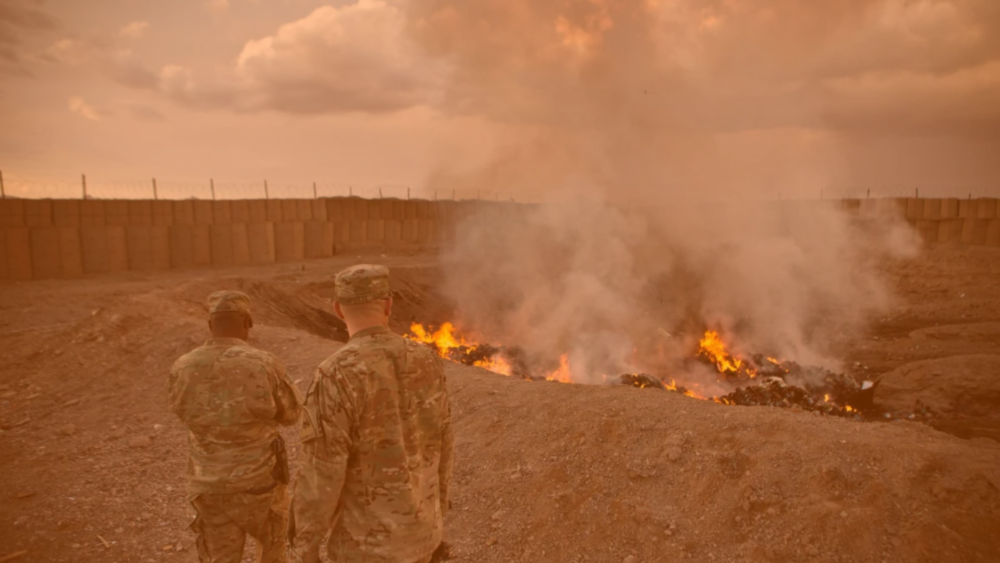
Militarisation is disastrous for the fight against climate change. Yet even “green” parties support increased military spending. This is despite the fact that armed forces as we know them today are too energy-intensive to fit within any serious climate policy.
It is unfortunate that the climate march on 26 October will not address militarisation, because the climate damage caused by war, armament and military exercises is enormous. At the same time, political parties that present themselves as “green” support massive militarisation, with a military budget that, according to Donald Trump and Mark Rutte, should rise to 3.5% of GDP, or 35 billion euro per year, plus an additional 1.5% for related matters. ‘Cabinet after cabinet chooses to spare major polluters instead of protecting people. It is up to us to change this,’ writes the climate coalition organising the climate march.
But apparently, the climate movement could also use a push in the right direction. To raise awareness about this issue, various peace groups are organising a peace block in the climate march. We call on the climate movement to put climate damage caused by militarism on the agenda and to demand that the government publish emissions data from the armed forces. In this article, you can read why this is important.
Green parties in favor of militarisation
War causes enormous human suffering, both among soldiers and civilians. This alone is reason enough to oppose war. However, war and militarisation have consequences that extend beyond the immediate suffering caused by armed conflict. One of these consequences is large-scale environmental and climate damage, which continues to claim victims long after the last shots have been fired, affecting people far beyond the original boundaries of the conflict.
Support for additional military spending is not limited to the cabinet, but is also backed by the left-wing opposition. Even “green” parliamentary parties—for whom demilitarisation was once a priority—are, remarkably, opting for a militaristic course. Under Frans Timmermans, GroenLinks-PvdA has decided to agree to increase military spending to 5% of GDP and is also continuing to pursue a militaristic course. At their congress last September, two motions from the internal group LinksBoven, which focused on countering militarisation, one of which had a green angle, were not even put to a vote.
The House of Representatives faction of the Party for the Animals (PvdD) has also decided to endorse additional spending. This change of course has torn the PvdD apart; there has been a split and an internal faction has emerged – the peace doves – which opposes the militaristic course. The SP and BIJ1, which do not profile themselves as particularly green, do speak out against militarisation. This raises the question of why this proves so difficult for ‘green’ parties.
Many peace and radical climate groups are watching this development with dismay. It is now even more important to put the effect of militarisation on the climate on the agenda, especially given the changing political landscape and broad political support for militarisation. This will make it possible to raise a counter voice to bring military spending in line with ambitious climate policy. Preferably starting with the upcoming climate march.
War and ecocide
At its core, war is a destructive activity. Groups of people do their utmost to impose their will on others through brute force. Since the industrial revolution, our ability to shape the world around us has increased exponentially, and with it the damage we can cause in war, whether intentionally or as a side effect. Environmental damage can sometimes have an impact for generations. A well-known example is the American use of Agent Orange, a chemical herbicide used in Vietnam to destroy the jungle where resistance fighters were hiding. Decades later, large areas of Vietnam are still contaminated with this substance. .
We can also find an example closer to home. The Zone Rouge in France is an area of originally 1,200 km2 that was so polluted with heavy metals, explosives, and gas grenades after the battles of the First World War that it was declared uninhabitable. 170 km2 of this area is still unusable to this day.
Unfortunately, environmental destruction as part of war is not confined to the history books. Ecocide, as the ultimate form of violence through the destruction of nature, is often used to make life impossible for people who depend on the land for their livelihood. In Gaza, pollution from bombing and targeted attacks on agriculture during the genocide have resulted in an estimated less than five percent of Gaza’s agricultural land remaining usable.
After all, you cannot starve people as long as they can grow their own food. Israel‘s destruction of olive trees and its policy of replacing indigenous flora with European exotics – so-called green colonialism – can also be classified as ecocide. Given the profound impact of such acts of war, there are international calls to add ecocide to the crimes that can be prosecuted by the International Criminal Court.
Military emissions
The connection with the climate is twofold. First, the goal of many wars and military missions is to gain control over raw materials, often fossil fuels. At the same time, the machinery of all these military activities also uses enormous amounts of fossil fuels, making them huge climate polluters.
The figures speak for themselves: in 2019, Scientists for Global Responsibility (SGR) and Conflict and Environment Observatory (CEObs) estimated that the military sector is responsible for approximately 5.5% of global greenhouse gas emissions. By way of comparison, according to the most recent (6th) Assessment Report of the International Panel for Climate Change (IPCC), emissions from air traffic, often identified as a major climate polluter, accounted for 1.9% of the total. That is less than half. If you add this to the 1.65% emissions from shipping, you end up with just under two-thirds of the military sector. If you were to put the entire military sector on the list of most polluting countries, it would rank fourth in terms of emissions in 2019, between India (6.8%) and Indonesia (3.9%).
Limitations due to lack of transparency
However, this is where we encounter a problem. Countries rarely report the emissions of their military sectors within the official frameworks of the IPCC. In the first climate agreement, the Kyoto Protocol of 1997, the military sector was granted an exemption thanks to the American lobby. The American army did not want to be restricted by agreements made in that protocol or any subsequent agreements. As a result, countries are not obliged to track and report military emissions. Most countries, including the Netherlands, therefore do not do this or do so only to a very limited extent. In fact, this also means that the military sector falls outside all binding agreements made at climate conferences. After all, it is impossible to monitor reductions in emissions if you do not measure them and, moreover, do not even know what those emissions were in the first place. This is despite the fact that the International Court of Justice recently advised in an explanatory note that damage caused by military activity falls under the responsibilities of states and their climate treaties. Incidentally, even after the Kyoto Protocol was watered down, the Americans never ratified this treaty.
As a result, tracking military emissions falls on the shoulders of independent research groups such as the SGR and the CEObs. They make estimates based on the limited figures that armed forces make public and small bits of data that, often hidden among other data, do end up in emissions reports. But they remain limited because much of the relevant data is not measured or shared, often under the guise of national security.
In addition, the above estimate by the SGR leaves much out of the picture; for example, the long-term consequences of warfare, such as damage to infrastructure (not only roads, but also oil storage facilities, for example), and emissions from reconstruction after destruction, are not taken into account. It is therefore likely that the actual contribution of the military sector to global emissions is higher than the estimated 5.5%.
Recent developments
The estimate of 5.5% also came from 2019, before Russia invaded Ukraine, Israel razed Gaza to the ground, and NATO countries decided to significantly increase their military budgets. If military emissions already accounted for 5.5% of global emissions before that, what should we expect with another active war, let alone if the heavily industrialised NATO countries expand their military budgets to 5% of GDP?
The SGR recently published a new study analysing the additional emissions that will result from extra military investment. Although this is complicated, they conclude that the extra money for NATO’s armed forces in the period 2019-2024 has led to 64 MtCO2e (more than Hungary’s annual emissions), and future investments are expected to lead to 132 MtCO2e annually (almost as much as the Netherlands). The SGR summarises: “It is extremely difficult to see how the planned increase in military spending can be reconciled with the transformative action needed to prevent dangerous climate change.” And that’s not even mentioning the disastrous consequences if this new Cold War were to break out, or the fact that increasing aggression undermines much-needed cooperation on climate research and measures.
In addition to the military sector being inextricably linked to environmental destruction, the armed forces as we know them are simply too energy-intensive to fit within serious climate policy.
A recent study by the Palestinian Institute for Climate Strategy (PICS) also shows that military operations lead to significant emissions. They calculated the climate reparations that Israel and its allies owe the Palestinians, including the emissions resulting from both the genocide in Gaza and the occupation of Palestinian land. Their conclusion: in addition to the unimaginable number of people Israel has already killed, Israeli occupation and war in the period 1948-2024 have led to 362 MtCO2e emissions, comparable to Italy’s annual emissions. The genocide in Gaza has led to 32 MtCO2e by January 2025, one-fifth of the Netherlands’ annual emissions. This is very substantial compared to the 81 MtCO2e that Israel itself reports annually. Not including emissions from military actions leads to a significant underreporting of greenhouse gas emissions by belligerent countries such as Israel.
The military sector is well aware of the problem and is looking for alternatives. In early 2023, the Ministry of Defense announced that it was conducting research into renewable fuels. They want to have a 30% share of these by 2030. According to the Air Force, 5% biofuel is being added to the fuel mix. However, such biofuels are very problematic in terms of land use. For example, the biofuel being considered by the British RAF, Hydrotreated Vegetable Oil (HVO), turns out not to be sustainable at all. Although it is largely plant-based and has a number of practical advantages, it turns out that palm oil and its by-products are the main components of HVO. And for those who may have missed it, palm oil plantations are one of the main causes of deforestation in the rainforests of Southeast Asia.
This points to an uncomfortable truth. In addition to the military sector being inextricably linked to environmental destruction, the armed forces as we know them are simply too energy-intensive to fit within serious climate policy.
Non-military security structures
For those willing to see it, the reality is very simple: if we want to keep our planet habitable, we simply cannot afford to resort to military “solutions.” War is always disastrous, but now that we are at a turning point in terms of climate change, it is even more important that we reject the increasing warmongering and build alternative ways to transform conflicts and guarantee security.
That may sound idealistic, but history offers many examples of disarmament treaties, such as the Chemical Weapons Convention. The UN also has the aforementioned Treaty on the Prohibition of Nuclear Weapons (TPNW), which countries should sign up to in order to work towards détente and confidence-building. The Netherlands has not signed this treaty and has even repeatedly voted against it in the UN General Assembly, even though 78% of Dutch people are in favor of the treaty, according to a 2020 YouGov poll.
Furthermore, the Netherlands could, for example, join The Hague Group, which is committed to strengthening international law with regard to Palestine. They could also work to strengthen and improve diplomatic solutions through, for example, the Organisation for Security and Cooperation in Europe (OSCE), a regional security organisation intended to promote cooperation for security within the European continent and prevent conflicts. In short, there are plenty of options for those who recognise that militarism is a dead end. And that is necessary, because for a livable planet, the climate movement can and must commit to demilitarisation.
Christian Menheere is a Master’s student in Climate Sciences in Wageningen. He is also active in DiEM25 and the New Peace Movement. This article was originally published by Jacobin.nl and has been republished with permission.
Thanks to Wendela de Vries (Stop Wapenhandel) for recommended sources and advice on the text.
*An earlier version stated that the motions from the top left concerning the UN Treaty on the Prohibition of Nuclear Weapons (TPNW) were not put to a vote, but these were other motions on demilitarisation.
Do you want to be informed of DiEM25's actions? Sign up here