

From Novi Sad’s concrete canopy to the ballot box, a generation forces Serbia to choose between silence and courage.
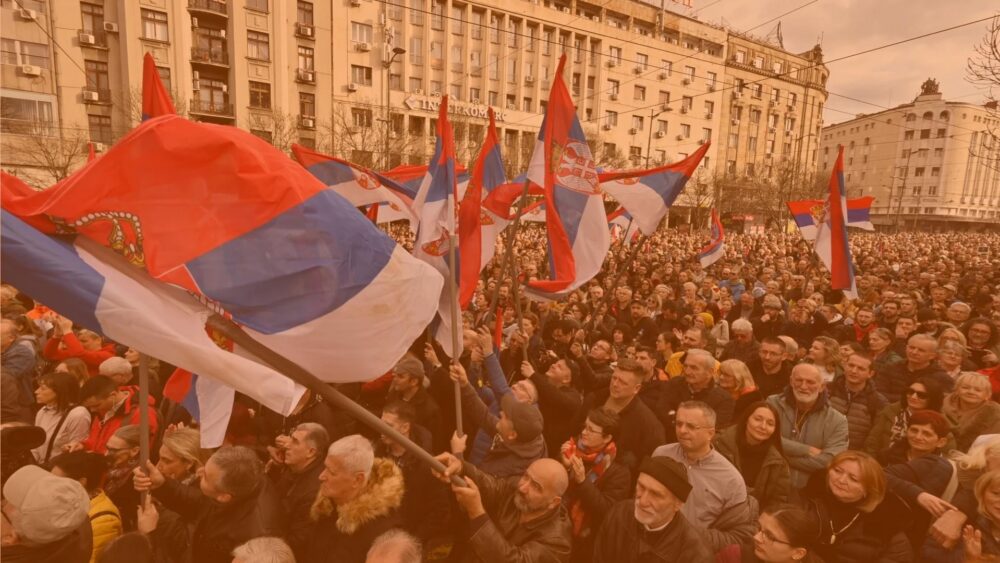
After nearly two years of brutal police crackdowns, bruised young bodies and souls, suffocating tension and a generation of students refusing to back off, the inevitable has finally happened: Aleksandar Vučić has called parliamentary elections for 25 October 2026.
For almost 24 months, our streets have echoed with grief and fury following the deaths under the concrete canopy of the Novi Sad railway station. That tragedy was not an accident; it was the fatal symptom of a system built on corruption, negligence and contempt for human life. Corruption has entered every pore of society, from ministries and courts down to faculties, local hospitals and public companies. Decades of decay will take generations – including this one – to understand and uproot.
When students stood up, blockaded faculties and filled the squares day after day, they did something veteran politicians had failed to do for 14 years: they stripped the regime of its narrative and exposed the raw machinery of autocracy behind the shiny façade of “stability” and “economic progress.” For years, elections have been held in the shadow of a captured media landscape and a fragmented, often co‑opted opposition, as many observers of previous election cycles have already noted.
From the outside, “two years of uprising” may sound abstract. For students, it has been a lifetime. They walked the walk and actually talked to people, instead of hiding behind rhetorical theory. They learned to expose propaganda, not just quote literary figures. Some were tear-gassed before their first mid-term exams. Instead of scaring them off, the repression made them shout even louder: you have blood on your hands.
I recognise that passion and courage. I have been politically active since I was 15 – more than 30 years of protests, campaigns and “historic moments” that were supposed to change everything. I support this student movement with every fibre of my being, not because youth is automatically virtuous, but because their stubborn authenticity has forced a crack in a monolithic wall. They brought humanity back into our public space, uniting unlikely allies around one simple principle: the system must work equally for everyone, regardless of party membership, family name or bank account.
And yet I am a chronic sceptic. In Serbia, scepticism isn’t cynicism, but rather a survival mechanism.
These elections must be understood for what they are: a referendum. On one side stands the students’ list, carrying the only genuinely new political energy this country has seen in years. On the other stands Vučić and the entire machinery of personalised power. The so‑called opposition now faces a simple moral test: withdraw and support the students’ list, or finally go where it has long belonged – the dumpster of our political history.
Precisely to prove they are not fighting for seats, students themselves are not on the list. The basic condition for standing was clear: you cannot be a student, and you cannot have been part of any power structure in any shape or form. The list was created democratically, through plenums, by checking and double-checking every candidate’s background. Names were kept secret until the end to avoid the usual media witch-hunt before the list was even announced. This is not an offer of careers; it is an offer of a clean break.
That clean break terrifies the marriage between the regime and corruption. With EXPO 2027 just around the corner – a final frontier for the great robbery and devastation of what is left of the country – with contracts worth billions with ELBIT, Chinese-made robots of the kind now banned in the USA, and the quiet sell-off of our land to satisfy the EU’s hunger for lithium, they have a lot to lose. A scared, wounded beast is most dangerous when it feels threatened, and this regime is exactly that.
On the outside, Vučić plays the EU’s good boy. At home, his para‑formations warmonger and normalise the language of racism and war, emboldened by the death of Ratko Mladić, a convicted war criminal now recast as a martyr in their narratives. One face for Brussels, another for the darkest corners of our own history.
The student‑backed list walks an impossible tightrope. They carry the immense, and frankly unfair, weight of a society’s hope. People whisper “now or never,” projecting onto these new leaders a salvation no movement can deliver. The danger lies in the translation from the moral clarity of the street to the muddy, compromise‑ridden arena of politics. How do you stay untainted in a system built to co‑opt and corrupt? How do you preserve horizontal solidarity when institutions demand vertical hierarchies?
Here, my support and my scepticism collide. I’ve seen too many waves of hope dissolve into backroom deals. I fear the psychological crash if the results disappoint: the devastating sentence, “We tried, nothing changed,” followed by a one‑way ticket out of the country and apathy for those who stay.
And yet, despite all these traps, we cannot afford to sit this one out.
These elections will not be a fair contest – everyone knows the playing field is tilted. That is exactly why we need election observers and reporters at every single polling station, every ballot box, every count. Still, these elections are an arena where pressure can be measured, presence asserted and a message sent: an entire generation refuses to be governed by fear.
Students have already achieved something irreversible. Politics is not confined to a hijacked parliament; it lives in faculty corridors, plenums, citizens’ assemblies, polluted rivers, unaffordable rents, and in every quiet attempt to silence dissent.
As we head toward 25 October, my hope is cautious, but it is real. Whether this election triggers a seismic political shift or simply marks another trench in a long war for our democracy, one thing is certain: whatever happens at the ballot box, the space for human‑centred civic action has been carved out by these students at great personal cost. We must pledge that no regime – no matter how brutal – will ever silence us again.
Do you want to be informed of DiEM25's actions? Sign up here