


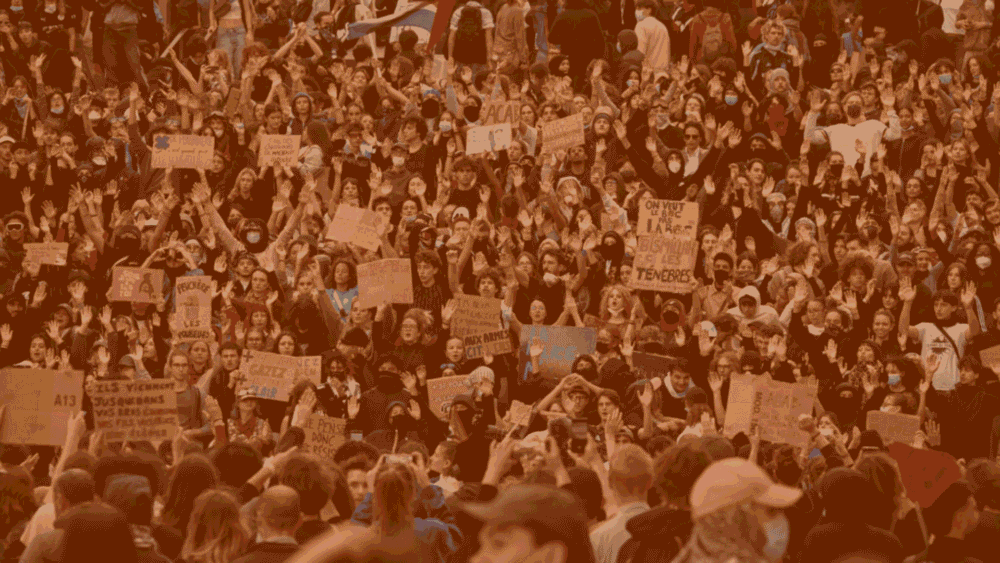
Belgium, Spain, Italy, France… a generation rises against a failing system
The situation in France is resonating in several other countries across the continent, shaken by nascent youth mobilisations following in the footsteps of French high school students. Debt, the dismantling of public services, militarisation, and the subjugation of youth: the projects of Europe’s oligarchs and the governments that serve them are facing the first signs of a promising resistance.
For several weeks, hundreds of thousands of high school students in France have been mobilising against the deterioration of their studying and living conditions, with numerous blockades of universities, campuses, higher education institutions, and other initiatives.
Students and high schoolers are demanding the abolition of Parcoursup (the French university admissions platform), the allocation of 10 billion euros in funding to meet their demands, and are joining the demands of workers and union members mobilised for wage increases, price freezes, and other proposals to combat the high cost of living.
Their demands resonate widely within the social movement, which already shares these aspirations: investments in education and public services, taxation of the wealthiest, and the end of the Fifth Republic.
Far from being isolated, this massive, radical phenomenon, reminiscent of a “Great Refusal,” sweeping through the country’s youth, is part of a broader European dynamic.
The old continent is beginning to tremble to the rhythm of youth revolts in German, Belgian, Italian, French, and Spanish high schools. And although these movements are not all on the same scale, they echo the deeper malaise affecting entire segments of the working class in their countries. Whether consciously or not, this internationalist convergence of youth is showing the way to fight against the bleak future that capitalism has in store for them in the years to come.
Belgium student movement against budget cuts and austerity
In Belgium, high schools in several cities have been blockaded since October 1, and hundreds of young people have chosen to follow the example of their French neighbours by mobilising for the same reasons. In Liège, the high school student movement was particularly dynamic. The students are denouncing the reforms of the Wallonia-Brussels Federation government, notably the €500 million in savings planned for education by 2029 in order to reduce the budget deficit. This attack is taking place in the context of an increase in the federal budget for armaments and militarisation. Among the attacks denounced by the high school students, the increase in tuition fees for higher education and the increase in teachers’ required teaching hours, without a salary increase, are causing outrage.
These attacks on teachers’ working conditions are masked by the budgetary policies of the federation and the federal government. Similarly, the Belgian federal government’s military budget has increased from 0.9% of GDP in 2023 to 2% of GDP in 2025 and is expected to reach 2.5% by 2034. These colossal sums are intended to purchase F-35s and other heavy weapons, as well as to finance a general increase in military personnel.
In Italy, too, the influence of the French protests is also evident. Italian youth have enthusiastically embraced the French protests. Occupations of high schools began on October 5 in Turin and Rome with the slogan “Let’s do as in France.” From October 16th, the movement spread to Milan, Naples, Genoa, and Bologna. In the capital, several higher education institutions in Rome were occupied, to denounce the deteriorating study conditions and the militarisation of the system. Students are protesting the state of the buildings and the measures that limit the number of foreign students per class. They are demanding that the state spend more on education and less on armaments, given that European rearmament is partly financed by cuts to public services
But the movement is primarily motivated by its own specific characteristics within the Italian political situation, since the government is seeking to pass a law to “combat antisemitism” that aims to equate criticism of the Israeli government with antisemitism.
This law, considered a “gag law” by Amnesty International, has sparked protests at the Cavour High School, directly echoing the massive mobilisations that took place between September and October 2025 against the genocide in Palestine. The ongoing occupations are also coordinating with Italian workers, against the war and the high cost of living, in conjunction with the USB trade union. This convergence between workers and students demonstrates that it is not only possible to push back Meloni’s pro-genocide far right—whose foreign policy is now under mass scrutiny—but that the alliance of high school students, university students, and workers opens up enormous possibilities.
In Greece, the housing issue is paramount. Since October 13, students have been occupying Syntagma Square in Athens to protest the rising cost of living, particularly student housing.
In Ireland, over 1,500 students demonstrated in Dublin on October 1 against the cost of living and university fees.
In Portugal and Spain, housing protests took place in Lisbon, Porto, and Barcelona, a city particularly hard hit by overtourism and the housing crisis. In Spain, young people are increasingly mobilising against vulture funds and speculative real estate investment. Really, young people in Spain have been waging a fierce battle for several weeks against another manifestation of capitalism’s decadence: the “rent-seeking” of large real estate groups and pension funds that are evicting thousands of working-class people and preventing young people from accessing decent living conditions. The eviction of an 87-year-old woman from the apartment where she had lived since 1956, after it was bought by a vulture fund, sparked the movement. She was seen by a large segment of Spanish youth as the victim of a profoundly unjust system where large real estate groups decide the fate of millions of people.
In Germany, the high school student movement is fighting against militarisation.
In Germany, where the high school student movement has been forging its path against militarisation for several months, 50,000 high school students demonstrated across the country on September 25 against the return of compulsory military service and the remilitarisation of the country desired by the ruling classes. Building on this momentum and in connection with trends across the continent, a call for an international youth strike against militarisation, the rise of the far right, and genocide has been launched for November 20. An internationalist convergence of youth against the projects of the European elite classes.
In Tirana, the capital of Albania, the movement began with a conflict over a real estate project. The protests started in May, the day after a demonstrator was assaulted by private security guards in Zvërnec, where residents were opposing a luxury tourism project in a protected area, linked to Jared Kushner, Donald Trump‘s son-in-law. Students joined the movement in mid-October, with their own demands regarding tuition fees and study conditions. Prime Minister Edi Rama asserted that it was “not a student phenomenon” and blamed “foreign interference”.
This wave sweeping through the major capitalist countries of continental Europe expresses something very profound. It goes beyond a simple, short-term reaction to a government offensive; it reflects a strong trend toward youth mobilisation against the society they inhabit and the future being imposed upon them by the ruling classes. In Spain, Germany, Italy, France, and Belgium, while European youth mobilisations may be based on different demands, they all denounce the same exhausted capitalist system, incapable of offering the slightest prospect of emancipation for the continent’s youth.
Faced with militarisation, war, genocide, and the complicity of imperialist states, how can anyone believe for a second the rhetoric that presents the current situation as ideal, when it is in fact the product of the political, economic, and moral decay of neoliberal bourgeois society?
What’s happening in Europe shows just how absurd the right wing’s cries of outrage are. For weeks, they’ve been claiming that the movement is being orchestrated behind the scenes by “La France Insoumise”, the self-proclaimed leader of the “far left”. Yet, the same demands concerning education, the cost of living, and housing are emerging simultaneously in Liège, Turin, Athens, and Tirana, where Jean-Luc Mélenchon is clearly not sending holograms to command the troops. There is obviously no conspiracy: just a generation of young people across Europe facing the same problems and rejecting capitalism as the end of history.
This sequence also shows us that the courage and determination of some can empower others, far beyond their own country. This implies ensuring that the movement is not only radical in its slogans but also constantly striving to broaden its reach as much as possible among the masses, by choosing majority-supporting modes of action and continuing to spread hope and optimism.
The ongoing mobilisations of European youth must now find a path to alliance with the continent’s working class, which can propel their aspirations and demands forward by building a decisive balance of power through strikes, self-organisation, and the methods of class struggle.
Do you want to be informed of DiEM25's actions? Sign up here