


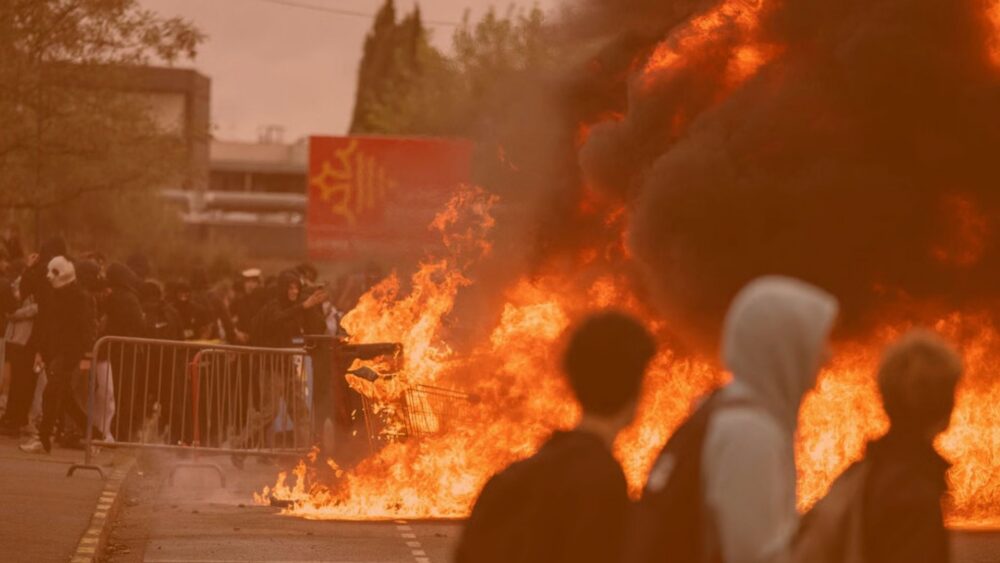
The student revolts began in Paris’s banlieues and are now spreading throughout the country. Scenes of peaceful protests have sprung up everywhere, with students demanding better conditions. But the intensity of the police violence in response is shocking beyond measure.
French students are taking to the streets to express their anger at a system that gives them unequal opportunities and offers little hope for the future.
What started as a desperate cry for help in some of the most run-down schools in the country – we’re talking rats in the corridors, no drinking water and ceilings falling to the floor, etc. – has now spread to many secondary schools across France. Students are organising blockades outside their schools in support of those in the aforementioned schools, but also with new demands of their own, such as the hiring of more teachers to ensure that all classes can take place. Indeed, 10% of class hours were not taught last year because absent teachers were not replaced (as there are now almost no substitute teachers left), and more than 50% of schools in the country started the school year with at least one teacher missing.
Following the “Blanquer reform” of 2019 (named after the education minister at the time), it is now common for 16-year-olds to be at school from 8 a.m. to 6 p.m., with only a few breaks during the day and barely any time to eat. In some areas, they may also have to spend up to an hour travelling to and from school, while still being expected to do one to two hours of homework a day. The system has become destructive for students, teachers and everyone working in schools, contributing to the worrying figure of almost 10% of young people having had suicidal thoughts in the previous year.
Students are also demanding the abolition of the Parcoursup platform, introduced in 2018 by Emmanuel Macron and Jean-Michel Blanquer as an online system for applying to universities and other higher education institutions. It puts enormous pressure on young people to satisfy an opaque algorithm that goes on to shape their futures. In July 2026, 120,000 students had not received an offer of a place through the platform for the following academic year, including 60,000 who had just finished high school.
Police violence
What makes these revolts stand out, though, is the violence used by the police to repress the demonstrators. French social media is now flooded with videos of teenagers being beaten while lying on the ground, shot at with grenade launchers and suffocating after tear gas is deployed in quantities that most adults have never experienced at a demonstration.
One young demonstrator has already lost an eye; another has lost his teeth and will spend months receiving treatment to rebuild his jawbone. Meanwhile, more and more videos of teenagers being strangled and beaten are being posted, and we recently learnt that another teenager had lost his hand.
Most people are no longer asking themselves whether someone will die, but when.
Teachers are joining the fight
Teachers, as well as elected representatives, are already joining their students on the streets. They are teaching them the basics of protecting themselves against tear gas and, in some cases, putting their own bodies between the police and the children. In many places, unions have joined forces to monitor and report police violence, as well as protect young people. Teacher unions have now called for strikes in support of the youth revolt.
The demands put forward by the youth movements are the same ones teachers have been fighting for for years, ever since Macron took power and embarked on a crusade to destroy what remains of France’s public services.
On Thursday, October 1, Prime Minister Sébastien Lecornu announced that, starting next year, students wishing to study for the Higher National Diploma (the “BTS” in French) would have to pay registration fees. The announcement was such a provocation amid a revolt of this scale that the education minister, Édouard Geffray (who worked for Jean-Michel Blanquer), had to backtrack that very same evening.
October 6 saw a powerful show of solidarity between students and workers, with more than 200,000 people taking to the streets. French people are now anticipating October 17 as the return of the Gilets Jaunes (Yellow Vests), whose movement made the president flinch in 2019 and 2020, only to be halted by the Covid-19 pandemic.
We can expect mobilisation to grow in the coming days, as issues such as the deterioration of public services and declining purchasing power are also becoming increasingly prominent sources of discontent across the country.
Do you want to be informed of DiEM25's actions? Sign up here