








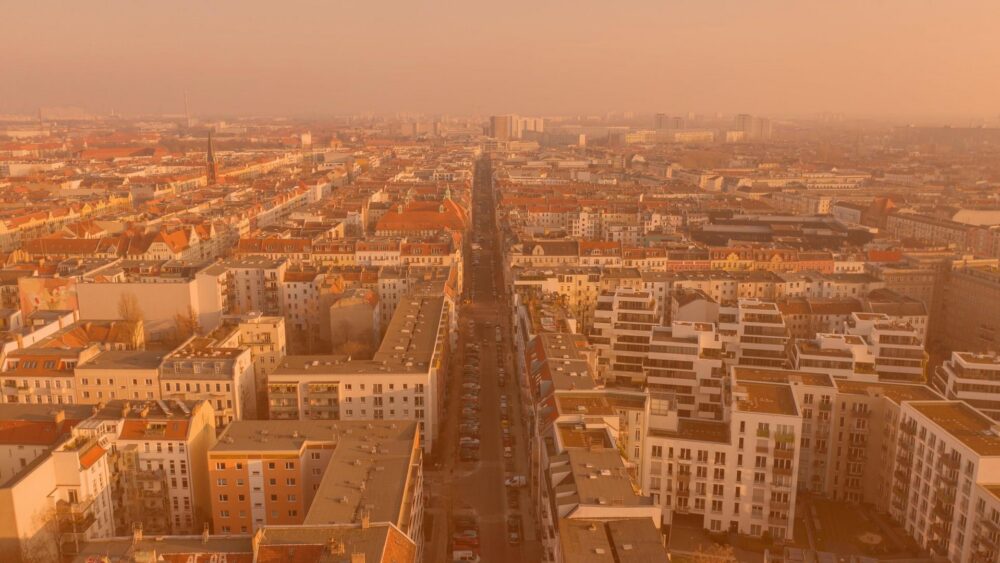
Die Linke won the most votes in the German capital on housing. Can its vision survive coalition talks, the courts, and the budget?
Across Europe, the right to housing has become an unavoidable social and political issue. As rents continue to outpace incomes, “big city life” increasingly feels like a privilege out of reach for young people, working households and the middle classes. Yet its structural causes remain inadequately addressed at the institutional level.
In Barcelona, police cleared an emblematic housing protest encampment in Plaça de Catalunya on November 16. The resentment towards mass tourism is palpable across the city, reflecting a deeper conflict in which gentrification undermines urban life. In Milan, students priced out of accommodation took to the streets again in September, setting up tents at the State University to protest unaffordable rents and the lack of accessible housing solutions, with the Meloni government unable to provide any vision of a sustainable future.
Different realities, one common grievance: Berlin is no exception. Once associated with relatively budget-friendly rents and an alternative urban culture, the German capital witnessed a sharp deterioration in its housing market over the last decade. In a city where about 85% of households are tenants, median advertised rents rose more than 75% between 2016 and 2025. For many, finding an apartment is no longer simply a matter of choosing where to live, but of whether they can remain at all. Berlin’s long history of housing activism is often summed up in the slogan “Wir bleiben alle” (we all stay), affirming the right to collectively belong in one’s neighbourhood and resist displacement: a promise that Berliners now see being contradicted in their daily lives.
Participating in social and economic life regardless of purchasing power was one of the defining issues of Berlin’s September 20 state election, in which Die Linke emerged as the largest party. Having openly campaigned against large private housing portfolios, the democratic socialist force now faces the challenge of translating such ambition into policy, confronting legal, financial and practical constraints.
Die Linke’s proposal
Elif Eralp, Die Linke’s lead candidate, built her political identity on being relatable to the communities she seeks to represent. Presenting herself as the face of a different Germany, set against the growing AfD and the declining CDU, she drew on her own experience to frame the city’s housing crisis. Despite being a well-paid member of Berlin’s state parliament, she openly says she spent years looking for a suitable flat. Eralp’s story shows how far the crisis has reached beyond traditionally disadvantaged households. Her posters showed her wearing a gold nameplate necklace reading Mietendeckel (rent cap), a nod to the cap the capital once tried and lost in court. The election campaign borrowed from New York’s door-to-door canvassing techniques and effective social media communication, putting the cost of living at its core: a clear à la Mamdani strategy.
The message was that housing should be a basic human right, not a commodity whose accessibility depends on spending power. The answer at its centre was socialisation. Die Linke pledged to bring into public ownership roughly 220,000 Berlin flats held by large private landlords such as Vonovia and Heimstaden, both of which own more than 3,000 homes. According to the proposal, these properties would be removed from speculative investment and transferred to a public-law body under a form of democratically accountable management. The stated aim is to bring rents under greater public control and redirect money now flowing to shareholders into lower rents and better maintenance. The state already owns about 400,000 flats through its own housing companies, roughly one in four in the city. The programme also promised 75,000 permanently affordable homes over ten years, more investment in the municipal housing companies, and a Secure Housing Law establishing affordability requirements for new lettings, backed by tougher enforcement against illegal rent rises.
The 25.7% vote share in the September election suggests that the framing resonated with Berliners, its appeal lying in its simplicity. Instead of regulating a market that keeps outwitting regulation, socialisation asks who ultimately profits from rent. Eralp did not have to reinvent the wheel: already in 2021, 59.1% of voters backed a local referendum to transfer large landlords’ housing into public ownership. Die Linke promised to deliver a popular verdict already given, and voters noticed. About 34% named it the party best placed to tackle the housing crisis. With Berlin’s state government still to be formed, what remains to be seen is how much of this survives the coalition talks.
Reality check
After the election, the campaign’s promises met the coalition table. Die Linke, the Greens and the SPD began coalition talks in early November, and the first two together hold 70 of 153 seats, short of the 77 needed. Their preliminary agreement already narrows the pledge: socialisation would apply only to companies with more than 10,000 flats, covering about 160,000 homes from five firms, not before 2029, with cooperatives, non-profit companies, and homes built since 2021 exempt. Within this scenario, the indispensable SPD remains the most sceptical partner: its leader Steffen Krach stressed that his own view has not changed, and 20 SPD members of the Bundestag spoke out against talks under current conditions.
Then comes the legal framework. Article 15 of the Basic Law, which allows land and means of production to be transferred to public ownership against compensation, has never been applied in practice. Although the plan could be legally feasible, a challenge before the Constitutional Court is widely expected. The federal government has already threatened a national law to block it; Vonovia, one of the clear targets, itself states that the plan as drafted would not withstand judicial review. Berlin knows the risk: its 2021 rent cap fell for exceeding the city’s competences. Money is the other limit. The preliminary agreement caps compensation at €16 billion, to be financed by loans and repaid through rents. The companies put the bill at up to €29 billion, and critics expect the below-market sum to be challenged in court, in a city already facing a budget deficit of about €4.6 billion this year.
Even measures within the state’s own reach are contested. After the election, the state housing companies raised rents for about 90,000 households, within agreed limits, although Die Linke had demanded a rent cap for them. The preliminary agreement does include such a measure for state-owned flats, which will show how far the promise can travel.
The appeal of socialisation is more evident than ever. Whether it can become policy depends on a law that survives the courts, a budget that can pay for it and, above all, enough homes for “we all stay” to be more than a slogan. In a city where the housing crisis is tangible and translates into a shared trauma, the question of who owns Berlin remains. Once divided by the Wall, and later a safe harbour for many, the capital must now decide whether the right to housing can be guaranteed in practice. That choice will define its trajectory.
Do you want to be informed of DiEM25's actions? Sign up here