

The chains of slavery and colonial oppression are not cut through with apologies. Words without deeds can’t undo the legacy of colonialism. Justice without reparations and radical rethinking of the power structures from a truly global, decolonial perspective is mere moral whitewashing. We don’t need comma’s. We need full sentences.
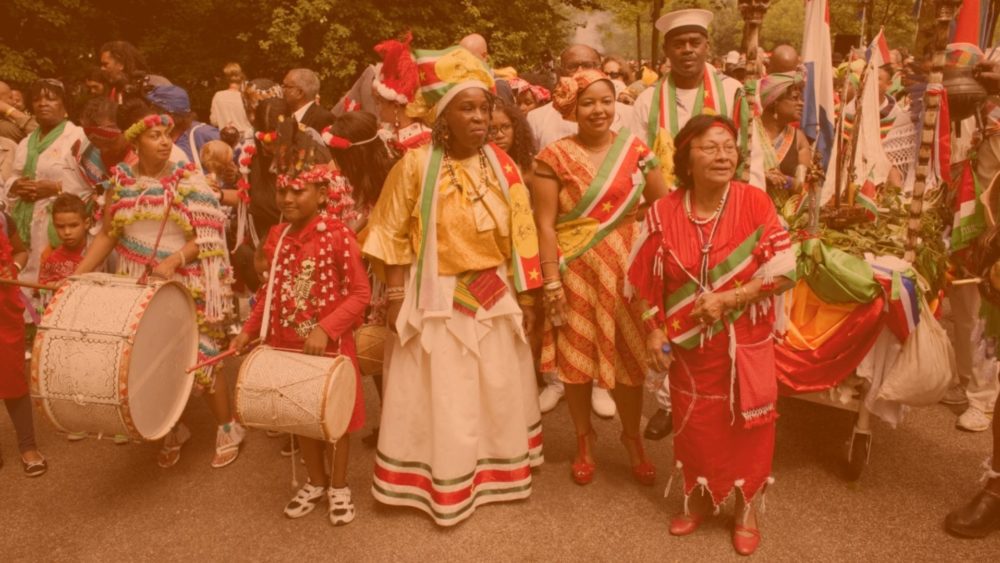
On July 1, the Netherlands celebrates Keti Koti – the breaking of the chains. At least, that’s what we do on paper. Because even on this most symbolic point, the Dutch state still tells an uncomfortable lie: the official date of the abolition of slavery in Suriname was July 1, 1863, but those who had been enslaved still had to perform ten years of forced labour before they were truly free. Even our celebrations are built on a half-truth.
A century and a half later, another half-truth: the expressions of regret. First, Mark Rutte, who assured us that his government’s apology was a “comma” – the beginning of a process to truly confront the colonial past. Then King Willem-Alexander, who acknowledged in solemn language what every descendant of enslaved people had long known: that the Netherlands built its wealth on a crime against humanity. And now, most recently, Rob Jetten, the new prime minister, has apologised to the Moluccan community for the betrayal and neglect after the Netherlands first deployed them as colonial auxiliary troops, then abandoned them to cold barracks and moral oblivion.
Three apologies. Three carefully staged moments of national introspection. And three times the same pattern: tears on Dam Square, nothing in the national budget.
The eternal comma of The Hague
Rutte called his apology a “comma.” The problem isn’t that he inserted a comma. The problem is that the Dutch state hasn’t finished a single sentence since then.
Anyone who reads the CARICOM Ten-Point Plan for Reparatory Justice – the Caribbean roadmap for reparations – can see with crystal clarity what’s missing. Not the words, but the actions. CARICOM does indeed begin with an apology, but it doesn’t stop there. It’s about reparations as a political project: from formal recognition to the return of cultural heritage, from debt relief to technology transfer, from public infrastructure to financial compensation. Not as charity, but as a right. Not as symbolism, but as a redistribution of power and resources.
DiEM25 has therefore decided to embrace the Repair Campaign and the CARICOM plan. Under Caribbean leadership it has a clear premise: Colonialism was not a moral error “from a bygone era,” but an unpaid bill in the present. Apologies can be a start, but only if they are linked to a binding process of restitution, reparations, and redistribution.
The Netherlands is doing the opposite. We are given apologies without any mechanism. A moral admission of guilt without financial or institutional consequences. A comma without a verb.
The Moluccans and imperialism’s disposable troops
The recent apologies to the Moluccan community fit seamlessly into this pattern. First the crime, then the myth.
The crime: The Netherlands recruited Moluccan soldiers for the Royal Dutch East Indies Army (KNIL), deployed them against the Indonesian struggle for independence, and then brought them—often under false pretenses, and certainly without any freedom of choice – to the Netherlands to supposedly protect them from the revenge of their former compatriots. Once here, they were herded into camps and former Nazi concentration camps, deprived of full rights, with no recognition of their service, and faced with broken promises regarding their return and the formation of a state.
The myth: that the Netherlands, however clumsy, always had “good intentions.” As if the colonial apparatus accidentally rounded up, displaced, exploited, and discarded people. As if racial hierarchy and military expediency were not a deliberate structure, but a tragic misunderstanding.
A few years ago we saw the same imperial playbook being used in Afghanistan. The interpreters, drivers, cooks, and support staff who worked for NATO troops were led to believe that “the West” would not abandon them. When the last planes left, thousands were left behind, declared outlaws. A small number were eventually brought to Europe in hasty evacuations—where they often ended up in asylum reception centers, facing legal uncertainty and stigma. The rest have been written off.
This is not a tragic coincidence. It is standard practice for imperialist powers: auxiliary troops are disposable. Useful as long as they protect the empire, expendable as soon as they threaten to become inconvenient witnesses.
The West’s intoxication with superiority
The hypocrisy of the Dutch apology fits into a broader pattern of Western arrogance. The West invariably presents itself as a moral superpower: champion of human rights, democracy, and international law. Meanwhile, the global system still revolves around the same axis upon which colonialism was built.
Colonialism was not an isolated incident, but an economic order: genocide, slavery, land theft, forced labour, and the plundering of natural resources. With the formal end of the colonial empires, the flags disappeared, but not the structures. The chains of the International Monetary Fund and the World Bank have replaced the chains on the plantations. Where ships once departed laden with sugar, cotton, and people, containers now depart filled with raw materials, profits, and interest income. Where once the governor-general was in command, “structural adjustment programs,” free trade agreements, and unilateral sanctions now do the work.
The European Union and the United States use Unilateral Coercive Sanctions to force governments in the Global South to open their markets, subject their budgets to external dictates, and make their populations bear the costs of “stability.” Development projects expropriate land, break up communities, and destroy ecosystems, often under the green guise of “conservation” or “climate compensation.” The same continents that have been plundered for centuries are now also saddled with the burden of climate change and debt.
And then Europe comes along with moralistic speeches about human rights, while refusing to ratify the International Convention on the Rights of Migrant Workers. All the while, it militarises its borders and lets people drown in the Mediterranean Sea. While it cancels debts for banks, but not for countries that are still bleeding from colonial wounds.
In that landscape, apologies without reparations are not a humble acknowledgment, but a form of moral whitewashing. An attempt to polish up the image of the old empire at little cost.
What true reparations would require
What would it mean if the Netherlands took its own words seriously? If “apologies” were not the end, but the beginning of policy?
First: a binding process of acknowledgment and restitution. Not one-off speeches, but legislation. The CARICOM Ten-Point Plan as a minimum framework. An independent commission, led by affected communities, with a mandate and budget to shape cultural and material restitution. The return of looted heritage. Complete and transparent archives. Recognition of land rights where they have been taken away.
Second: financial and structural reparations. Debt relief for former colonies still trapped in imperialist debt regimes. Climate reparations for the ecological damage resulting from centuries of extraction and contemporary neo-colonial exploitation. Public investment in education, healthcare, infrastructure, and technology transfer, under the democratic control of the affected communities – not of consultants in The Hague or Brussels.
Third: decolonisation of the homeland. A radical reform of education and the media, in which colonialism is not portrayed as a “footnote to the Golden Age” but as the backbone of Dutch prosperity. Space for non-European voices, languages, and histories. Fair representation of the contributions of indigenous peoples, enslaved people, workers, and migrants to the world as we know it today. A systematic dismantling of racist and xenophobic narratives, not just through nice campaigns, but by redistributing power in newsrooms, boards, and curricula.
Fourth: protection of migrants’ rights and an end to the regime of hierarchical mobility. Ratification of the Migrant Workers Convention, as also demanded in the DiEM25 Migration Policy. An end to policies that allow people from the Global South only as cheap, disenfranchised labour – in meat processing, distribution centers, and seasonal agriculture—but deny them full citizenship with political and social rights.
Fifth: a break with neo-imperial foreign policy. Stop imposing unilateral sanctions. No participation in “humanitarian” interventions that primarily serve to secure raw materials and spheres of influence. Support for a global anti-imperialist commission that reins in multinationals, trade agreements, and institutions such as the IMF and the World Bank.
None of this is compatible with the Netherlands’ current role as a well-behaved vassal within the Western power structure. And so it will not happen.
The task of progressives in Netherlands and Europe
What should the progressive political forces do in a country that likes to see itself as a “moral guide” but refuses to pay the price of justice?
To begin with: refuse to be swayed by the language of the comma. Do not go along with the narrative that “we’re on our way,” that “it takes time,” that “the country isn’t ready for reparations yet.” These are not neutral observations, but political choices. Every day that reparations are delayed is a day on which the colonial order persists in new forms.
The task of the progressives is not to applaud royal apologies, but to ask the counter-question: where is the budget? Where is the law? Where is the redistribution? And if these are lacking: what, then, is the value of these words?
At the same time, the progressives must not separate the struggle against racism and colonial legacies from the struggle against class divisions and imperialist structures. That was precisely the mistake of the social-democratic middle ground: condemning discrimination while leaving the underpinning economic order untouched. As a result, the anger of the exploited classes in the North was hijacked by a xenophobic right wing that pitted “our own people” against migrants, refugees, and the descendants of colonial oppression.
The only credible path forward is a unified agenda: anti-racism as the cornerstone of a broader anti-imperialist and anti-capitalist project. Reparations not only for slavery and colonialism, but also for contemporary plunder through debt, free trade agreements, and sanctions. An internationalism that does not stem from “Western values,” but from the shared interests of exploited classes in both the North and the South.
For the Netherlands, this means, in concrete terms: aligning with the Repair Campaign, embracing the CARICOM plan, and waging the struggle for the decolonisation of migration policy, education, media, and the economy as a single, unified effort. Not as an identitarian niche, but as the core of any progressive program worthy of the name.
Returning the comma
On July 1, politicians will once again deliver solemn speeches about Keti Koti. About “a dark chapter” that we “must face together.” About “connection” and “living together.” The prime minister will present himself as progressive, the king as empathetic, and the talk shows as understanding.
Let them keep their comma. We need full sentences.
Sentences in which “apologies” are inextricably linked to “reparations.” Sentences in which the Moluccan veterans and their children receive not just sympathy, but the right to redress. Sentences in which Keti Koti is no longer the folkloric finale of a year full of racist police actions, ever-tightening migration laws and structurally racist cuts on social securities, but an annual benchmark for what has truly changed in law, budget, and power.
Until then, the chains have not been broken, but merely shifted: from the slave ship to the burden of debt, from the plantation to the distribution center, from the concentration camp to the asylum seekers’ center.
The task of the progressives, in the Netherlands and beyond, is clear: not to go along with the minutiae of colonialism, but to insist on the crux of the matter, that inevitable break: the recognition that there can be no just future without genuine restitution, without a radical rethinking of property, borders, and power.
Keti Koti deserves nothing less.
Do you want to be informed of DiEM25's actions? Sign up here