


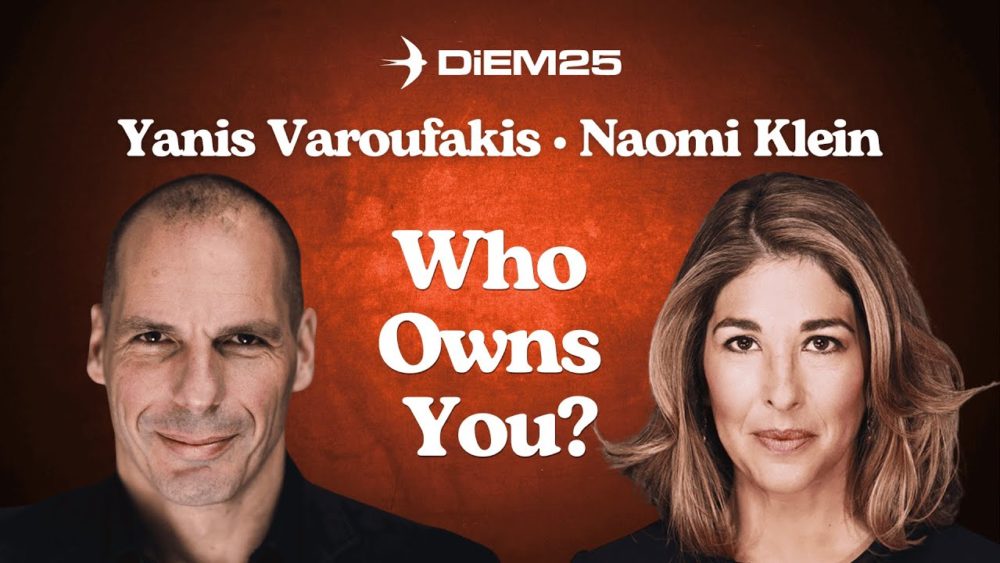
From AI doppelgangers to platform power, Naomi Klein and Yanis Varoufakis explore how tech giants are reshaping democracy, truth and public life itself
In a recent DiEM25 livestream hosted by Mehran Khalili, Yanis Varoufakis was joined by journalist and author Naomi Klein for a discussion that began with something strangely personal and quickly expanded into a diagnosis of our political era: what happens when you no longer control your own identity.
Varoufakis has recently found himself dealing with two parallel experiences. On the one hand, deepfake videos of him have circulated online and gathered millions of views. On the other, Greek authorities have revived decades-old remarks to justify police harassment. Different phenomena – but linked by the same question: who gets to define who you are?
As Klein noted, this is not limited to public figures. Anyone speaking publicly – activists, organisers, writers – now risks being replaced by a manipulated version of themselves.
Meeting your digital double
Varoufakis described the surreal moment he realised a viral video of “him” was not actually him.
“A BBC producer messaged me saying they’d watched a talk I gave on YouTube and wanted to interview me. I clicked the link and to my horror, it wasn’t me. It was a deepfake AI version of me.”
The sophistication was alarming. “I was convinced I was going senile because it was saying things I would have said – until suddenly it inserted something I would never say, something my enemies could easily use to defame me.”
Klein explained she had anticipated this phenomenon while writing Doppelgänger.
“I had the feeling we were all going to be battling our digital doppelgängers soon enough… They already trained AI on our books and everything we’ve ever said. The data was the doppelgänger waiting to happen.”
The business model of identity theft
Varoufakis attempted to have the videos removed.
“I wrote to Google because most of the fakes were on YouTube. They asked for forms, then more forms… Eventually they removed them – and within 25 seconds the same videos appeared again on another channel.”
He concluded the problem is structural. “My AI fakes had more views than the real me. That is their business model… Now we don’t even own our audiovisual image.”
Klein linked this to what Cory Doctorow calls “enshittification”: platforms lure users in, make them dependent, then exploit them.
Varoufakis extended the argument beyond surveillance capitalism: “These platforms lure both users and companies in. Once you depend on them, they blackmail you for visibility. It’s not just advertising – it’s control.”
Not a technological problem – a political one
Could regulation stop it? Both agreed the answer is yes technically, but no politically.
“Google could kill deepfakes in an hour,” Varoufakis argued. “Look how quickly copyright violations disappear.”
The reason they do not act, Klein said, is power. “We are living through a revolt against regulation. These companies are racing to be the last company standing.”
Varoufakis called this the power of “cloud capital” – technology capable of incapacitating the state meant to regulate it.
“To regulate, you need a state with autonomy from those being regulated. Today the regulators are captured.”
When AI meets geopolitics
The conversation turned darker as Klein described how tech platforms increasingly function as instruments of state power.
She pointed to sanctions imposed on UN rapporteur Francesca Albanese after her report on the “economy of genocide”.
Varoufakis elaborated: “She lost access to social media, her bank account, even the ability to sell her apartment. Social media, finance and the military-industrial complex are merging.”
He then recounted a disturbing conversation with a former Palantir employee about data gathered during bombardments in Gaza:
“When you bomb a densely populated area you create movement. Survivors run, call relatives – and that trains the algorithms. Those systems are later sold to hospitals.”
Driving people out of public life
For Klein, the goal of disinformation and humiliation is political.
“This is driving people out of public life. Women experience it constantly – it’s meant to make you stop speaking.”
Varoufakis agreed: “Driving out those detrimental to the interests of big tech.”
The result is a paradox: individuals lose control of their identity, yet remain permanently punishable for statements – even distorted ones – from years ago.
What the left must do
Despite the bleak picture, neither advocated retreat. “We should not abandon the means of communication,” Varoufakis said. “We must socialise them.”
Klein added: “We deserve an information commons… These business models are built on theft.”
The task, they suggested, is dual: organise in the real world while fighting politically to democratise digital infrastructure.
“This is a political problem,” Varoufakis concluded. “And politics is the only place it can be solved.”
Do you want to be informed of DiEM25's actions? Sign up here