


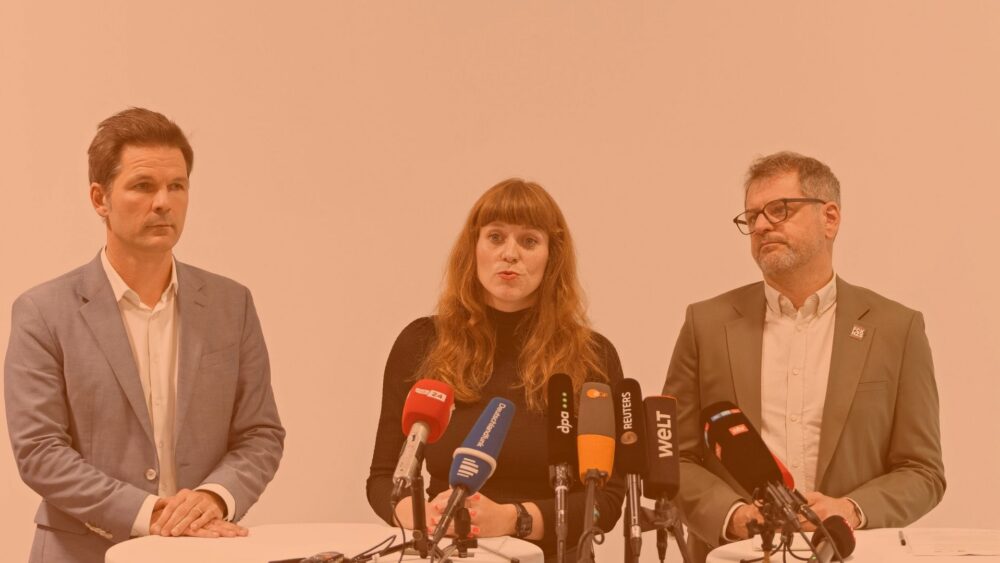
Statement by the coordination team of MERA25 and DiEM25 in Germany and the MERA25 Berlin board on the outcome of the exploratory talks between Die Linke, the Greens and the SPD in Berlin
On October 17, Die Linke, the Greens and the SPD in Berlin presented the outcome of their exploratory talks. It is entitled ‘More Together, More Berlin’ and promises a fresh start. Anyone who reads the 30 pages carefully will see a different pattern: the big promises are subject to conditions, postponed to later years or contingent on the financial situation. By contrast, the austerity measures and the restriction of the debate on Palestine are binding.
Socialisation: postponed, scaled back, made more expensive
In 2021, almost 60 per cent of Berliners voted in favour of the socialisation of large housing corporations. The exploratory paper reaffirms its commitment to Article 15 of the Basic Law. However, the conditions attached to it undermine this commitment:
- Delayed: A bill is not due to be tabled until mid-2028. It will only apply to the flats one year after its promulgation. They would therefore be transferred, at the earliest, shortly before the next election.
- Scope reduced: Instead of housing groups with 3,000 flats or more, as in the referendum, only those with 10,000 flats or more are now affected. Added to this is an ‘exemption’ of 10,000 flats. Medium-sized housing groups are excluded entirely, whilst the large ones retain a considerable proportion of their stock.
- Costly: Compensation may amount to up to 16 billion euros, but only ‘subject to’ fiscal sustainability. Furthermore, legal risks are to be ‘ruled out’. This is impossible given that this is the first time Article of the Basic Law has been applied. Both clauses are exit clauses.
- No relief: Rents in the nationalised flats will initially remain at the level set by the former corporation.
A referendum is not a mandate to review the matter. We expect a binding timetable and the implementation of the draft bill prepared by the ‘Expropriate Deutsche Wohnen & Co’ initiative. Furthermore, existing state-owned housing associations, which would take over the transferred flats, should be converted into genuinely non-profit organisations, rather than being subject to profit maximisation due to their corporate structure.
Austerity instead of a social city
The budget chapter makes it clear where things are heading. The plans include savings of 900 million euros in 2027, 500 million euros on a permanent basis from 2028 onwards, and a spending cap. New projects will only be possible through the reallocation of funds. A “pact with social service providers” is explicitly intended to regulate the “limitation of expenditure growth”. This means less money for social work, counselling and youth support – in other words, for the structures that hold a city together in a crisis.
At least 400 million euros a year are to be raised “primarily through tax and fee increases”. Fees hit people on low incomes the hardest. As for wealth tax, inheritance tax and the end of the debt brake, all that remains is to appeal to the federal government. At the same time, rent control, tenant advice services and staffing for building authorities are subject to the ‘spending path’ and ‘available funds’.
This is the sort of austerity policy we are familiar with from Europe. It was put into practice in Greece and failed there. Anyone who promises a social city must not make it conditional on funding.
Investment policy and arms production under a new name
The chapter on the economy could have come from any economically liberal programme. It focuses on growth, international competitiveness, more venture capital via the state-owned development bank IBB, investment bonuses for private companies and an EXPO 2035. BER airport is to attract more long-haul flights, right in the midst of the climate crisis.
We view the planned funding of ‘drones, autonomous systems, aerospace and satellites’ as ‘resilience technologies’ with particular scepticism. This is simply funding for the arms industry under a different name. By contrast, there is no law ensuring compliance with collective agreements, nor is there a state minimum wage.
Palestine: Compulsory declarations of Israel support instead of an urgently needed debate
Anti-Semitism, just like any form of racism, must be resolutely combated. If this debate – which is essential for our society – continues to focus primarily on criticism of Israel, whilst singling out, in particular, migrants living in Berlin and/or anti-Zionist Jewish people, then we will fail. This is particularly true if, on top of that, the ongoing genocide against the Palestinians is not addressed to the same extent. Berlin has a special responsibility in this regard, both because of its history and its current reality. The ‘Berlin Agreement’ of 8 October, which now forms part of the outcome of the exploratory talks, does not live up to this responsibility:
- The existing definition of antisemitism remains in place. The basis for the state’s strategy – the IHRA definition – continues to apply. The Jerusalem Declaration on Anti-Semitism, which Die Linke has adopted at federal level, plays no role. Universities are to ‘consistently enforce’ their disciplinary powers.
- Members of the state parliament will face disciplinary action. All elected representatives must ‘guarantee’ that Israel’s right to exist is not called into question. In the event of breaches, a panel of three external experts will assess the case, and the consequences may extend as far as expulsion. Decisions on the political views expressed by elected members of the House of Representatives will thus be made by people whom nobody has elected.
- The scope of the debate is being restricted. The House of Representatives is to deal only with issues that ‘directly affect’ Berlin. In the city with the largest Palestinian community in Europe, therefore, there is to be no further debate on Gaza.
- The criteria are open to interpretation. Organisations that “further fuel the spiral of violence” are to be excluded from funding and joint events. This wording is so vague that it could affect both Palestinian and anti-Zionist Jewish groups. The anti-Semitism clause in cultural funding failed in 2024, and for good reason.
- Suffering is described in a biased manner. Gaza is mentioned only in terms of ‘suffering, hardship and destruction’. The intention is to ‘clearly identify’ violations of international law, yet not a single one is named. Even Die Linke itself described the actions in Gaza as genocide at its party conference.
Anyone who wishes to combat racism and anti-Semitism effectively needs clarity, not clauses based on blanket suspicion. Criticism of a state’s policies and system of government, solidarity with the people of Palestine, and advocacy for international law and against apartheid, colonialism and genocide must not become grounds for exclusion in Berlin.
If we continue the discussion at this level, we will neither combat the anti-Semitism that remains deeply rooted in Germany nor put a stop to the increasingly rampant Islamophobia. Whilst both naturally pose a threat primarily to those directly affected, it is ultimately society as a whole that will suffer as a result of these divisive debates. In this regard, we refer to the issues mentioned above concerning the erosion of the social city.
What is to be welcomed
The paper also contains some positive developments:
- The prepaid card for refugees is to be abolished, and state reception programmes are to be reinstated.
- Cooperation with the Bundeswehr in schools is to end.
- There will be rent control and a specialised public prosecutor’s office to combat rent gouging.
- ‘Housing First’ will become the guiding principle of homelessness policy.
- Tempelhofer Feld will remain undeveloped.
- Berlin is campaigning against the continued construction of the A100 motorway.
These are successes that have only been made possible by years of pressure from the grassroots.
Our demands for the coalition negotiations
- Socialisation: a binding timetable, the threshold of 3,000 flats as set out in the referendum, and compensation significantly below market value.
- Budget: no cuts to social infrastructure, no increases in fees, and concrete steps to generate more revenue from billionaires and corporate profits, insofar as the state has jurisdiction over these matters.
- Armament: no state funding for weapons technology and a halt to arms production in Wedding.
- Palestine: Sanctions against members of parliament will be scrapped; debates on Palestine in parliament will remain permitted; violations of international law will be explicitly identified; war criminals travelling to Berlin will be arrested and transferred to The Hague; and anti-Semitism will be defined in accordance with the Jerusalem Declaration.
Berlin has voted for a fresh start, not for cuts disguised as social measures. As MERA25 and DiEM25, we will be closely monitoring the coalition negotiations with a critical eye. We stand alongside the residents of Berlin and all those who campaign for peace and international law.
Do you want to be informed of DiEM25's actions? Sign up here