







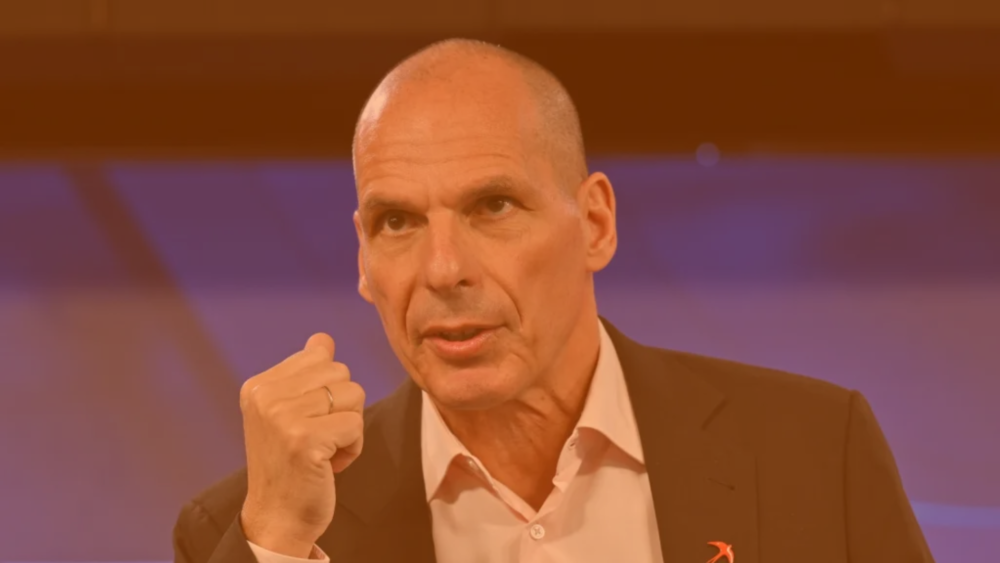
Yanis Varoufakis on technofeudalism, digital addiction, political courage and rebuilding democratic life beyond the cloud lords.
Speaking with Oz Journal, Yanis Varoufakis examines how technofeudalism is reshaping democracy, public discourse and everyday life. He argues that citizens and workers must develop new democratic institutions, digital commons and forms of collective resistance if freedom and self-government are to survive the age of the cloud lords.
- Dissonance – You have explained that without intellectual freedom, true democracy is impossible. People seem to be increasingly conscious of their own enslavement to the psycho-digital forces of technofeudalism. Despite this awareness, the addictive nature of these technologies creates compulsive behaviours that prevent decisions protecting individual and societal wellbeing. Why does our conditioned individualism override collective wellbeing, and why do governments ignore the exploitative business models behind our digital enslavement despite clear evidence?
Ah, the great paradox of our time: we know we are being played, yet we cannot stop playing along. This is not a failure of individual will; it is a triumph of false consciousness as updated and weaponised in the technofeudal age. Our conditioned individualism is not natural—it is manufactured. The cloud lords have built hyper-weapons of behavioural modification that short-circuit our capacity for collective reasoning. Every swipe, every like, every notification triggers a dopamine loop that feels like personal desire but is in fact algorithmic capture. We mistake addiction for freedom.
Why do governments ignore this? Because they are no longer sovereign. Your Australian parliament, like my Greek one once was, is a debtor’s court. The state’s fiscal capacity depends on the cloud lords’ platforms for tax collection, communication, and even welfare distribution. To regulate Amazon, Google, or Meta would be to risk capital strike or digital exile. So they perform theatre—hearings, fines that amount to parking tickets—while the business model of surveillance capitalism remains sacred. The exploited are not just us; the state is also a serf. So the dissonance persists: clarity without action, awareness without agency.
- Human agency – You have explained how tech giants have created a digital society through “hyper-weapons of behavioural modification” that have eroded our intellectual independence, removed our agency and reduced the majority to “silent idiots”. How do you suggest we can regain our independence and our faculty of reason in an age of technofeudalism and deteriorating democracy?
Regaining our faculty of reason demands first recognising that we have been reduced to silent idiots—not because we are stupid, but because our voice has been algorithmically silenced. The first step is dispossession of the digital self. I propose a simple, radical act: treat your data as an extension of your labour. We must join forces to demand payment for every click, every location ping, every scroll. When tech giants refuse, as they will, we must build techno-commons—decentralised, cooperatively owned platforms for social interaction, search, and commerce.
Second, we need a new Luddite consciousness—not smashing machines, but reclaiming the power to switch them off collectively. Civil disobedience in the digital age means going on data strikes: coordinated blackouts from cloud platforms, reverting to peer-to-peer tools. Education must be rebuilt around dialectical reasoning, not memorisation. Teach children to ask: “Who benefits from my attention?” Agency returns when we break the feedback loop of instant gratification. It requires pain—like withdrawal from any addiction—but pain is the birthplace of freedom. We must become difficult subjects again, refusing the smooth seduction of the algorithm.
- Courage – Your father was a resistance fighter during Greece’s civil war – what do you think it means to have political and intellectual courage and integrity in an age of renewed authoritarianism? How did you find the courage to speak out with integrity?
My father resisted fascism and authoritarianism as a student, ending up in a concentration camp. For him, courage was physical, immediate, mortal. Today’s authoritarianism is soft, smiling, cloud-based—but no less lethal to the soul. Political and intellectual courage now means refusing to succumb to the blackmail on central and private banks, declining to optimise for the algorithm. It means speaking truth not when it is viral, but when it is inconvenient. Integrity is not shouting louder; it is refusing to let the platform turn your dissent into content.
How did I find courage? I nearly lost it. As finance minister, I faced the Eurogroup’s bullying—not tanks, but checklists put together to follow the path of my humiliating subjugation. In the end I said “No!”. The courage came from remembering that my father’s generation did not fight fascism so that I could defect to the financiers and the pseudo-technocrats. I spoke out to break the silence that has become the default state of the professional politician. I say to young people: courage is not bravery; it is habit. Start small. Tell it how you see it over dinner. Disagree with your own side. When you fail—and you will—forgive yourself and try again. The new authoritarianism crumbles when ordinary people risk ridicule more than prison. Ridicule is cheap; democracy is not.
- Audience – You have a large global online audience, who do you think is missing from your audience? Do you feel excluded from any necessary audiences of society given your stance on the nature of the world around? Is the working class able to hear you?
My online audience is large, but it is a mirror of technofeudalism’s distortion field. The missing are not just voices; they are entire social strata. Where are the precariat? The warehouse picker, the Uber driver, the call centre worker in Manila? They cannot hear me because they are too exhausted, too surveilled, too algorithmically channelled into outrage loops or cat videos. The working class is fragmented into micro-segments, each fed a different reality.
Do I feel excluded? Yes, from the corridors of governmental quasi-power and the editorial boards of captured media. But that exclusion is my badge of honour. The real tragedy is not my exclusion—it is that the working class cannot afford the attention span to listen. I am not defeated; I adapt. I speak on podcasts, on radio, in union halls. But the cloud lords decide who sees me. To truly reach the missing audience, we must build off-grid agora—public squares, physical assemblies, worker co-ops with their own media. Until then, I am another voice in the cloud, and the cloud has a mute button controlled by shareholders.
- Media – We have mainstream media that is captured and controlled, while our online platforms algorithmically manufacture consent, embedding doubt and burying the truth. Investigative journalists continue to be targeted, threatened and killed. What is next for true journalism and access to ‘the truth’ ?
True journalism is dying twice: once by the sword (assassinations, imprisonment) and once by the algorithm (manufactured consent, clickbait equivalence). The next phase is not a rescue of legacy media—that ship has sunk. What comes next is micro-journalism: decentralised, encrypted, reader-owned collectives. Think of Novara Media, Double Down News, the Blocked and Reported podcast, or Drop Site News—tiny, agile, unafraid. But even these struggle because the truth now requires verification without central authority.
We need a new institution: a Citizens’ Truth Commission, composed of randomly selected laypeople, forensic accountants, and whistleblowers, empowered by civil society, not the state. Their reports would be published via blockchain to prevent tampering. Investigative journalists would feed them evidence under digital dead-man’s switches. The model is the ancient Greek graphē paranómōn—a public indictment of unconstitutional acts. The truth will not come from CNN or Fox; it will come from leak networks, anonymous collaboratives, and tech-savvy citizen auditors. Journalism becomes guerrilla warfare against entropy. The price will be high. But the alternative is a permanent fog of war.
- Rule-of-law – Privacy and freedoms have continuously been eroded in the name of safety and security, and now, in Australia, ‘social cohesion’. For example, laws in Australia have been placing citizens under ever-expanding surveillance, such as the recent anti-hate speech laws. The effective result is to dismantle the guardrails that protect civil liberties, by labelling intellectual critique as dissidence and dissidence itself as crime. Despite public sentiment and public protests, the Australian government has continued to push through these laws. For Australia, what can the concerned minority do when many are apathetic, and governments are influenced by private interests and foreign states?
Australia’s turn to surveillance in the name of ‘social cohesion’ is the classic authoritarian move: rebrand control as care. When the concerned minority faces apathy and state-private collusion, you must abandon the illusion that legislation is the only arena. The state has a monopoly on violence, but not on disobedience. First, build transparent, encrypted affinity groups—neighbourhood assemblies that meet offline, with no digital trace. Use Signal, but assume compromise.
Second, weaponise the law’s own contradictions. Every surveillance law creates exemptions. Demand those exemptions for journalists, activists, and indigenous communities. File test cases. Crowdfund legal defence for every arrest. The goal is not to win but to increase the cost of enforcement. Third, and most radically, declare digital sanctuary. Refuse to carry identity-verifying devices in public. Use cash. Create mesh networks. When the state labels critique as crime, you must make crime so widespread that it becomes normal. The apathetic majority will move when the surveillance touches their lives—when a parent is fined for a Facebook post, when a worker is fired for a like. Your job is to accelerate that moment through nonviolent, relentless, creative friction. Do not ask for permission. Just do it.
Do you want to be informed of DiEM25's actions? Sign up here