

The biggest tournament in world football arrives amid a backdrop of war, repression and profiteering, where everyday fans are encountering injustices on a number of levels
The FIFA World Cup is supposed to be football’s greatest celebration, one that brings cultures, communities and the world’s most popular sport together. Yet as the 2026 tournament kicks off across the United States, Canada and Mexico, there is a distinctly different feeling in the air.
In the United States, Donald Trump’s administration has spent the past year escalating ICE raids, attacking migrants, crushing dissent and dragging the country – and by extension, the rest of the world – into a dangerous new conflict with Iran. Across the US, fear and division have become part of everyday political life. Yet FIFA’s answer is not to confront these realities, but to ignore them and wrap them in spectacle.
This World Cup was sold as a celebration of unity but, in reality, in the months leading up to the tournament, it is instead shaping up to be an event of hypocrisy and corporate greed.
Pricing ordinary fans out of football
Football is often described as the people’s game, but clearly not for the world football’s governing body, as FIFA appears determined to test how many people it can keep out of it.
The 2026 World Cup is the first tournament to introduce dynamic pricing on a large scale, allowing ticket prices to fluctuate according to demand.
Dynamic pricing has allowed ticket costs to balloon far beyond the reach of many supporters, with some seats for marquee fixtures selling for several times their original value. The result is a tournament where lifelong fans are priced out while corporate hospitality packages and premium experiences are prioritised.
The consequences are already visible. Reports of empty seats during early matches have reignited criticism that ordinary supporters are being priced out of stadiums while FIFA chases ever greater profits.
A tournament for billionaires
The exploitation does not stop inside the stadiums. In New Jersey, transport officials originally announced that a 15-minute return rail journey between New York City and MetLife Stadium would cost around €130 per person. Following public outrage, the fare was reduced, but it remains vastly more expensive than normal matchday transport.
Supporters travelling to matches already face soaring accommodation costs, expensive flights and inflated ticket prices. Now even public transport has become another opportunity for extraction. Due to the largely unwalkable locations of American World Cup stadiums, fans face no other option other than paying these extortionate transport prices that are more than what most European match tickets cost.
FIFA’s “Peace Prize” farce
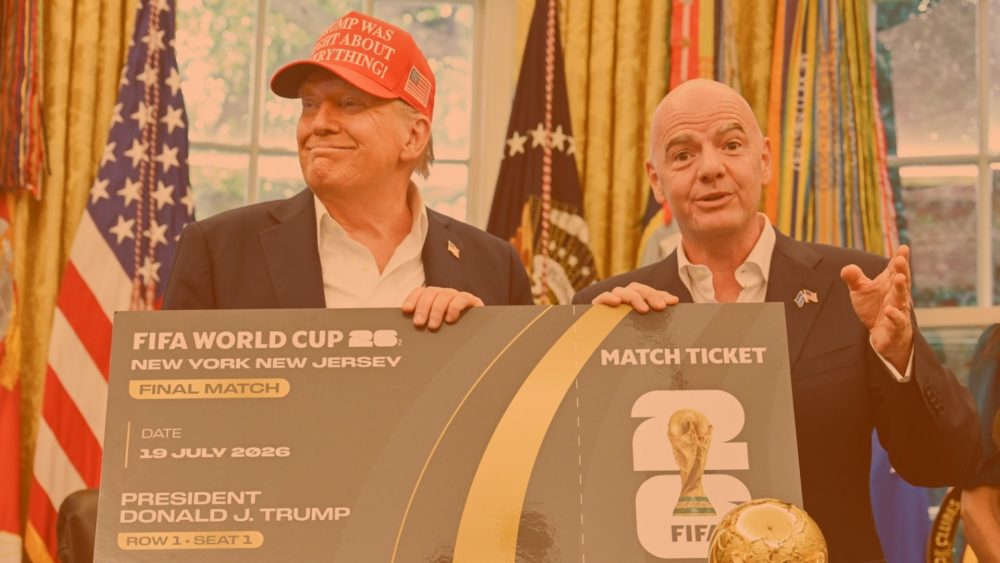
Perhaps nothing captures the contradictions of this World Cup more clearly than FIFA President Gianni Infantino awarding Donald Trump the inaugural FIFA Peace Prize.
The award was supposedly created to recognise individuals who have taken “exceptional and extraordinary actions” for peace and unity. Infantino praised Trump for helping bring people together and making the world safer. Yet months later, Trump has helped plunge the world into greater instability through military escalation with Iran while continuing to fuel international tensions on multiple fronts.
The contrast is impossible to ignore. Russia remain excluded from international football because of its invasion of Ukraine, yet FIFA found no contradiction in allowing a nation that has launched more wars than anyone else this century to host its biggest tournament, and then to celebrate a leader whose own administration has contributed to the further militarisation of international politics.
Co-hosts under pressure
The tournament is jointly hosted by Canada and Mexico, yet both countries have spent much of the past two years being publicly antagonised by Trump.
Trump repeatedly referred to Canada as America’s “51st state”, imposed tariffs and mocked both former Prime Minister Justin Trudeau and his successor Mark Carney. Mexico has faced repeated threats of military action under the guise of anti-cartel operations.
Iran unwelcome
The treatment of Iran reveals another layer of political discrimination. Not only do they find themselves victims of US-Israeli attacks at home, their travelling squad members are then tormented by Trump’s administration as they attempt to restore some pride for their nation.
Iran were pressured into relocating their training base from Arizona to Tijuana after US authorities claimed they could not guarantee the team’s security. Fourteen members of Iran’s delegation were then denied visas despite all of Iran’s group-stage matches taking place inside the United States.
Iranian supporters have also faced obstacles, with reports that ticket allocations were withdrawn shortly before the tournament began, disrupting travel plans for many fans.
Borders before football
The same logic has affected officials as well as supporters, as Somali referee Omar Artan, one of Africa’s most respected match officials, was denied entry to the United States despite reportedly holding a valid visa. His exclusion stems from the administration’s travel restrictions, with Somalia being one of several on Trump’s travel-ban list, demonstrating once again how the reality of the president’s policies go against the rhetoric about the World Cup.
Even the water breaks are sponsored
Perhaps the most absurd symbol of this tournament is the new mandatory cooling-break system. Water breaks have existed before, but only in extreme heat conditions when the temperature surpassed 30 degrees Celsius. At this World Cup, however, they have become compulsory in every half of every match, lasting three minutes in which commercial breaks now play – a first ever for the sport, in a move in line with America’s hyper-commercialisation of its sporting events.
Football deserves better
The World Cup should belong to supporters, communities and players. Instead, FIFA has delivered a tournament shaped by corporate interests, political hypocrisy and exclusion. From extortionate ticket prices and transport costs to visa bans, geopolitical double standards and relentless commercialisation, the 2026 World Cup reflects many of the worst tendencies of our age.
Do you want to be informed of DiEM25's actions? Sign up here