

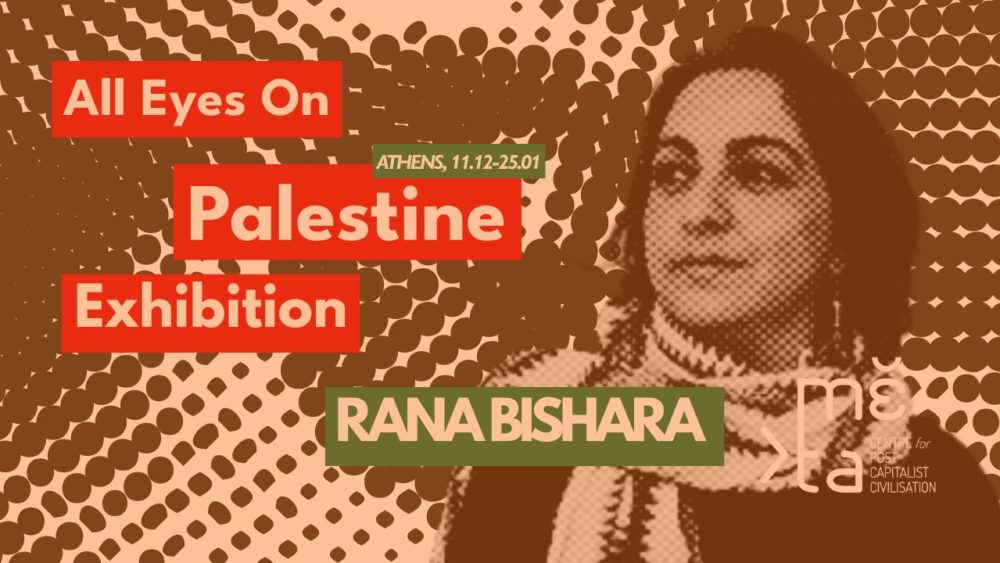
As the All Eyes on Palestine exhibition travels through Europe, it carries with it the experiences, histories and testimonies of Palestinian artists whose lives are shaped by the ongoing struggle for existence. Among them is Rana Bishara, a Galilee-based artist whose practice is rooted in memory, land and the daily realities of life under occupation. Speaking from her village near the Lebanese border, she describes how art became both a refuge and a responsibility.
“I come from Galilee, northern Palestine, on the Lebanese border,” Bishara begins, emphasising that Palestinians remain on their historic land despite the imposed Israeli citizenship. “This part of Palestine still has a large number of Palestinians living inside historic Palestine, but we are forced to hold the Israeli passport.” Her village, she notes, was “the last to fall in 1948,” a fact that shapes her family’s collective memory and her own artistic path.
Bishara insists that she did not choose art so much as art chose her. “I believe art came to me to save my life, to save my memory, and to save my dignity. Art is my surrender,” she says. Growing up in a family of goldsmiths, she remembers watching her father work with precious metals, developing a sensitivity to detail and material. “I was inspired to be a sensitive person who pays attention to small things,” she recalls.
The landscape of Galilee – olive trees, cactus, mountains – was a source of inspiration, but also a site of danger. “It sounds very romantic,” she says of childhood days spent foraging and wandering, “but once you realise how risky it is to live here, you become shocked.” For Bishara, this realisation was sharpened by the political events unfolding around her.
One of the defining moments of her youth was the 1982 Sabra and Shatila massacre. “I was 11 years old when I woke up to the sweeping pain in our village, hearing the news,” she remembers. “In our village we marched – from the church to the mosque – because we are Christians and Muslims, holding coffins and marching.”
The memory stayed with her for decades and eventually led to her participation in creating a monument for the massacre in Paris. “I held this memory for so long,” she says. “I didn’t decide it – these things became part of my life.”
When asked about Palestinian identity, Bishara speaks plainly about the attempts to erase it. “They want to erase us every second. They want to remind you that you are not welcome in your home, in your own land. It’s so systematic.” Living inside the 1948 borders, she says, is a continual struggle with reminders of vulnerability: “You walk around and find someone with an M16 entering your clinic. Being a Palestinian in 1948 is a big challenge. Each one of us has our own burden.”
Her response to this burden is to hold memory with care. She describes a glass-book artwork she created more than two decades ago, recording the names of depopulated Palestinian villages. “You can see the Nakba in one shot – the names piling and piling,” she says. The fragility of the glass mirrors the fragility of her community: “If the glass book breaks, then what? If we break, we lose everything.”
For Bishara, art is a form of protection – of history, identity and future generations. “Art gives me strength: resisting through art, resisting through memory, and for the new generation,” she says. What drives her is not only personal survival but collective continuity. “I have no choice but to remember, to depict, to record.”
As All Eyes on Palestine continues its journey, Bishara’s voice stands as a reminder of the power of artistic witness: rooted in land, sharpened by loss, and unwavering in its insistence on remembrance.
Do you want to be informed of DiEM25's actions? Sign up here