

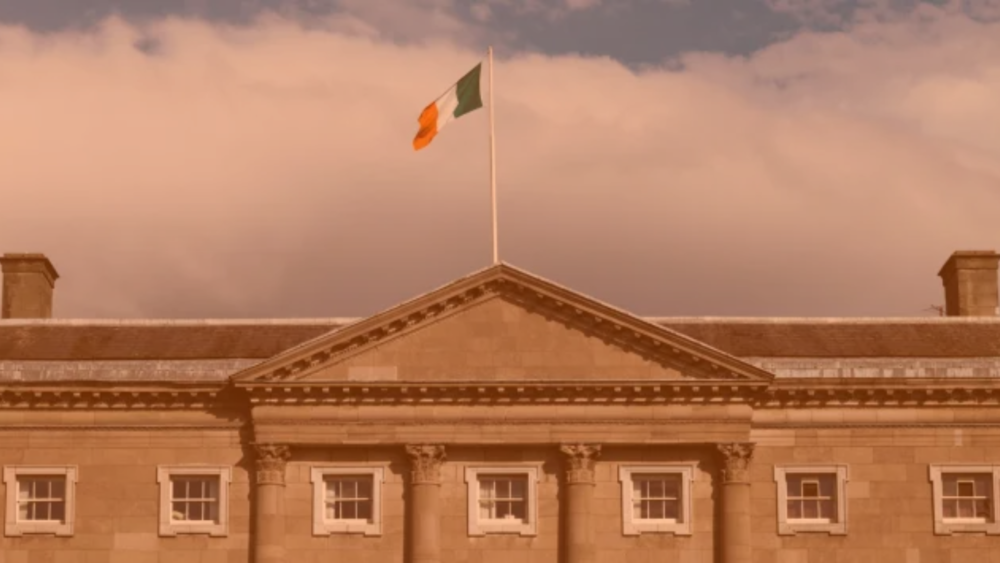
The date of the election for President of Ireland will be October 24. Candidates have expressed support for a united Ireland. One of them, independent Catherine Connolly has said she wants to see ‘a new United Republic where everyone is valued’.
There is a growing view that the debate should be about not just a united Ireland, but a new Ireland. It cannot simply be an absorption of the six counties of the north with the existing jurisdiction in the 26 counties. What is urgently required is a renewal of the Good Friday Agreement and a new economic and social contract for all of the people of Ireland. Inspiration for envisioning this new Ireland of the 21st century can be found not just in the celebrated works of the Easter Rising martyr James Connolly, but in the earliest resolutions of the First Dáil. On January 21, 1919, the Irish state was born, with the Democratic Programme as its charter of economic and social principles.
Yet the vision of 1919 was stifled. Following independence, conservative forces in the Free State suppressed the revolutionary programme. The promises of common ownership and social justice were replaced by narrow nationalism tethered to global capital. Ireland’s soil, fisheries and mineral wealth were increasingly commodified for foreign profit. Waves of emigration relieved social pressure, while austerity, weak labour protections and dependence on speculative foreign investment became defining features of the counter-revolutionary state.
Introduction
Separated by a century, scale and circumstance, the Democratic Programme of the First Dáil (1919) and DiEM25’s Manifesto for Democratising Europe (2022) read like dispatches from different fronts of the same struggle: how to make political freedom meaningful by democratising economic power. One speaks for a nascent Irish republic emerging from empire; the other for an internationalist movement operating transnationally to confront Europe’s technocratic drift.
Though born of different contexts, both articulate radical democratic programmes that insist political sovereignty must be rooted in social and economic justice. Both insist that sovereignty rests with the people; both couple liberty to social justice; both call for public control over key resources; and both view democracy not as a ritual of representation but as a living authority over the economy, the state and shared futures.
- Popular sovereignty as first principle
Each text begins by anchoring authority in the people and extending sovereignty beyond ballots to material life.
- First Dáil: “the right of the people of Ireland to the ownership of Ireland… extends… to all its material possessions… all the wealth and all the wealth-producing processes.” Popular sovereignty is inseparable from control of land, resources and production.
- DiEM25: casts democracy as the “shared nightmare” of unaccountable European power centres and declares the movement’s “one simple, radical idea: Democratise Europe!” Sovereignty must be reclaimed from opaque institutions to “Europe’s sovereign peoples.”
- Political Freedom Requires Social and Economic Rights
Both programmes reject a thin, purely procedural democracy. Political liberty must deliver material security and dignity.
- First Dáil: guarantees “an adequate share of the produce of the Nation’s labour,” pledges care for children (“no child shall suffer hunger or cold”), and replaces punitive poor laws with a “sympathetic native scheme” for the aged and infirm.
- DiEM25: links liberty to “basic goods that render one free from need and exploitation,” targets “rising poverty,” and condemns austerity that “fuels cruel inequality.”
- Subordinating private property to the public and common good
Both documents refuse to treat property as absolute.
- First Dáil: “all right to private property must be subordinated to the public right and welfare.”
- DiEM25: seeks to “dismantle the habitual domination of corporate power,” re-politicise market rules and direct investment toward “shared, green prosperity.”
- Public stewardship of strategic resources
Each text emphasises that key resources should be governed for public benefit.
- First Dáil: urges development of “the Nation’s soil… mineral deposits, peat bogs and fisheries, its waterways and harbours,” and organises trade to meet domestic needs before exports.
- DiEM25: advances a platform for democratically guided investment, environmental sustainability and an “Ecological Europe,” treating technology and finance as tools for the common good.
- Democracy versus unaccountable elites
Both texts define their adversary as an elite order that masks power behind neutrality or law.
- First Dáil: critiques “odious, degrading and foreign” poor laws and prioritises native, accountable provisioning.
- DiEM25: names the “Brussels bureaucracy,” the Eurogroup, the Troika, lobbyists and media oligarchs, describing a “top-down, opaque decision-making process… presented as ‘apolitical’.”
- Transparency, participation, and institutional reform
Democratisation is operationalised as institutional redesign, not only moral appeal.
- First Dáil: frames duties for government, social protection, industry revival and international labour standards, so that citizens can “spend… strength and faculties in the service of the people.”
- DiEM25: offers concrete steps: live-streaming EU councils, publishing ECB minutes, lobbyist registers, a Constitutional Assembly elected on transnational tickets, and a timeline “by 2025.”
- Work, dignity, and the social value of labour
Labour is central to both documents’ moral economy.
- First Dáil: ties citizenship to “willing service” and guarantees a proportional “share of the produce of the Nation’s labour.”
- DiEM25: opposes the “commodification of labour,” insists that “democracy is essential for limiting capitalism’s worst… drives,” and aims to democratise workplaces as part of a “Decentralised Europe.”
- Child welfare, education, and human development
Both texts hinge democratic renewal on human development.
- First Dáil: makes children’s “physical, mental and spiritual well-being” the government’s “first duty,” promising education and training as citizens of a free nation.
- DiEM25: envisions a “Social Europe,” “Technological Europe” and “Creative Europe,” investing in capacities, culture and knowledge so that freedom is lived, not merely proclaimed.
- Internationalism and cooperative standards
Though arising from different geopolitical aims, both articulate solidaristic internationalism.
- First Dáil: proposes “co-operation of the Governments of other countries in determining a standard of Social and Industrial Legislation,” and an “extensive Irish Consular Service” for mutually beneficial trade.
- DiEM25: is explicitly internationalist: “We, the peoples of Europe,” seeking common rules chosen democratically and an “Internationalist Europe that treats non-Europeans as ends-in-themselves.”
- Rhetoric of urgency and moral renewal
Both texts deploy moral language and a time horizon to galvanise action.
- First Dáil: speaks in declarative, constitutional tones: “We declare… we affirm… it shall be the duty, ”presenting a founding ethic for statecraft.
- DiEM25: adopts movement cadence and a countdown: “We give it a decade, by 2025” to dramatise the stakes: “The EU will be democratised. Or it will disintegrate!”
- Developmental ambition: Industry, investment and the green transition
Both link social justice to a developmental strategy.
- First Dáil: calls to “reinvigorate” industries on “co-operative and industrial lines,” regulate trade for the people’s needs, and prevent scarcity via export controls when necessary.
- DiEM25: orients investment to “shared, green prosperity,” embeds sustainability (“become fossil-fuel free”), and treats innovation and technology as public goods.
Conclusion
The vision of the First Dáil remains unfulfilled. DiEM25’s Manifesto demonstrates that the struggle for democratic control is no longer confined to the nation-state but requires transnational cooperation. A United Ireland, born not merely of territorial integration but of social and economic transformation, can fuse the radical republicanism of 1919 with the internationalist democratic radicalism of DiEM25.
A truly united and sovereign Ireland must therefore:
- Reassert democratic ownership over natural resources, housing and strategic infrastructure.
- Guarantee social rights: child welfare, housing, education and healthcare, not as market commodities, but as constitutional entitlements.
- Rebuild industry and work on cooperative, democratic foundations, giving workers direct say over production.
- Adopt transnational solidarity in confronting capital, learning from DiEM25’s vision of democratised institutions across Europe.
To build the Ireland imagined by its revolutionaries is to finally end the counter-revolution: to reclaim resources from global capital, end forced emigration and construct a republic rooted in equality, sovereignty and solidarity between all citizens. Only by doing so can Ireland honour its radical past and contribute to a democratic future beyond its borders.
Do you want to be informed of DiEM25's actions? Sign up here