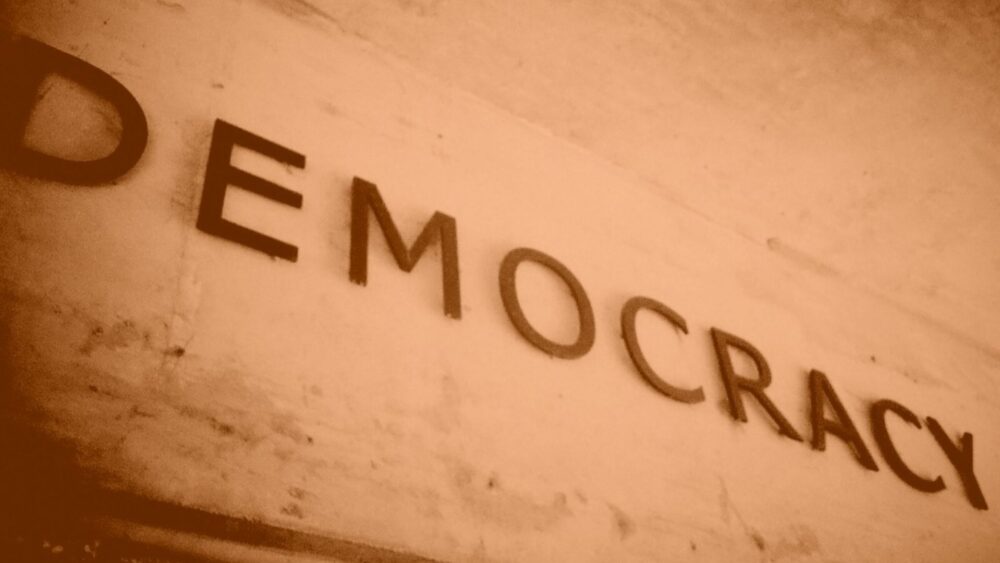
When I was 11, I had a history teacher, Mr Nagan, who shaped my world and the way I thought about it. He took us on a historical journey, with great grandiloquence, from the Boston Tea Party to the Dutch East India Company and, most importantly, to the meaning of democracy. I still remember his deep, commanding voice saying:
“Democracy is government for the people, by the people.”
That definition became entrenched in my young mind. Yet I have never been entirely comfortable with the idea that democracy simply means the majority gets to decide everything concerning human life through a vote.
There is something deeply unsettling about reducing democracy to numbers. Why should we assume that because one group is larger than another, its decision must therefore be right?
What if the majority is wrong?
With far-right extremist movements gaining ground across Europe and elsewhere, I believe it is time to seriously reconsider what we mean when we call ourselves democratic societies.
Numbers are not always right.
Who protects those who cannot protect themselves?
I believe we should shape our democracies around the most vulnerable, not because they are more important than everyone else, but because how we treat those with the least power tells us something fundamental about who we really are.
A child cannot lobby parliament. An elderly person living alone may have almost no political influence. A person with a disability cannot simply become more “economically productive” to satisfy our capitalist wet dreams. Families experiencing poverty cannot always “pull themselves up by their bootstraps”.
So who protects them when their interests are inconvenient, expensive or unpopular?
A conversation with my husband at the breakfast table changed my life. He said:
“If it’s working for me, and not working for you, it’s not working.”
That is where I believe the real test of democracy begins.
The test is whether we defend human dignity when doing so is politically inconvenient, economically expensive or unpopular with the majority.
We have made wealth the measure of worth
We increasingly measure people by what they have, what they earn and what they produce. Somewhere along the way, economic productivity became confused with human value.
I believe that is dangerous.
AI will increasingly write, analyse, calculate, design, manufacture and perform tasks for which human beings currently earn their livelihoods.
So what happens when human labour is no longer as economically necessary?
If our answer is that people only have value when they are economically productive, we risk creating a future in which millions are told:
“You are no longer needed.”
I cannot accept that.
A human being is not a machine. Our value cannot be determined by our productivity.
Who governs the technology?
We must also ask: who controls the technology that increasingly shapes our lives?
Algorithms make decisions. Platforms determine what we see. Corporations control enormous amounts of data. AI increasingly influences decisions that affect our lives.
We have been led to believe that because something is “technical”, it is somehow beyond politics. I reject that.
Technology is political when it determines who has power.
We need expertise, but expertise must serve democracy, not replace it.
When we are told, “The markets require it”, “The algorithm says so”, or “There is no alternative”, we must still ask:
Who decided? And who benefits?
Democracy cannot remain healthy when economic, corporate or technological power becomes sufficiently concentrated to bend political power around it.
Perhaps technology should give us back our lives
This is why we need courageous conversations about universal basic income and a shorter working week.
If technology allows us to produce more with fewer hours of human labour, why must the answer always be to work more, consume more and make more money?
What if technology gave us something far more valuable: time?
More time to raise our children, care for our elderly, create, learn, volunteer, build communities, rest and simply be human. Wouldn’t that be real progress?
Capital should never become more important than the people it was created to serve.
We cannot separate people from the planet
I am not anti-business, anti-capitalism or anti-progress. I am interested in what kind of progress we are creating and who gets to benefit from it.
The economy exists within society. And society exists within nature.
We cannot continue pretending that endless economic growth comes without consequences on a finite planet.
The climate crisis is not simply an environmental issue. It is a question of justice.
Our green transition must not become another opportunity for corporations to create markets while ordinary people carry the cost. It must be a people’s transition: cleaner energy, sustainable communities, better public transport, healthier cities and decent work.
We cannot save the planet by simply creating another market for the rich.
We need to redefine prosperity itself.
The future is ours to shape
AI will change work, industries and economies. It may even change the meaning of employment.
But AI does not get to decide what kind of society we become. We do.
We can choose a future where technology concentrates wealth in the hands of a few, or one where technological advancement benefits everyone.
We can accept decisions increasingly made by technocrats, corporations and algorithms and presented to citizens as unavoidable, or we can choose a democracy where people have meaningful power over the institutions, technologies and economic systems that shape their lives.
Perhaps we should stop asking:
“How much can this person contribute to the economy?”
And start asking:
“How can the economy contribute to the wellbeing of this person?”
Who owns the future? Who controls the technology? Who benefits? Who pays the price? What kind of planet are we leaving behind?
These are democratic questions.
Perhaps democracy should no longer be understood simply in terms of who gets the most votes.
Perhaps it should also be understood by how fiercely a society protects those who have none.
Democracy must be redefined, not as the rule of the majority over the minority, but as a system that protects the vulnerable, restrains concentrated power, ensures technology remains a servant of humanity, shares power among the people and recognises that there is no meaningful prosperity on a dying planet.
The future should not be built around the machine, capital and profit.
It must be built around the human being.
Because perhaps, finally, democracy should mean exactly that:
A society where every human being matters.
Not just the majority.
Not just the wealthy.
Not just the powerful.
Everyone.
That is the democracy I believe we should be brave enough to build.
Do you want to be informed of DiEM25's actions? Sign up here