

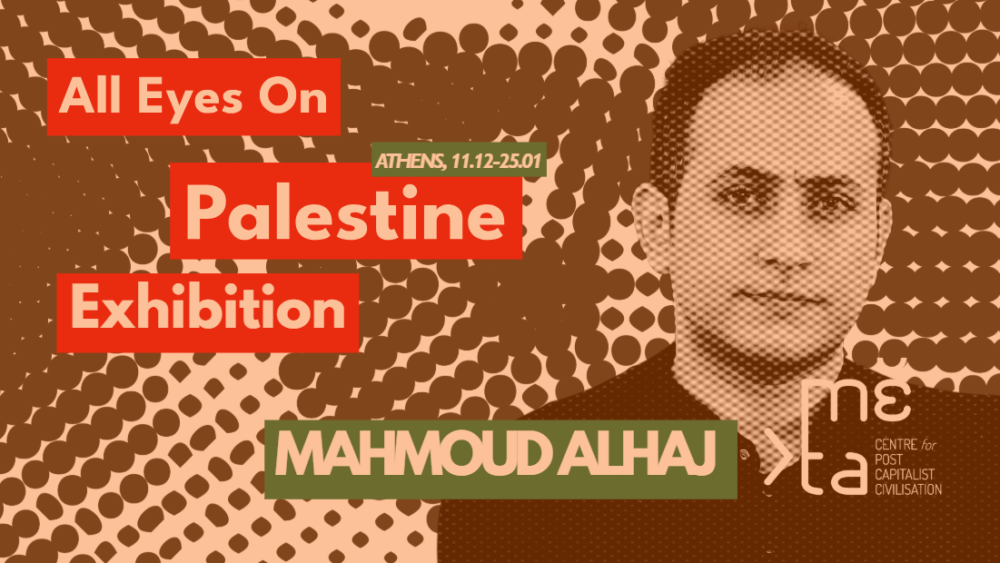
The All Eyes on Palestine Exhibition raises awareness about the ongoing genocide in Gaza. Through the work of Palestinian artists, it creates a space for expression and solidarity, where art becomes a form of resistance.
As the All Eyes on Palestine exhibition travels through Europe, the Athens edition has opened a space not only for art but for testimony. Among the voices amplified is that of Palestinian artist and researcher Mahmoud Alhaj, whose work interrogates violence through the very materials used to perpetrate it.
Mahmoud begins by locating his story at a point of rupture. “I left Gaza last year at the end of April,” he recalls, describing an uncertain period spent alone in Egypt before receiving a researcher’s visa to France. “Recently I received my kids and my wife from Gaza… after the process of evacuation that the French government established.”
Yet even outside Gaza, the memories of the months before his departure press on him. “The displacement and the loss of people, the loss of the landscape, the loss of the architecture… every day I think about how I can express… using tools appropriate with what’s going on there.”
Much of the work presented in the exhibition pre-dates October 2023. It forms part of his long-term project 24/7 Violence, through which he “traced how violence developed between 1987 and 2023.” But the genocide reshaped the trajectory of his practice. “I’m trying to find a way to tell about the new update of violence… what we lived during the eight months I spent in Gaza.”
One of the most distinctive elements of Mahmoud’s method is his use of Israeli military footage – material released by the IDF to showcase technological prowess, strength and “efficiency”. Mahmoud reverses this logic. “I use these materials to add the human sense that they try to remove… They publish footage from drones while they are killing civilians… They show how strong they are without mentioning the stories of the people who got killed.”
He describes his aim with precision: “I want, through my work, to tell that as a victim, I see what the man behind the drone sees… I see how he sees me.” This unsettling act of mirroring gives his work its sharpest edge – an intimacy with violence that refuses to collapse into abstraction.
His route into art was neither linear nor conventional. “My family… we could consider it an artistic family, because my father is a poet, my brothers are musicians, and my sister is a journalist,” he explains. Prevented from studying cinema in Egypt in 2008, he turned to journalism, which brought him into the world of photography. The shift into art came in 2012 with Art Garage, Gaza’s first photography magazine. “Art was something contagious… I trusted what I do day after day, and the family helped me to do this shift.”
Journalism nevertheless shaped his approach. “To be a journalist and to see the picture in general gives you a different perspective… You investigate and dismantle the pictures.”
Today, even in France, he does not feel entirely safe. “Being an artist here doesn’t mean you are 100% safe… If someone important decides that I should not show my work, I will not be able to get grants or live as an artist.” His medium – digital photography and image manipulation – not only circumvents material limitations but echoes the very technologies of surveillance and targeting he critiques. “My tools are connected to the same tools of violence that I’m talking about.”
Throughout the interview he returns to the question of community. “We became so connected after October 7. My responsibility is to help artists still in Gaza… most lost their studios, computers, their artwork.” He supports them by rebuilding portfolios and restoring digital traces of destroyed archives. “I wish I could do more.”
As the conversation closes, Mahmoud reflects on the purpose of showing his work. “I wish people enjoy the art, but also that it moves them… You cannot stay in a grey area while a genocide is committed in Palestine. I wish my art is good enough to do something.”
His words crystallise the ethos of All Eyes on Palestine: art not as ornament, but as witness, resistance and an insistence on seeing, especially when those in power work to erase.
Do you want to be informed of DiEM25's actions? Sign up here