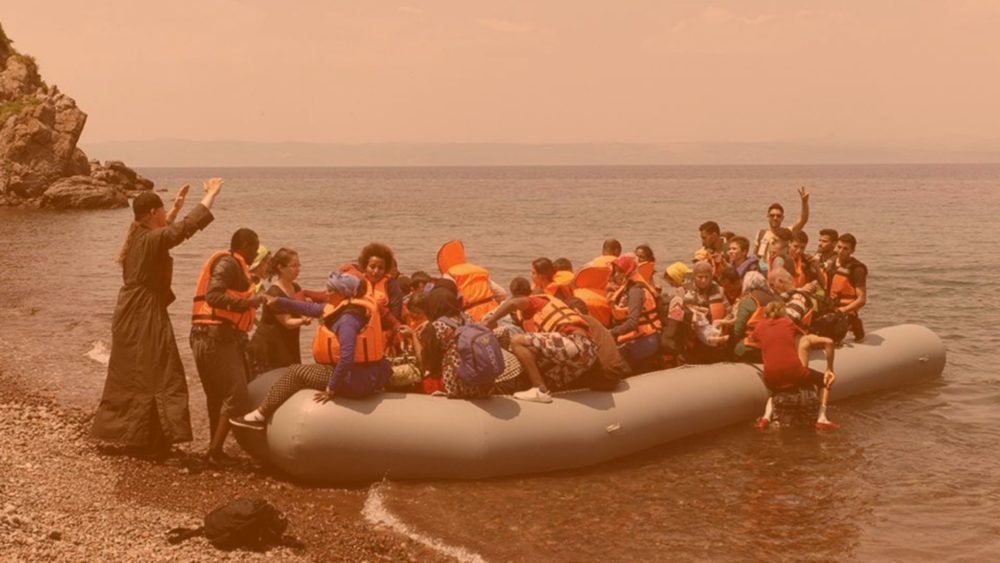
Never before have so many people – lawyers, delegations from human rights organisations such as Amnesty International and Human Rights Watch (HRW), activists, family, friends – traveled to Lesbos to attend a hearing, now the fifth, in a bizarre lawsuit brought by Greek authorities against 24 volunteers, aid workers, and rescue workers at sea. For helping refugees who struggle at sea and wash up on beaches, they risk insanely long prison sentences.
They are known as ‘The 24 of Lesvos’ in the NGO world of human rights activists.
The hearing began on Thursday, December 4, at 09:00. and continued until 18:00. on that first day. This never happens in Greek courts. And I should know, because as a Dutch correspondent for De Groene, I myself have been accused of all sorts of things because in 2019 I took Fridoon (21), an Afghan refugee with his dog, from a Greek horror camp outside Athens into my home. My trial lasted ‘only’ four years. After being sentenced to eight months’ probation, I was immediately acquitted on appeal last November. Because the allegations were absurd.
“The same must and will happen with ‘The 24’” was the first thing I thought at the time.
“We are all ordinary people with a heart who helped other people in need. I believe in the rule of law. I hope this trial will put an end to years of uncertainty and make it clear that humanitarian aid is not a crime. Because we are all human beings, everyone is entitled to humanitarian aid. Whether you are a refugee or not,” writes businessman and financial advisor to large pension funds Pieter Wittenberg (77) in a group chat that I am also part of, managed by his sister Dinne, who has accompanied him to the island. He is one of the defendants.
In 2016, Wittenberg and his colleagues helped severely traumatised, soaked, mostly crying and screaming refugees, many of them babies and toddlers, who washed up on Lesbos.
“At night, you didn’t see or hear the rickety boats first, in the dark, you smelled them first. A mixture of gasoline, shit, and urine. Most refugees literally wet their pants during the perilous crossing. You’ll never get rid of that smell”, Wittenberg told me a few years ago.
(Hyperlink to my article at the time, ‘floating on the sea’)
After the annus horribilis of 2015, when just under a million refugees, including for the first time many women and children, mainly from Syria, arrived on the sleepy holiday island, a stone’s throw from and directly opposite Turkey.
The completely unprepared population of 85,000 islanders, along with thousands of unsuspecting tourists who were happily vacationing there that summer, were taken by surprise, did what they could, and were also traumatised. Because the Greek government and the EU did nothing at all until late winter of that year.
Soon, especially from 2016 onwards, many humanitarian workers from all over the world flocked to Lesbos. To help where they could: providing dry clothes, food, water, moral support, basic medical assistance. Sometimes, risking their own lives, they rescued screaming refugees from drowning in the pounding waves.
The beaches were littered with clothes, blankets, bags, life jackets, and wreckage from the rickety boats ‘provided’ by Turkish human traffickers to make the deadly crossing. There were also volunteers who tirelessly cleaned the beaches and rocks, cleared debris, and recycled clothes and blankets. An impressive mountain of more than a million life jackets was created. Instead of turning it into a monument to commemorate 2015, the authorities burned everything a few years ago. Only a thick, dirty layer of charred rubber remains as a reminder.
Greek authorities want ‘The 24’ to receive up to 20 years in prison for everything they did. Some of the group – Greeks, islanders, refugees who had already arrived on Lesbos, such as a Palestinian man and a Syrian Olympic swimmer, an Irish lawyer, and a Dutch businessman – worked as volunteers for what was then a small non-profit sea rescue organisation: Emergency Rescue Center International (ERCI).
Since 2018, they have been falsely accused by the Greek authorities of completely fabricated “crimes.” The logic of the Greek authorities is as absurd as it is surreal. Saving human lives at sea or rescuing exhausted shipwrecked people clinging to rocks or collapsing on beaches is considered ‘human trafficking’. That is crime number one. It would follow that ERCI is therefore a criminal gang. Working for ERCI is therefore equivalent to ‘membership of a criminal organisation’. Crime number two. And that in turn would mean that crowdfunding, raising funds for ERCI, is nothing less than ‘money laundering’. Voilà crime number three.
For years, the trial was a farce: entire pages of the indictment were missing, there were no translations of the documents into the language of the accused, nor were translators present during the hearings. Which is required by law. On one occasion, they were even summoned to the wrong court, which was not competent to hear their case, and were immediately sent home. The list of legal blunders is incomprehensible and endless.
Instead of stopping the trial, the Greek authorities dug their heels in even deeper. Today is the day when, for the first time, they seem to have their affairs in order, at least in terms of legal protocol. That is why there is so much press and attention for the first time.
The entire human rights community is up in arms, unanimously declaring that this trial is downright perverse and should never have been brought. And that the fact that it has been, and has been going on for seven years, reveals a disturbing new trend in Europe, even globally: the criminalisation of solidarity with and assistance to refugees.
The UN Special Rapporteur on Human Rights states that in Greece, human rights activists and humanitarian aid workers are confronted with serious abuse of criminal law “to a shocking degree.”
Five of the accused have already spent 107 days in pre-trial detention in 2018 in one of Greece’s appalling prisons, which for the past year have been increasingly overcrowded with undocumented refugees who have been denied asylum. This is because the new Minister of Asylum and Migration, Thanos Plevris, has made it a criminal offense for undocumented migrants from outside the Schengen area to stay more than 7 days in Greece, after their asylum application has been denied definitely. As a result, providing assistance to sans papiers can also be a criminal offense. The case of the twenty-four, which began in 2018, was a dystopian precursor to what is now increasingly happening in Hellas: the criminalisation not only of refugees themselves, but also of aid workers. Increasingly, this also applies to journalists and even immigration lawyers.
Minister Plevris is the son of a Greek fascist parliamentarian who once gave the Hitler salute in the Greek parliament. Son Plevris was called as a character witness in a trial against his father on that matter and defended his father’s Sieg Heil with verve. Prime Minister Kyriakos Mitsotakis, who is extremely neoliberal, anti-refugee, and pro-pushback, is now allowing him to push one horrific anti-refugee law after another through parliament, where the prime minister has an absolute majority with his conservative party Nea Demokratia (ND). It seems as if what Plevris is allowed and able to do is like a “wet dream” for former Dutch minister Marjolein Faber. Her legislative proposals seem to be copies of Plevris’s.
Over the years, only a few of the defendants in ‘The 24’ have become the face of the entire group in the media. You could even say that they have become ‘famous’. Against their will. It just happened.
On that first day, the entire press corps, including the BBC, ran after the same “stars”: Sean Binder, an Irish lawyer; Sara Mardini, Syrian, who together with her top swimmer sister Yusra, jumped into the water after the engine of their own rickety dinghy had failed and, pulling with ropes and swimming, brought dozens of refugees safely to shore. – Netflix made the film ‘The Swimmers’ about this; former businessman Pieter Wittenberg, who abruptly quit his job in the financial sector shortly after the death of their 19-year-old son in 2016, in deep mourning, together with his wife Liesbeth, to do something meaningful with their lives after their loss: to help refugees on Lesbos.
I decide to do the opposite. I go in search of people from ‘The 24’ who almost never get a voice, who have no face. Like the severely traumatised Greek Nassos, one of the five who spent 107 days in prison. And also the Palestinian refugee Ihab, who, according to his friends, is burnt out by the trial. He can no longer cope with the detention, the protracted case, and on top of that, the genocide of Palestinians by Israel.
I don’t go to the court, but visit old acquaintances in Mytilini who are friends of both of them, to get phone numbers and email addresses. It’s also a convenient excuse not to have to listen to my heart pounding at the mere thought of having to go back to a Greek courthouse – shabby, dilapidated, grimy, filthy toilets, nasty police officers. The four years of my own trial still linger in my mind. I follow everything from a distance via the app group blog – the incomprehensible procedural actions, the interrogation of the witnesses from Greek Coast Guard and Port Police – glad that I don’t have to be there. On that first day, the defendants and their witnesses don’t even get their turn.
On St. Nicholas Day, Friday, December 5, things are coming to a head.
The case must and should be finished by two o’clock in the afternoon, because the judge and prosecutor have to go to courts on other islands. Greece has a severe shortage of doctors and an overburdened and understaffed legal system. So doctors, judges, clerks, and prosecutors travel around. Given how long it took the day before, it is questionable whether closure is feasible. Because each of “The 24” still has to be heard. They all have two witnesses. If it doesn’t work out, it will be continued in the first week of January. That will be the eighth year. According to Greek law, the charges expire after ten years.
Because I have been acquitted, I dare to show up wearing my infamous red hat. I was explicitly asked to do so by island activists who have been my friends for years and who are attending the trial out of solidarity.
After my shout-out to Prime Minister Kyriakos Mitsotakis during a joint press conference with then outgoing Prime Minister Mark Rutte in Athens, on camera. The images went viral worldwide. My red hat instantly became a national and international symbol for “Stop the lies, Stop the pushbacks!”
In 2021, I asked the Greek prime minister when he would finally stop lying about the barbaric, violent pushbacks carried out by the Greek Coast Guard and about the refugee horror in Hellas in general. Mitsotakis exploded and started yelling at me. He made a complete fool of himself, all on camera. As a result, my red hat became notorious and famous. Since then, half of the Greeks hate me, the Mitsotakis supporters. The other half adore me, want to take a selfie with me.
Immediately after entering, the hat tucked almost invisibly under my arm, Dinne gently pulls me out of the room. She asks me to please make myself invisible. Not to sit in the courtroom. The red hat could have a negative influence on the judges for the defendants. That was a request of scared witnesses and family mermbers. She asks me kindly, almost embarrassed.
Still, it takes me by surprise.
Not even without the hat?
No, not even that. Because even without the hat, they think I will be recognised.
Of course, I honor this request, but I am shocked by it. When people from “the good side” of solidarity with refugees versus “the evil side” of the prosecutors ask for something like this, it is a fear-driven form of “self-imposed censorship” that limits my work as a journalist. Or makes it impossible. That is exactly what the “criminalisation of solidarity” aims to achieve. It is a threat to press freedom. Self-censorship is one of the most powerful tools of fascism.
‘Has it already become that bad in Greece?’ I wonder.
The Greek non-government press present gets wind of it and wants to sound the alarm. To report on it immediately. I ask them to please wait until after the court hearing.
The prosecution’s main witness, a man from the port police security, is heard. He is verbally lynched by the lawyers and even the judges. That is a good sign. He cannot prove anything about human trafficking or membership of a criminal gang. With every answer, he sinks further into his own quagmire.
Ihab, the Palestinian, is too exhausted, too depressed to talk to me. Another time? When he has had a chance to process this last hearing?
Nassos, the Greek, tells me in the neglected courtyard of the courthouse, in the rain, that he has moved to Maastricht to study, but that he still has nightmares every night about the time he spent in prison.
What kind?
“I wake up sweating and have absolutely no idea where I am or how I got there,” he says softly. “It will be years before this is over.”
Liesbeth is heard as a witness for her husband Pieter Wittenberg. She has to tell how intensely good and helpful her Pieter is. Throughout their entire marriage, which is many years, he has helped everyone and everything. She tells her story so well that many people in the courtroom are moved to tears. Another good sign.
It is well past two o’clock when the hearing is abruptly ended. It will continue on January 15 and 16, 2026. The anticlimax is huge, the disappointment palpable. What a waste of money, what disrespect for all those people from all over the world who will have to make another expensive trip, what an unnecessary extra burden on the Greek justice system.
Outside, Liesbeth and Pieter Wittenberg thank me for complying with their request. They apologise.
Wittenberg: “I’m struggling just like you probably are. I keep thinking: if I’m acquitted, what then? Do I run back to the beaches on Lesbos to help again? That would be like giving the authorities the middle finger. Can I tell others to go too? And if they then have to go through the same thing we’re going through now? Can I then live with myself? And if I don’t go, can I still look at myself in the mirror? Self-censorship is driven by fear. Should we let fear win?’
His wife and sister pull him down the steps of the courthouse. They need to debrief each other. And then eat. It is raining and stormy. Together under an umbrella buffeted by the Lesbos winter winds, they disappear through the gate.
“To be continued!” Wittenberg calls out.
He is almost inaudible.
The storm drowns him out.
Do you want to be informed of DiEM25's actions? Sign up here