

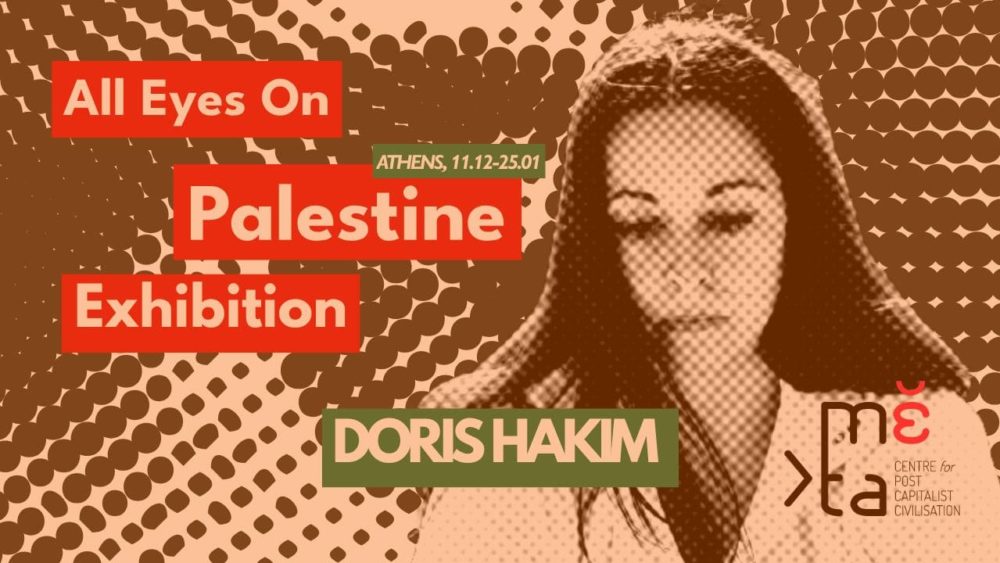
The All Eyes on Palestine exhibition continues to open space for Palestinian artists to speak, remember, and resist. For artist and co-curator Doris Hakim, born in Nazareth to a Palestinian father and a Greek mother, art became the means to navigate borders that were never just geographic but linguistic, psychological and political. In this conversation, she reflects on identity, erasure, and the everyday racism that shaped her celebrated photographic series You Don’t Look Arab.
Hakim grew up in Nazareth in what she calls “a mixed family in a city charged with religious and cultural tensions”. From an early age, theology surrounded her. “It was all around me where I grew up – if you are a Jew, you have the best religion; if you’re a Muslim, you’re the best; if you’re Christian, you’re the best,” she recalls. This landscape of competing certainties pushed her towards study rather than faith. “I decided I wanted to study theology because I was curious… I wanted to understand why it was so important. I first studied theology, which apparently made me an atheist.”
It was only after leaving Nazareth at twenty and moving to Greece that she was able to turn fully to the arts, studying at the Athens School of Fine Arts and later completing a master’s degree in Seville. Distance allowed clarity – and identity, which had been blurred and policed throughout her childhood, began to surface. “Growing up in Nazareth, studying in Jewish institutions, it makes you doubt your identity, from the brainwashing you get all the time. They say you are not Palestinian – you are an Israeli Arab. This thing actually doesn’t exist.”
For Hakim, this imposed category produced a deep and lasting confusion. “I didn’t know where I belonged… our parents were afraid to talk, and at school we were not allowed to talk about the Nakba. By law, you’re not allowed.” Instead, she and her peers pieced together their identity on their own. “It wasn’t just me – many Palestinian friends my age had the same experience. Our generation had to discover alone.”
When she finally found physical distance, she found psychic space. “I think my Palestinian identity got stronger when I came to Greece. Maybe I needed space to digest it.” That clarity inevitably entered her work: “I don’t think a Palestinian artist can forget they are Palestinian. Either it’s hidden, or it’s very obvious. My works are very political… it’s all about Palestine, actually.”
Hakim also sees a flourishing contemporary Palestinian art scene emerging despite – or because of – the ongoing oppression. “The last years, the Palestinian art scene is very much growing… many important artists, and many exhibitions around the world.” She highlights the work of Han Zob, whose practice recreates the trauma of the Second Intifada. “When the IDF entered Gaza and sprayed tar everywhere, everything was black. He kept the memory of the smell. Later he used tar as his basic material… his works are powerful.”
Memory, she insists, is inseparable from Palestinian art. “All the artists I know froze at first – not denial, but shock. After a few months we realised how severe everything is, and you could express it through art. Memory is a very important part… our identity, oppression, the stories from our parents and grandparents. It’s in our DNA.”
Her own contribution to All Eyes on Palestine, You Don’t Look Arab, confronts the racism she faced growing up. “It was very common – the first thing they would say to me or my friends was: ‘Oh, but you don’t look Arab,’ and they meant it as a compliment. So I asked: how should an Arab woman look? It has to do with the whole philosophy of racism.”
Through her work and voice, Hakim reveals how borders leave residue – in the body, in memory, and in the art that finally names what was once forbidden to say.
Do you want to be informed of DiEM25's actions? Sign up here