

From starvation to scholasticide, the Tribunal exposes the full spectrum of crimes against Palestinians
The Gaza Tribunal, the people’s inquiry into Israel’s military conduct in the tiny Palestinian enclave, has reached its epic conclusion, affirming that “Israel is perpetrating an ongoing genocide against the Palestinian people in Gaza, within and enabled by a broader settler colonial apartheid regime”.
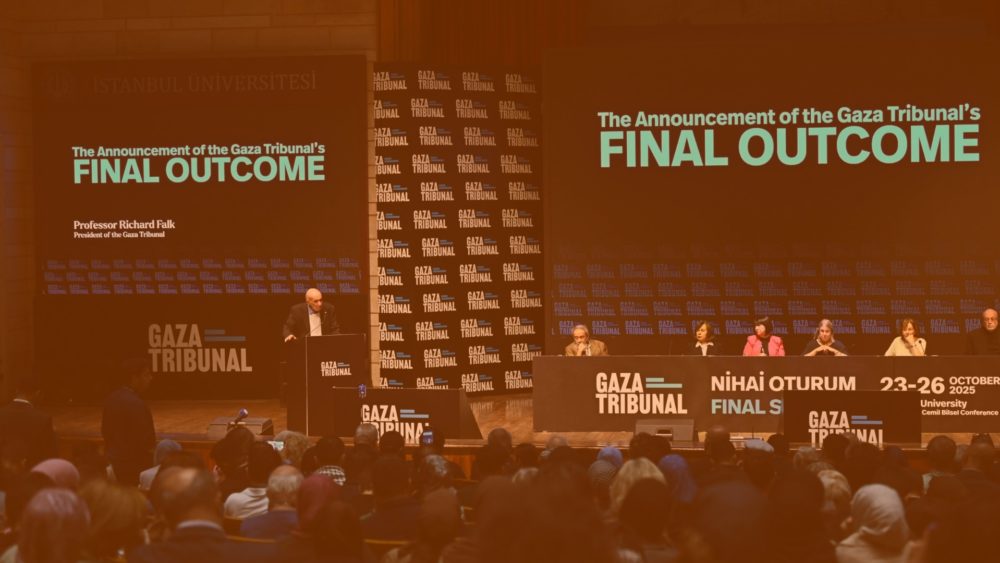
The distinguished panel of six international experts and world-class academics did not mince words, delivering coruscating findings in historic Istanbul after three intense, emotional days of public hearings. Testimonies included harrowing evidence from Gazan survivors, journalists, doctors and other witnesses, who delivered first-hand, detailed accounts of atrocities, criminality and human rights violations over the past two years. The atmosphere was electric as the findings were announced in Istanbul University’s Cemil Bilsel conference hall.
“Genocide in Gaza is the concern of all humanity. When states are silent, civil society can and must speak out,” Professor Christine Chinkin, Chair of the Jurists, said. She added: “Silence is not neutral. Silence is complicity. Neutrality is to surrender to evil.”
While the Gaza Tribunal is not a court of law, it is guided by law and represents a civil response to the silence of states and the current lack of accountability, following in the tradition of the Russell Tribunal of the 1960s (established by philosopher Bertrand Russell to examine the Vietnam War). The Gaza Tribunal was the initiative of its President, Richard Falk, International Law Professor at Princeton.
A year of fact-gathering, deliberation and expert analysis – from Palestinian eyewitnesses to leading global thinkers, including historians Professor Ilan Pappé and Avi Shlaim, former UN human rights official Craig Mokhiber, and former Greek Finance Minister Yanis Varoufakis – led to the final stage of hearings and the announcement of findings, conclusions and recommendations.
“We have heard extensive evidence of the crimes committed by Israel, of the causes of the genocide, of the collusion by and complicity of other actors, of the courageous resistance and resilience of Palestinians and of global civil society. We have heard moving personal testimonies of the physical and mental harms wrought by these crimes and the suffering of the Palestinian people. This concluding statement presents our findings based upon this evidence, the legal standards of the Genocide Convention, human rights treaties, the Rome Statute of the International Criminal Court and the moral imperatives of natural justice,” Professor Chinkin said.
Alongside affirming that Israel has committed genocide in Gaza, the Tribunal separately named and condemned other crimes:
- Starvation and famine: caused by Israel’s deliberate denial of food and water and the systematic destruction of the entire food system. One witness, Hani Almadhoun, spoke of “the fight to feed Gaza”, while Hilal Elver presented on “the weaponisation of humanitarian aid”.
- Domicide: the mass destruction of residential homes, property and related infrastructure—electricity, water and sanitation. Balakrishnan Rajagopal explained how Israel should be held accountable for domicide, noting that the loss of one’s home is not merely the loss of shelter but of memories, dreams, culture, connections and self.
- Ecocide: Israel has devastated land fertility, air quality, food and water sources, and caused catastrophic environmental damage that undermines the ability to survive after the bombing. Mazin Qumsiyeh described an “environmental Nakbe”, while Professor David Whyte stressed the global implications: “Gaza is a question for all of us because Gaza is about the future of the planet.”
- Deliberate targeting and destruction of the health system: including hospitals, clinics, equipment and personnel. Some 1,722 doctors and health workers have been killed, and 94% of Gaza’s hospitals destroyed (33 out of 36). Dr Mads Gilbert gave powerful evidence of systematic attacks on healthcare, while Gwyn Daniel addressed the monumental mental-health crisis and trauma inflicted on Palestinians.
- Reprocide: the intentional and systematic targeting of Palestinian reproductive care, preventing births and eliminating future lives. The most haunting images emerging from Gaza have been of suffering, dying and dead Palestinian children. Hala Shoman told the Tribunal that Israel “targets the present and future of Palestinian life.”
- Scholasticide: the destruction of Palestine’s intellectual future, through the killing, silencing and displacement of students and teachers (19,900 students and 193 academics killed) and the obliteration of schools and all 12 universities. Student Osama Alostta’s testimony, The dreams they took, described a bright future destroyed.
- Attacks on journalists: “Genocide documentation is carried out by Palestinian journalists—and they and their families are targeted. Silencing them is instrumental to concealing the genocide.” At least 248 journalists have been killed. Al Jazeera bureau chief Wael Al-Dahdouh lost his journalist son Hamza, his wife, two other children and a grandchild in targeted airstrikes. Journalist Abubaker Abed described transcribing witnesses’ anguish as “beyond painful.”
- Torture, sexual violence, disappearances and gender-based violence: in detention, at checkpoints, during house searches and displacement. Sahar Francis provided some of the most disturbing evidence, emphasising that “without accountability there is no justice”.
- Politicide: the assassination and kidnapping of political and cultural leaders, representatives and activists, and the destruction of civic institutions. Nearly every possible leader of the Palestinian cause has been assassinated, while a potential future leader, Marwan Barghouti, remains in prison and was not released in the latest prisoner exchanges.
Professor Chinkin continued: “The Jury finds a coherent and consistent pattern of exterminatory violence in hospitals, clinics, universities, cultural and religious institutions, agricultural land and natural ecosystems. The weaponisation of hunger, denial of medical care and forced displacement are not collateral damage. They are instruments of collective punishment and genocide. They are not justified by any claim of military objectives.”
The Jury, composed of academics and one author, detailed the “sadistic” nature of Israeli military actions and emphasised how the dehumanisation of Palestinians enables the commission of these crimes.
Addressing the causes of the genocide, the Chair stated that it “is inseparable from over a century-long project targeting Palestinians across all of Palestine and in exile. The root causes lie in a racist supremacist ideology – Zionism – which underpins a system aiming to dispossess, dominate and erase Palestinians.”
She continued: “We believe that genocide must be named and documented, and that impunity feeds continuing violence across the globe. Genocide in Gaza is the concern of all humanity.”
In a section on complicity and collusion, the Jury was scathing. The genocide was supported by “an oppressive neo-colonial power structure, led by the US and its allies, shielded by international complicity.”
The Tribunal recommends dismantling Zionism: “The Jury endorses a global rights-based strategy to dismantle Zionist structures, identify and map the regime’s sources of power and enabling pillars. We call for building a worldwide movement that weakens, isolates and dismantles each source through coordinated political, economic, academic, cultural, technological and social action.”
The jurists emphasised: “The struggle is with Zionism as a racist supremacist settler-colonial project, not with Jews or Judaism.”
They concluded: “We issue this statement in the name of justice, dignity and peace, and in remembrance of all who have perished in Gaza and throughout Palestine.”
The Jury recommended a UN protection force in Gaza and the other Palestinian territories. Elaborating on a one-state solution, the Tribunal argued:
“The strategic horizon is a single rights-based political order grounded in equality, decolonisation, restitution and the unfettered right of return. Only this course can end the ongoing genocide and open a path to just and durable peace.”
For attendees, the findings were “cathartic” – and the genocide “tragic” in the sense that only concepts from ancient drama could match the scale of devastation. Over two nightmarish years of Israeli assaults, images of mutilated and maimed Gazan children, women and men have been livestreamed across the world. After so much gaslighting and official silence, many attendees described the Tribunal’s truth-telling as a profound relief.
But the Tribunal’s message feels Cassandra-like. Western politicians and media seem unwilling to listen, unwilling to look at evidence, choosing instead to suppress protest and maintain silence. A Western ally attempted to exterminate an entire people, in full visibility of the global public. The Tribunal insists this must be acknowledged—and that all responsible, or complicit, must be held to account.
With Western mainstream media largely absent, extraordinary testimonies from Gaza – some available on the Witness Eye website – have been sidelined. More journalists have been killed in Gaza than in any conflict in modern memory, yet Western legacy media stayed away. The conclusion is difficult to avoid: corporate media serve power, not truth. Even conservative voices such as Peter Oborne have noted the scandal.
Western governments have attempted to suppress protest and minimise public debate. Considering the size and regularity of global mobilisations, this is both unsustainable and unconscionable.
Historically, the Gaza Tribunal will be recognised as a significant global event. Its archive is a vital resource for truth-telling, justice, healing and future rebuilding. As the Jury said, it “provides lasting evidence of the truth of the genocide against the Palestinian people.”
Time will tell whether the Tribunal shifts the narrative, strengthens activism or forces a reckoning within Israel, the United States and European Union member states, whose strategic orientation has culminated in genocide. Many believe these governments cannot recover reputationally and that a profound strategic rethink is required for the restoration of international law in a multipolar world.
What is certain is that the genocide in Gaza has opened the eyes of many Western citizens to the violent colonial temper of their own states. Their leaders colluded with, covered for and remained silent during a genocide.
Gaza has changed the world forever. Gaza is watching how we respond.
Do you want to be informed of DiEM25's actions? Sign up here