

In the city where Herzl launched Zionism, 400 participants reclaimed Jewish identity from colonial nationalism and voiced solidarity with Palestinian liberation
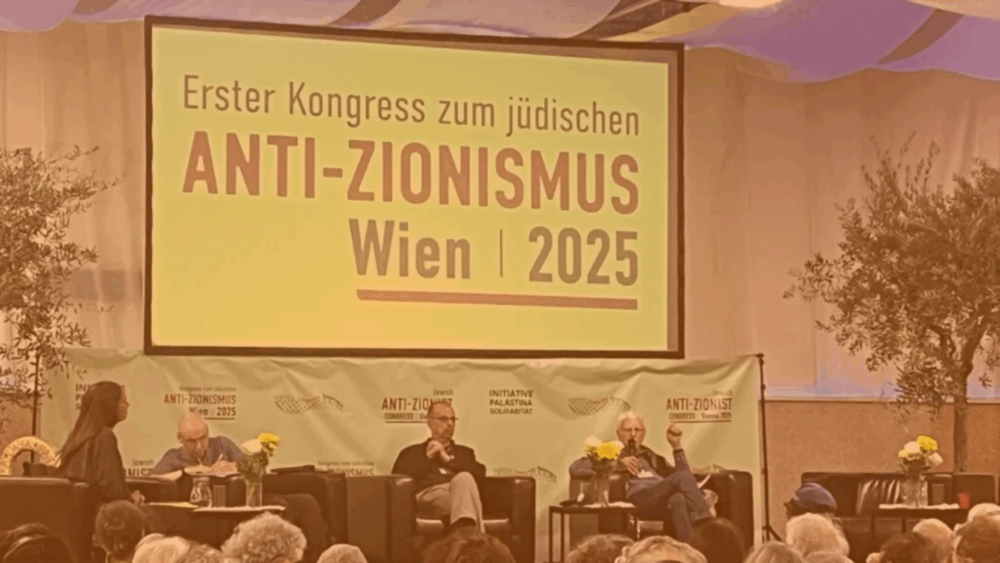
In a symbolic act of defiance, Vienna – the city where Theodor Herzl launched the Zionist movement more than a century ago – hosted the First Jewish Anti‑Zionist Congress from June 13–15, 2025. Over the course of three days, more than 400 participants – including Jewish and non-Jewish allies – gathered to challenge the mix-up of Zionism with Judaism and to voice solidarity with Palestinian liberation.
Although held in Europe, the Congress indicated a global realignment. Attendees included Jews and activists from South Africa, Latin America, the Middle East, North America, and Asia. The event aimed to de-centre Europe and Israel as the only legitimate homes for Jewish thought and politics, and instead emphasised the rise of Jewish anti-Zionist voices in the Global South. Participants came from across the globe: Holocaust survivors, Jewish academics, rabbis, anti-Zionist Israelis, Palestinians, and international solidarity activists. Their collective presence emphasised the intersection of anti-Zionism and decolonisation, framing the congress not merely as a protest, but as a global campaign for liberation.
Opening with messages from Jewish and Palestinian journalists, scholars, and survivors, the Congress framed its mission around asserting that “Judaism is not Zionism.” Speakers -including Ilan Pappé, Ghada Karmi, Ramzy Baroud, Rima Hassan, Awad Abdelfatah, Tony Greenstein, and others – presented a historical and moral critique of Zionism as a colonial, racist project rooted in ethnic cleansing and apartheid.
Perhaps the most powerful moments of the Congress came from Holocaust survivors who spoke out against the misuse of Jewish suffering to justify Zionist policies. Their testimonies highlighted a deep moral rift: that the legacy of Jewish trauma should be used to protect the oppressed, not to oppress. Such voices were deeply significant – not only for their personal pain – but for their authority in confronting the ideological foundation of Israel’s moral narrative.
The congress was also remarkable for its emphasis on Jewish–Palestinian solidarity. Palestinian speakers were not guests but co-leaders in shaping the discourse and demands. The shared analysis of Zionism as a form of settler colonialism fostered a strong sense of mutual struggle, not charity or reconciliation. This shift challenges long-standing dynamics in both activist and diplomatic spaces, where Jewish voices often dominate or mediate Palestinian representation.
Here, solidarity was grounded in shared resistance to racism, apartheid, and colonial violence. The congress concluded the adoption of a “Declaration”, a bold political document that laid out the ideological and strategic vision of the gathering. The declaration came out as a detailed statement, but its major themes can be summarised in the following:
- Ideological rejection: Rejected the equation of Judaism with Zionism, affirming that Zionism is a political ideology, not a religious or cultural identity. And asserts that anti-Zionism is not antisemitism, but a moral imperative rooted in Jewish ethics.
- Representation and identity: Zionism does not represent Jews or Judaism
- Legal accountability: Condemn war crime acts in line with ICC and ICJ resolutions, and call for the suspension of Israel’s membership in the United Nations and European Union due to violations of international law and human rights.
- Palestinian justice: Advocate for refugee return, and endorse actions to help build a future of equality, justice and dignity for all who live in historic Palestine – a land where shared life and mutual respect can once again flourish.
- Ethical solidarity: Stand with Palestinian resistance, condemn Western complicity, and call for a renewed Boycott, Divestment, and Sanctions (BDS) campaigns to pressure Israel globally.
The congress was conducted not only as a singular event but as the beginning of sustained Jewish and Palestinian collaboration. Organisers have announced that planning is already underway for a second Congress to be held in a Global South country in 2026. This step reflects a broader strategy: to internationalise the anti-Zionist struggle and to connect it with broader anti-imperialist and anti-racist movements.
The First Jewish Anti-Zionist Congress may come to be remembered as a turning point – not merely in Jewish political thought – but in global solidarity with Palestine. For too long, Zionism has presented itself as the inevitable and natural expression of Jewish history and destiny. In Vienna, that narrative cracked. By reclaiming Jewish identity from the grasp of a nationalist, colonial project, and by affirming solidarity with Palestinians as central to Jewish ethics and survival, the congress reframed what it means to be both Jewish and just in the 21st century.
You can support this initiative by signing the Congress declaration here.
Do you want to be informed of DiEM25's actions? Sign up here