

From Congo to Iran, destruction is not a mistake but a strategy – driven by profit, protected by impunity and sustained by empire
What is driving the Epstein class – our ruling class, more accurately named – towards destruction? Not drift, not miscalculation, not the fog of geopolitical competition. Destruction, deliberate and systematic, as a policy preference?
I am afraid the answer is too simple to be believed. That an empire spanning the globe, with vassals across Europe and beyond, held up by over 800 military bases and the threat of nuclear Armageddon, selects destruction because: why not?
Those living within the West struggle to fathom how this is even possible. How could our democracies – so-called, of course – produce such policy objectives? The question itself reveals the problem. It assumes a restraint that was never there. It assumes that our institutions, our elections, our procedural norms impose some limit on what power can do to those it has already decided do not fully count.
They do not. And those of us who have experienced United States napalm bombs, Israeli Lavender and Where’s Daddy algorithms, German chemical weapons, French Exocet missiles, British tanks – we already know this. We knew it before the think tanks named it, before the leaked cables confirmed it. We knew it because it happened to us. It was not another war for peace. It was not saving a population from a dictator. It was not the spread of freedom. It was: why not?
It’s the system, of course
The question, then, is not moral. It is structural. “Why not?” requires no justification when there is no accountability. And when destruction itself becomes profitable – when the demolition is the point, not the prelude – then “why not?” becomes something closer to: of course.
The political economist Ali Kadri – whose work on imperialism and the Arab world remains among the most rigorous outside the Western mainstream – offers the structural answer. Under late imperialism, capital can no longer expand primarily through production. The surplus has nowhere productive to go. Destruction becomes the accumulation mechanism. War, sanctions, demolition – not interruptions to the economic order. They are the economic order.
It works in several ways: destruction generates demand – arms, reconstruction, private security; it eliminates competitors; it depresses the value of resources and labour until acquisition becomes cheap; and it disciplines any state considering resistance. Impunity is what removes the brake.
History reminds us
When Congolese workers could not meet their rubber harvest quotas – and they could never meet their quotas, that was rather the point – King Leopold’s administrators found an elegant solution. Not adjust the quotas, naturally. Kidnap the children. Sever the hands. Present the severed limbs as proof of discipline enforced. Productivity, you understand, had to be maintained. And if the destruction exceeded any productive logic – if the sadism outran the economics – well. Why not?
Apartheid South Africa’s Project Coast was not a rogue operation. It was the apartheid state’s official biological and chemical warfare programme, sanctioned at the highest levels of government and known – if not actively supported – by Western intelligence services, who shared an interest in suppressing southern African liberation movements. Its mandate was not defence. It was the development and deployment of weapons against political enemies. Case in point: SWAPO fighters detained in Namibia were loaded onto helicopters, handcuffed, injected with experimental substances, their deaths recorded, their bodies rolled into the Atlantic. The programme ran for years. The West looked away. When apartheid fell and prosecutions began, the institutional knowledge was quietly dispersed. Some of it ended up in American and British hands. Why not?
Venezuela is the proof of concept. When Nicolás Maduro would not yield, he was kidnapped by the US military and the United States assumed direct control of the country’s oil exports. Over a billion dollars in oil revenue flowed first into a US-controlled account in Qatar – later moved directly into the US Treasury. Five billion more in deals were already lined up. The destruction here was political rather than military. Cheaper. More surgical. But the logic is identical: remove the obstacle, capture the asset, route the revenue. Why not?
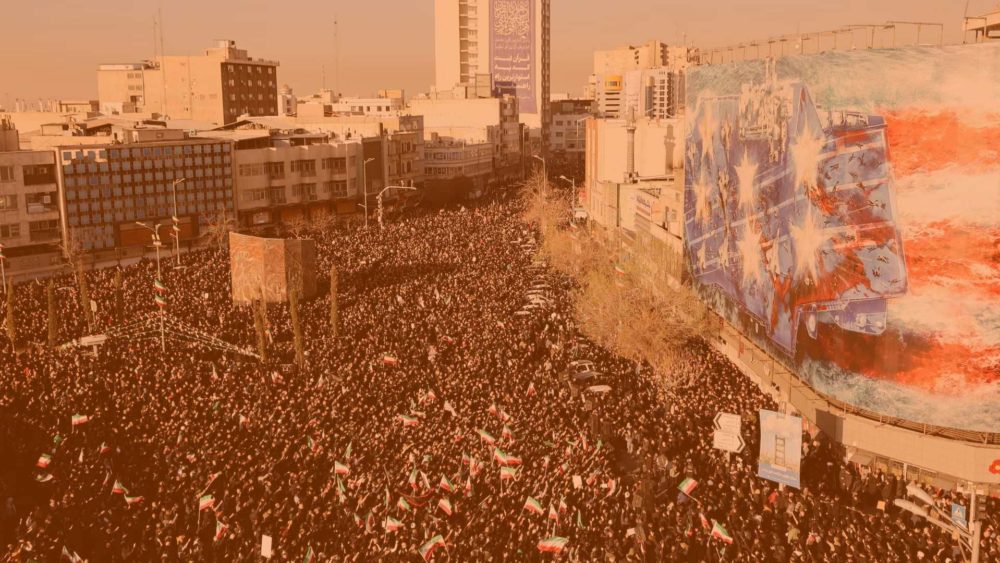
On Iran: they tried the cheaper method first. Sanctions, maximum pressure, exile networks, attempted coups. It partially worked in Venezuela. It did not work in Iran. So now we are here. Bombing infrastructure to break the state’s capacity to resist. Targeting schools, ancient sites, civilian morale – not because they are military objectives but because demoralisation is the point. Sinking unarmed ships. Turning day into night by bombing oil facilities – smoke filling the air, rainfall turned to acid.
And then, as they plan, bringing in the MEK – delisted from the US terrorist register in 2012 after years of lobbying by paid Western political figures, repackaged as a government-in-waiting, funded by the same networks that will expect a return. What awaits would be a vassal regime that will open Iranian oil, Iranian labour and Iranian infrastructure – a nation of over 92 million people, sitting atop some of the world’s largest energy reserves, at the crossroads of Eurasian trade routes – to the Epstein class on preferential terms. The destruction is not the prelude to the deal. It is how the price is set, and how opposition is cleared.
Why not?
It is a system. Under late imperialism, capital can no longer expand primarily through production – the surplus has nowhere profitable to go. So destruction becomes the accumulation mechanism. War, sanctions, demolition – not interruptions to the economic order. They are the economic order.
Congo was demand generation and labour discipline. Namibia was the price of resistance, broadcast to a continent. Venezuela was asset capture through political decapitation. Iran is all of it at once – elimination, acquisition, discipline, and the planning to install a comprador class to route wealth indefinitely. Each iteration more refined than the last. Each one made possible by the same thing: the certainty that no one will be held to account. Impunity is not incidental to the system. It is what makes the system run.
But empires crumble. They always have. The Romans knew it. The British knew it, even as they did not say it. The Americans know it now, even as they do not say it either – which is perhaps why the appetite for destruction has grown so urgent, so unrestrained. This is not confidence. It is the behaviour of a class that knows, somewhere below the level of admission, that the clock is running.
And the people remain. In the Congo, where Lumumba’s assassination did not extinguish what he represented. In Namibia, where SWAPO prevailed. In Venezuela, where no military operation, no billion-dollar oil grab, has yet produced a population willing to become a vassal. In Iran, where a civilisation that was ancient when Rome was young has survived every empire that believed it could be broken – Mongol, Ottoman, British, American. They bomb the schools. They sink the ships. They terrorise. And still, in their lands, in their homes, the people remain – steadfast as ever.
Which leaves one question for those of us living inside the empire, or within the vassal states that serve it – in the cities of Europe, in the ‘democracies’ that supply the weapons, launder the politics and look away. You understand now what this system is. You understand that the destruction is not accidental, not regrettable, not a failure of policy. It is the policy. The clock the Epstein class is racing against is not just geopolitical. It is yours too. Futility is what they are counting on. Resist. The empire is counting on you not to.
Do you want to be informed of DiEM25's actions? Sign up here