


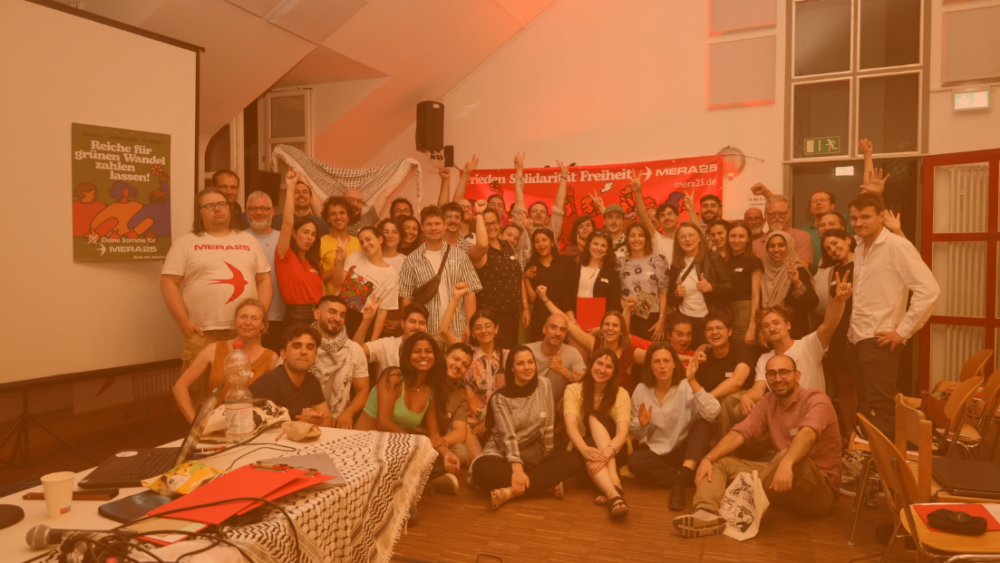
Four years after the founding of MERA25 Germany, Johannes Fehr reflects on the practical lessons of building a political movement
Today, four years ago on November 13, we founded MERA25 and have since worked hard to grow the party and movement in Germany. To mark the occasion, I want to briefly describe four lessons we’ve learned in our development as a political party in Germany, which others might also find useful.
What every new national MERA25 party has as a massive advantage from the start is this: we are part of the internationalist movement DiEM25, which provides us with a shared foundation of values and political direction. If you’d like to learn more about why MERA25 is not just another political party, I recommend looking at the MERA25 model, principles and pathway.
One: Establish concrete goals
Concrete goals are vital to focus an organisation’s work – and for a political party, those goals are elections. Of course, demonstrations, events, and non-electoral campaigns are also viable goals. It may sound obvious, but discussing and deciding on concrete aims to guide our work is the foundation for everything.
With clear goals in mind, we could direct all our activities towards something tangible. In the very beginning, we focused all our efforts on one small election in a single city. Campaign after campaign, we grew, both in experience and in membership numbers.
Two: Politics needs to be on the street
Real politics doesn’t happen in the media – it happens on the streets. Because that’s where people go when they are desperate for change, to shout their demands at the powerful. On the streets, people decide what is important, and it’s much harder for the establishment or the media to control that space.
Demonstrations are the meeting points where you make connections, form alliances, and, quite simply, learn what people think and feel. Showing that you truly care about an issue means more than just turning up and waving flags – it means helping to co-organise and mobilise for the demonstrations yourself.
Three: Social media is the best available media
Most social media platforms are privately owned and therefore far from spaces of free speech. Still, they remain the best available means to make your voice heard, especially when compared with traditional media. Whether it’s state or private TV, the establishment is always in charge.
On social media, you can control your own narrative, tell your stories, and reach people directly. And let’s not forget: you can also have fun by ridiculing the old parties and politicians. Don’t rely on a single platform, as this reduces the risk of being banned. And, as always, learn by doing.
Four: Ride the wave and be as up front as possible
A detailed position is the basis of being able to ride the wave of public mobilisation when it comes into focus. In Germany, taking a clear stance against the genocide in Gaza was the most important prerequisite in a media environment, where they tried to make you think this was an extreme position.
Whatever the topic, the ability to communicate your position clearly under pressure is vital. Look at the political landscape and identify what others are not yet saying or doing. Focus on issues that genuinely matter to people: opposing genocide and war, but also addressing the cost-of-living crisis that is squeezing the working class.
And of course: Organise
A continuous challenge is how to activate new and existing members with limited resources available. This requires ongoing effort that should not demoralise you, but needs steady attention and constant improvement.
What will help is a constructive approach: welcome people’s ideas, try to integrate them into existing structures, and give them space to grow. Try to build a culture where people can contribute according to their skills, and where comradeship and respectful criticism guide collaboration.
Understand political work as a continuous effort that must go hand in hand with the rest of your life. This is of course not everything, but it is a start.
Do you want to be informed of DiEM25's actions? Sign up here