


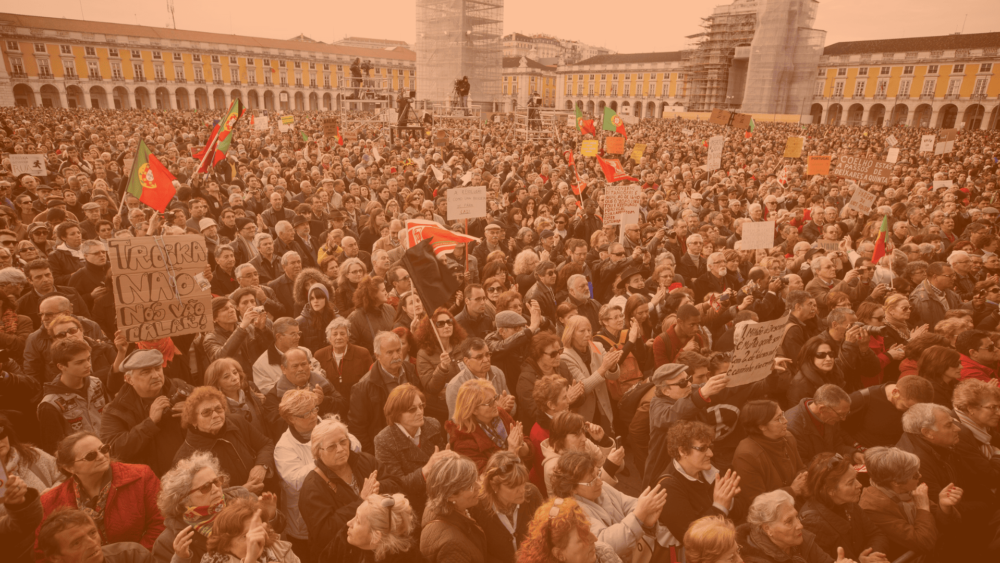
In May 2025, Portugal held snap elections following the collapse of the government led by Luís Montenegro, who became embroiled in the so-called “Spinumviva Case” – a controversy involving potential conflicts of interest due to family ties to a company with public contracts.
In those elections, the far-right party Chega became the main opposition force, surpassing the Socialist Party and securing 60 parliamentary seats. It was the first time a party from this ideological spectrum reached such a position in Portugal, signalling a troubling shift in the national political landscape.
At a time when the far right is gaining ground in Portugal, as it is elsewhere in Europe, a serious and strategic reflection is urgently needed on how the left – in all its forms – can respond, resist, and renew itself. In a recent debate hosted by Causa Pública, with Ana Drago, Paula Marques, Paulo Pedroso, and Ricardo Sá Fernandes, the message was clear: to stop this advance, we must rethink and act differently.
Is the left a victim of its own success? The welfare state – one of the 20th century’s greatest achievements – remains in place, but it was not enough to halt the economic rot exposed by the banking crisis.
The left failed to confront the roots of neoliberalism and the collusion between political power and major economic interests. The ground was left fertile for the far-right’s simplistic narratives, which point the finger at “the system” in a way that is both seductive and dangerous.
Historically, the left was the main voice of the working classes. Today, that connection is weakened. The left no longer truly represents the popular masses, especially the lower-middle classes, because it speaks too often among itself and too rarely with people living very different realities.
The left must speak to real families, to young adults crushed by a system that offers no room to build a future – and not just to the already-convinced. This is the challenge of truly representing the popular masses.
To the crisis of representation, we must add a communication crisis and the fragmentation of the public sphere. A key idea from the debate was the urgent need to rethink how we communicate. Left-wing messaging doesn’t easily fit into a 30-second TikTok – but ignoring that format means losing the battle in a field where it’s already being fought.
Social media channels social discontent into easy, populist formulas, while traditional media, increasingly biased to the right, sidelines critical voices. Ana Drago spoke of a “profound transformation of the public space,” where traditional tools and styles of progressive politics now feel obsolete.
New forms of communication must be developed – ones that reach social media audiences with accessible language and offer direct solutions to the key problems Portuguese society faces.
The response, several speakers argued, must involve a renewed rootedness. Trade unions, social movements, and political parties must once again become part of the lived reality of communities. Only then can “popular protagonists” emerge – people with the legitimacy and empathy to lead their own struggles. Human empathy was cited as the left’s greatest weapon – a quality that can’t be manufactured in a campaign, but must be cultivated through real presence on the ground.
The left cannot give in to cynicism or fall into institutional complacency. To be uncompromising in defending democratic values and the welfare state – even when that requires political rupture and courage – is now more urgent than ever.
It is essential to fight not only the dismantling of public services, but also to strive for a truly participatory – and above all, emancipatory – democracy. The far-right feeds on exclusion, resentment, and the absence of hope. Only a left that offers a real future will be able to stand up to that threat.
What became clear in this debate is that it’s not enough to “speak differently” – we must also learn to listen differently. That demands a redoubled effort from the Portuguese left: to leave its comfort zone, acknowledge past mistakes, rebuild bonds, and reinvent how it organises and mobilises.
The struggle against the far right will not be won with programmes and proposals alone – but with rooted politics, genuine empathy, and the courage to confront a system that has also failed us.
Do you want to be informed of DiEM25's actions? Sign up here