










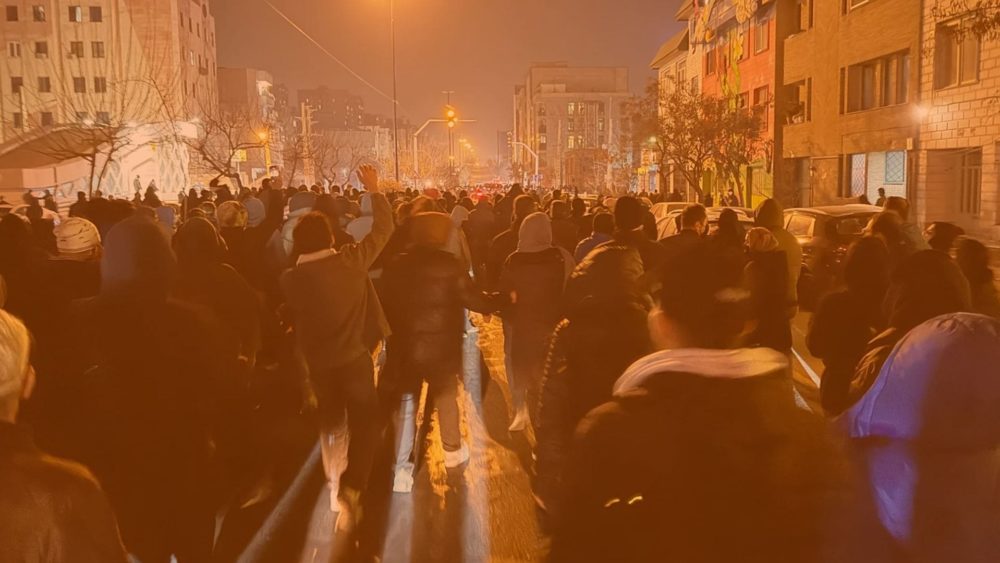
As repression intensifies in Iran, society confronts a system sustained by fear, while the EU faces a choice between escalation or protecting civil society and de-escalation
Voices want to scream, but mouths are forced shut. Minds want to write, but hands are made dead by fear, injury, and exhaustion. Feet want to march, but legs are broken – sometimes literally. Families still pace outside courts and mortuaries, searching for the disappeared. Doctors are arrested for treating the injured, as are lawyers for defending their clients. Some – blinded by shotgun pellets to the face – have been condemned to a life without a future; others carry wounds that will never fully heal. What has become of Iran? These are not isolated horrors. They are the lived face of a system that has run out of legitimacy – and now seeks to rule by fear.
Over recent weeks, uprisings began again in Iran with bread-and-butter pressures: inflation, unpaid wages, a collapsing currency – shaped by domestic misrule and worsened by external sanctions. Sanctions and coercive financial measures imposed by the United States and its allies have inflicted real harm on ordinary people. But they do not explain why protest becomes rupture.
What drives people into the streets is not only economic pain, but the obscene inequality of a system built on rent-seeking, privilege, and loyalty networks. Large parts of society have reached a harsh conclusion: hardship is not accidental. It is the product of impunity, corruption, and discrimination, maintained through institutional violence. The repression we’ve witnessed – among the most horrific in recent years – is a strategy to force society back into fear. And people are refusing a widening gulf that leaves the majority struggling while those tied to power live above the law.
Over time, governance has ceased to be government of the people. Elections have been hollowed out. Civil society has been pushed towards suffocation. Opposition figures have been killed, imprisoned, silenced, or kept under house arrest. Critical media has been strangled. Trust has been burned away. And when a society can no longer imagine a path to dignity within the existing system, governing by fear becomes a dead end: it may delay change, but it cannot restore legitimacy.
None of this happens in a vacuum – and the European Union is not a bystander.
At this crucial juncture, the EU should stop defaulting to escalation and sanctions, and instead prioritise de-escalation while protecting Iranian civil society. That means making humanitarian carve-outs and payment channels that actually work, while tightening targeted measures on perpetrators rather than punishing society at large. It also means using Europe’s leverage – diplomatic and trade – with regional actors, including Israel, to prevent opportunistic interference that turns Iran’s crisis into a proxy theatre.
But the decisive struggle is Iran’s. Iranians wish to see a democratic transition free of violence, foreign interference, and domestic despotism – no war, no externally imposed leaders, no geopolitical “salvation” delivered at gunpoint.
For Iran, that begins with immediate de-escalation: an end to lethal repression and the release of all political prisoners. This must be followed by a genuine reopening of political life – lifting bans on political organisations, guaranteeing freedom of the press, and allowing independent civic organising – so society can breathe again.
From there, a credible route to self-determination becomes possible: a referendum leading to a constituent assembly for a new, secular constitutional order, shaped by Iranians themselves. Recent experiences elsewhere – including Chile’s broadly participatory and deliberative constitutional process – show how such assemblies can serve as arenas for societal reckoning rather than elite bargains.
For that process to be real rather than managed, the machinery of fear must be dismantled: executions and mass sentencing halted, emergency security rule lifted, information blackouts ended, and journalists, lawyers, and civic organisers protected. Without these conditions, any constituent process risks reproducing control rather than enabling democratic choice.
And before more blood is spilled, Khamenei must resign, while security units responsible for recent massacres are dismantled and held accountable – not as retribution, but to make de-escalation and a transition possible.
The alternatives are not abstract: escalation towards war, indefinite repression enforced by fear, or an elite-managed transition brokered from outside – all of which have repeatedly ended in catastrophe for ordinary people.
The steps outlined above do not presume goodwill from those in power; they are proposed because every alternative path carries far higher risks of bloodshed and regional escalation – a lose-lose scenario for Iran, its people, and the wider region, even if those alternatives are viewed by some as strategically advantageous.
The task for those of us outside Iran is to defend Iranian agency as the country charts a way out of theocracy and towards democracy.
Do you want to be informed of DiEM25's actions? Sign up here